

An enclosure can arrive at final assembly with every electrical component ready, yet one cable entry can still delay the build. The gland will not seat because the opening is slightly undersized, the locknut has no room beside a folded edge, or the paint around the cut has chipped far beyond the sealing washer. These problems often begin before the drill starts. The hole saw was chosen by a nominal conduit label instead of the required cutout, or the cup and arbor were treated as separate purchases. For control-panel builders, electrical contractors, and distributors, a hole saw needs to match the enclosure material, cable-entry hardware, drill, and expected production volume as one working assembly.
Quick Answer
Choose a hole saw for an electrical enclosure from the cable gland or fitting manufacturer’s required mounting-hole diameter, then confirm the enclosure material and wall thickness. A bi-metal cutter can suit many mild-steel, aluminum, and plastic panel jobs when its application range covers the material. Carbide-tipped or HSS constructions may be more appropriate for other sheet conditions or repeated production, but the product rating and sample result matter more than the material name alone.
Bestwin manufactures and supplies hole-making tools for panel builders, contractors, distributors, and OEM programs. We can match a hole saw with a suitable arbor and pilot arrangement after reviewing the enclosure material, cutout diameter, drill chuck, rear clearance, finish requirement, and order quantity. The correct purchasing unit is the complete cutting assembly, not only the cup diameter.
Start With the Cable Entry Hardware
The finished opening exists to hold a cable gland, conduit hub, grommet, push-in fitting, or another panel-mounted component. Its required cutout is therefore the first dimension to confirm. A thread designation such as M20 describes the component thread, but it does not automatically define the hole that every brand or construction requires. The component drawing or installation data should state the mounting-hole diameter and any permitted tolerance before a hole saw is ordered.
This distinction matters because a hole saw is normally sold by its nominal cutting diameter. If the chosen size is smaller than the specified cutout, forcing the gland through can damage the thread or coating. If the opening is too large, the sealing washer may not cover the edge correctly and the locknut may have less material to bear against. A visually round hole can still be unsuitable for the installed part.
The outer dimensions of the gland also affect placement. The sealing washer needs a flat area on the enclosure face, and the locknut needs room on the inside. A nearby bend, mounting rail, gasket channel, weld stud, or terminal block can interfere even when the cutter itself fits the marked location. The hole saw diameter, pilot projection, and drill-body clearance should be reviewed against both sides of the panel before the product is approved.
For new enclosure designs, a drawing that records the component reference and required cutout gives purchasing and production a stable target. For retrofit work, the actual hardware should be identified before the opening is enlarged. Matching a cutter to a guessed pipe or cable diameter is unreliable because the entry component, rather than the cable alone, controls the mounting geometry.
Enclosure Material Controls the Cutting Edge
Electrical enclosures may use painted mild steel, stainless steel, aluminum, thermoplastic, fiberglass-reinforced material, or a removable gland plate made from a different material than the main body. The same hole saw should not be assumed suitable for every one of these surfaces. Cutting-edge material, tooth geometry, cup construction, and recommended operating conditions all need to correspond to the actual panel.
A bi-metal hole saw combines a high-speed steel tooth edge with a more flexible body. This construction is widely used for general metal and mixed workshop applications, but the specific product still needs a declared material range. Tooth pitch and tooth form influence how the cutter engages thin sheet. A product intended mainly for wood may catch or leave an unacceptable edge when applied to a flexible steel panel.
An M42 bi-metal construction can provide a harder tooth material for demanding cutting conditions. That label identifies part of the product construction, not a universal performance result. The enclosure grade, thickness, support, drill speed, feed, and cooling practice still influence the cut. Our M42 product family can be considered where the declared application and the customer’s representative panel support the choice.
Carbide-tipped and HSS hole cutters create additional options. A carbide-tipped product can be useful for suitable sheet-metal applications and repeated openings, while an HSS cutter may suit thin sheet and non-ferrous work within its rated range. The useful hole saw comparison is not simply bi-metal versus carbide versus HSS. It is the complete product specification against the panel material, thickness, desired finish, and expected number of holes.
Plastic and fiberglass enclosures need their own review. Heat, cracking, fraying, or delamination can become more important than tooth wear. The selected hole saw needs a cutting action that the panel manufacturer permits, and sample work should reproduce the actual support and surface condition. If an enclosure already provides molded knockouts or a removable gland plate, using those designed features may be preferable to cutting the main body.
Table 1. Product Direction for Common Enclosure Materials
| Enclosure cutting situation | Product direction to discuss | Information needed before selection |
|---|---|---|
| Painted mild-steel panel | Material-rated bi-metal, HSS, or carbide-tipped cutter | Sheet thickness, coating, hole diameter, production volume |
| Stainless-steel gland plate | Stainless-rated bi-metal or carbide-tipped construction | Stainless grade, thickness, support, finish requirement |
| Aluminum enclosure wall | Cutter rated for non-ferrous sheet | Alloy condition, thickness, chip loading, surface protection |
| Thermoplastic enclosure | Sharp cutter approved for the plastic | Resin type, wall thickness, cracking and heat sensitivity |
| Fiberglass-reinforced enclosure | Product construction confirmed by sample testing | Reinforcement, wall thickness, edge quality, dust controls |
| Existing knockout or modular gland plate | Use the enclosure maker’s intended entry method | Knockout size, gland-plate type, fitting compatibility |
Thin Sheet Requires a Stable Cutting Assembly
An enclosure wall can flex as the teeth begin to cut. That movement changes the way individual teeth enter the metal and can create chatter, an oversized opening, chipped paint, or a sudden grab at breakthrough. Choosing a more expensive cutting edge without controlling the complete assembly may leave the main source of the defect unchanged.
The hole saw body must run concentrically with the arbor and pilot. A bent pilot, worn arbor connection, loose chuck, or damaged thread can make the cutter orbit around the intended center. The measured opening then becomes larger or less round than the nominal size. When a sample hole is inaccurate, the hole saw should not be blamed or downsized until the drive assembly and work support have been checked.
Panel support close to the cutting area reduces vibration. On a removable gland plate or loose enclosure panel, stable fixturing also prevents the workpiece from spinning with the cutter. The support arrangement must leave enough clearance for the pilot and center plug. For a finished enclosure, internal components and wiring should not be exposed to the pilot, the slug, or metal chips. The safest production sequence is often to make planned openings before sensitive equipment is installed, when the enclosure design and factory process allow it.
Surface protection helps only within limits. Protective film or suitable tape may reduce incidental marking, but it cannot correct runout or replace mechanical support. A thick stack of soft material under the hole saw can also reduce stability. The sample should represent the production surface treatment so that paint chipping and washer coverage can be evaluated before a batch cutter is released.
Breakthrough deserves particular attention because the remaining ring of material offers less resistance. Excessive feed at that point can pull the hole saw into the panel and leave a raised exit burr. A cutter designed for thin-wall work may use geometry or a shoulder intended to control this stage, but suitability must be confirmed from the product data. Where rear components are present, usable cutting depth and pilot projection need separate limits.
Nominal Size and Finished Cutout Are Different Measurements
The diameter printed on a hole saw is a product size. The finished opening also reflects tooth set, runout, panel movement, pilot accuracy, and the way the cutter enters the work. A nominally correct tool can produce an unacceptable cut when one of these conditions is uncontrolled. This is why a sample assembly check is more useful than comparing catalog diameters alone.
Metric and inch sizes can look close enough to substitute, but the difference may matter to a sealing washer or snap-in component. If the cable-entry drawing specifies a metric cutout, the available inch size should be compared with the permitted tolerance rather than rounded by habit. The same rule applies when a distributor builds a mixed-market hole saw kit. Size labels must remain unambiguous through packaging, quotation, and replenishment.
The hole location adds another dimensional constraint. Enough flat material must remain around the opening for the washer, locknut, and required separation from neighboring entries. A hole saw removes a circular ring, but the installed component occupies a larger envelope. A dense row of glands can therefore fail at assembly even when every individual cutout diameter is correct.
Pilot location controls the center of a conventional assembly. A center mark or drawing coordinate needs to account for the actual fitting, not only the visible cable route. If an existing opening must be enlarged, a normal pilot may have no material to follow. That is a different cutting condition and may require a guide fixture or another manufacturer-approved method. A standard arbor should not be expected to center itself in open space.
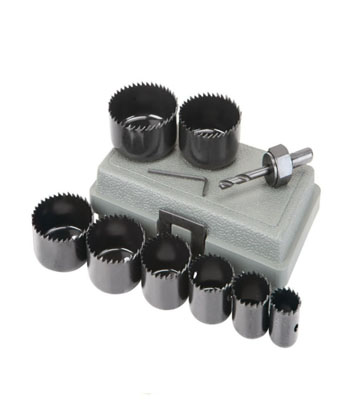
In general hole saw construction, the annular cutting edge removes a ring and leaves a center slug. This reduces the material removed compared with a solid large-diameter drill, but it introduces practical questions about pilot guidance, slug clearance, and cup depth. Those details belong in the product specification for enclosure work.
Arbor Compatibility Affects Accuracy and Changeover
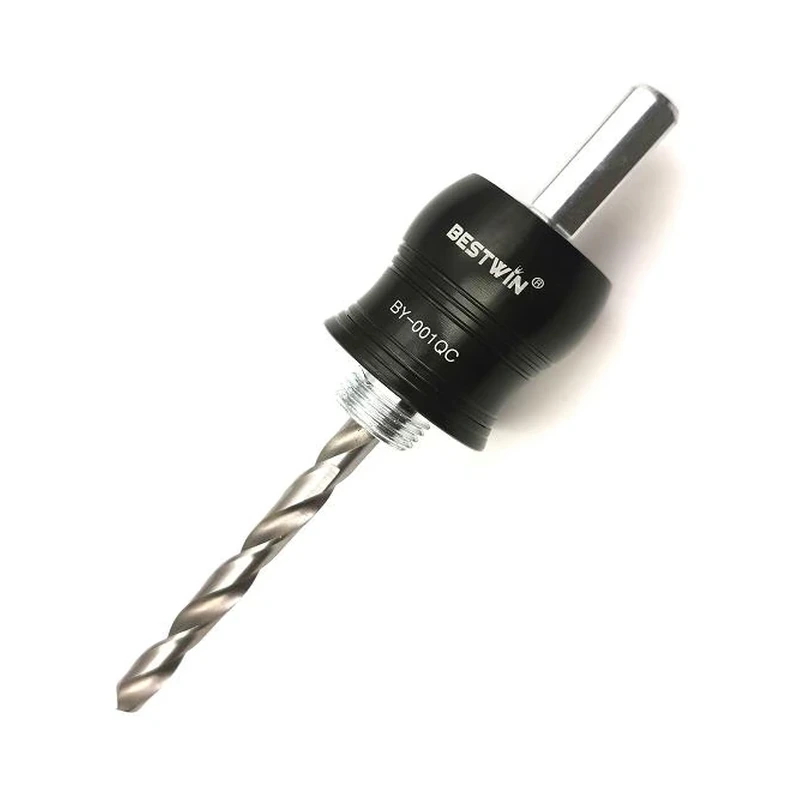
The arbor connects the cutter to the drill, carries the pilot, and transfers torque. Thread size, drive pins, locking features, pilot retention, shank shape, and chuck capacity all affect whether the assembly is compatible. Two hole saw products with the same diameter can use different arbor arrangements, so visual similarity is not enough for purchasing approval.
Smaller cutters may use one arbor size while larger diameters require another connection or additional drive support. The drill chuck must accept the shank without gripping on an incorrect surface. The available drill also needs suitable low-speed control and torque for the diameter and material. A hex shank can improve drive engagement, but it does not by itself authorize impact operation. Metal enclosure cutting generally requires controlled rotary use according to the cutter and power-tool instructions.
Quick-change arbors can help a panel shop that changes a hole saw among several common cable-entry sizes. The benefit depends on a stable connection, compatible cutter range, and replaceable pilots. A quick-release feature should not introduce looseness or allow the cup to seat incompletely. For distributor and OEM kits, the supported diameter range and included adapters need to be recorded so the user does not receive several cutters with only partial arbor coverage.
A hole saw manufacturer reviewing an enclosure program should therefore ask which drills and chucks are already used, whether work is performed on loose gland plates or assembled cabinets, and how often diameters change. Bestwin supplies standard and quick-change arbor options that can be matched with compatible cutters. We can structure a sample set around the intended machine interface rather than treating the arbor as an afterthought.
Cutting Depth Must Protect the Space Behind the Panel
Electrical enclosure walls are usually thin compared with the depth of a standard cup, but a deeper cutter is not automatically better. The pilot extends behind the front surface before the teeth complete the cut. The center slug can also fall or remain in the cup. A rail, wire duct, terminal, busbar cover, or mounted device behind the cut may be reached before the operator expects it.
For planned production, the opening process and component layout should keep the cutting path clear. When work is performed on an installed enclosure, isolation, access, and confirmation of concealed components become essential project controls. The cutting accessory cannot make an energized or obstructed enclosure safe. Product selection should therefore include the accessible working depth and the maximum acceptable pilot projection, not only panel thickness.
A stopper-style or thin-wall product may limit penetration in a defined application. That feature needs to be confirmed from the specific product design. It should not be inferred from a shallow-looking cup in a photograph. Likewise, shortening or substituting a pilot can change centering, retention, and compatibility with the arbor. The approved hole saw assembly should be kept intact unless the product manufacturer provides another configuration.
Double-wall panels, reinforcing plates, and insulated constructions create a different depth question. The hole saw may pass through more than one layer, and the center plug can trap insulation or debris. The complete section should be described during product matching. If the enclosure manufacturer restricts field modification, the required opening method takes priority over a general cutter recommendation.
Heat and Chip Control Influence Hole Quality
When a hole saw rubs instead of cutting, heat rises at the teeth and the panel surface. In painted steel, that can discolor or damage the coating near the opening. In stainless steel, poor conditions can make the cut progressively harder. In plastic, excessive heat can soften the edge. A hole saw chosen for the material still needs an appropriate rotational speed, steady feed, and chip-clearing pattern.
Larger diameters create higher cutting speed at the tooth edge for the same drill RPM, so one setting is not suitable for every hole saw size. Use the specific cutter manufacturer’s guidance for material and diameter. If a production sample shows blue chips, smoke, melted plastic, or polished teeth with little progress, increasing pressure is not a reliable remedy. The cutter condition, speed, support, and chip evacuation need review.
Lubrication may be appropriate for some metal-cutting products. Its compatibility with the enclosure coating, cleaning process, and final electrical equipment matters. Excess fluid inside a finished cabinet can create a new cleanup problem. The selected cutting method should support both tool performance and the required condition of the enclosure before components are installed.
Chip removal also affects repeat work. Slots in the cup can provide access to a retained slug, and an arbor system may offer features that simplify release. These details have purchasing value in a shop that makes many identical entries because clearing time can dominate the cycle. Slugs and chips should be removed only after the tool has stopped and the power source is controlled.
The hole saw supplier should receive enough information to distinguish an occasional field opening from a repeat production operation. The required edge life, changeover frequency, spare pilot quantity, and packaging arrangement differ. Bestwin can use the stated material, diameter mix, drill interface, and sample target to match a more useful product set for the working pattern.
Sample Holes Should Be Judged With the Actual Fitting
A representative sample uses the same enclosure material, coating, thickness, support, and cutting assembly expected in production. A test in a thick unpainted steel offcut cannot confirm performance in a thin powder-coated door. The pilot, arbor, drill, and hole saw all belong in the sample because each part of the hole saw assembly can affect the finished opening.
The first inspection is dimensional. Measure the cutout and confirm that the gland, hub, or grommet fits according to its instructions. Then inspect the face around the opening, the back edge, and the seating area. A slight exit burr may still prevent a locknut or washer from sitting flat. A chip in the coating outside the washer footprint may require rework even when the hardware can be installed.
The assembled component provides the most useful acceptance check. The washer should cover the cut edge as intended, the body should seat without distortion, and the locknut should have full access. On a sealed enclosure, the component installation and the enclosure maker’s requirements determine whether the finished entry can meet the intended protection rating. The cutter alone cannot certify the completed enclosure.
Table 2. Sample Results and Product Details to Review
| Sample result | Product or assembly details to review | Purchasing implication |
|---|---|---|
| Opening is larger than expected | Arbor runout, pilot condition, chuck grip, panel movement | Correct the assembly before changing nominal size |
| Teeth chatter at entry | Tooth geometry, panel support, spindle control | Compare a cutter rated for the sheet condition |
| Paint chips beyond washer coverage | Cutter sharpness, support, entry stability, coating behavior | Approve only after a representative finish test |
| Heavy exit burr remains | Feed at breakthrough, cutter condition, thin-sheet suitability | Review cutter construction and finishing allowance |
| Slug is difficult to remove | Cup slots, cutting depth, arbor features, chip packing | Include clearing time in product comparison |
| Gland or hub does not seat | Actual cutout, burr, flatness, nearby bends | Verify the hardware drawing and opening location |
| Pilot approaches an internal component | Pilot projection, rear clearance, work sequence | Use a safer planned process or approved alternative |

Build the Purchasing Specification Around Repeatable Results
Once a hole saw sample is accepted, the purchase description should preserve the details that produced it. Diameter alone is insufficient. Record the cutter family and construction, compatible arbor, pilot specification, usable cutting depth, intended materials, relevant thickness range, shank, and package quantity. For a kit, list every included size and the arbor coverage for those sizes.
Replacement planning is equally important. Pilot drills, arbors, adapters, and frequently used cup diameters may wear at different rates. A distributor set that cannot be replenished with compatible components creates avoidable service problems. Stable item codes and clear packaging help separate similar metric and inch sizes during warehouse handling and field selection.
For OEM and private-label programs, the confirmed sample can define inspection points for repeat supply. These may include diameter identification, tooth condition, connection fit, pilot alignment, finish, packaging protection, and set composition. Claims about a universal number of holes are less useful than an agreed product specification and application-based sample result because tool life changes with material and operation.
When requesting a quotation, providing the enclosure material, wall thickness, cutout diameters, fitting type, drill-chuck range, expected hole quantity, set composition, packaging need, and target order quantity helps us prepare a more relevant recommendation. An inquiry can begin even if some details are still being confirmed. The missing items can be resolved during product matching and sample planning.
Common Selection Mistakes
One common mistake is ordering by conduit or cable size rather than the fitting cutout. Another is assuming that a harder tooth material automatically solves thin-sheet vibration. A third is buying cups and arbors from separate lists without checking the thread, drive, pilot, and chuck. Each mistake can produce a tool that appears reasonable in a catalog but cannot create an acceptable assembly hole.
It is also risky to standardize one hole saw across every enclosure material. A product that performs well in a painted mild-steel gland plate may not be the right choice for stainless, aluminum, thermoplastic, or fiberglass. A controlled product range can still be compact, but each included cutter needs a defined material and diameter role.
Finally, the largest kit is not always the best kit. Electrical enclosure work usually concentrates on a limited group of cable-entry sizes. A set built around those repeated cutouts, supported by compatible arbors and spare pilots, may be more useful than a broad assortment with several unused sizes. We can match a hole saw program to the customer’s fitting range, panel materials, tool interface, packaging plan, and batch demand.
Frequently Asked Questions
Can one hole saw cut painted steel and stainless enclosure panels
Only when the specific product is rated for both materials and the sample results meet the required finish. Stainless and painted mild steel can impose different cutting conditions. Record the material for each approved use instead of extending one successful test to every metal panel.
Should the cutter size match the cable gland thread size
Use the mounting-hole dimension stated by the gland or fitting manufacturer. A thread designation does not necessarily equal the required cutout. Check the drawing, permitted tolerance, washer coverage, and locknut space before choosing the nominal hole saw diameter.
When is a quick-change arbor useful
It is useful when operators frequently change among compatible cutter sizes and the system provides a stable, correctly centered connection. Confirm the supported cutter range, shank, pilot, and drill-chuck capacity before adding it to a kit.
Can a hole saw enlarge an existing opening
A conventional pilot may have no material to guide it in an existing hole. Enlargement can require a suitable guide fixture or another approved method. Do not assume that a normal arbor will center the cutter without support.
What information helps with an OEM quotation
Share the panel materials and thicknesses, required cutout sizes, cable-entry hardware, drill interface, expected production volume, preferred set composition, packaging, sample quantity, and target order quantity. These details help us match cutters, arbors, pilots, and replenishment items without turning the initial inquiry into a barrier.
Match the Cutter to the Finished Cable Entry
A reliable enclosure opening begins with the installed gland or fitting, then works backward to the cutout, panel material, cutter construction, arbor, pilot, and drill. Representative samples confirm the fit and surface quality that a catalog description cannot establish alone. Bestwin can review those conditions, prepare suitable hole saw and arbor options, support sample comparison, and align the confirmed assembly with OEM, distributor, and repeat-supply requirements.









 English
  العربية
  Français
  Português
  Português do Brasil
  Italiano
  简体中文
简体中文  繁體中文
繁體中文  日本語
日本語  한국어
한국어  Deutsch
  Español
  Slovenčina
  ไทย
ไทย  Türkçe