
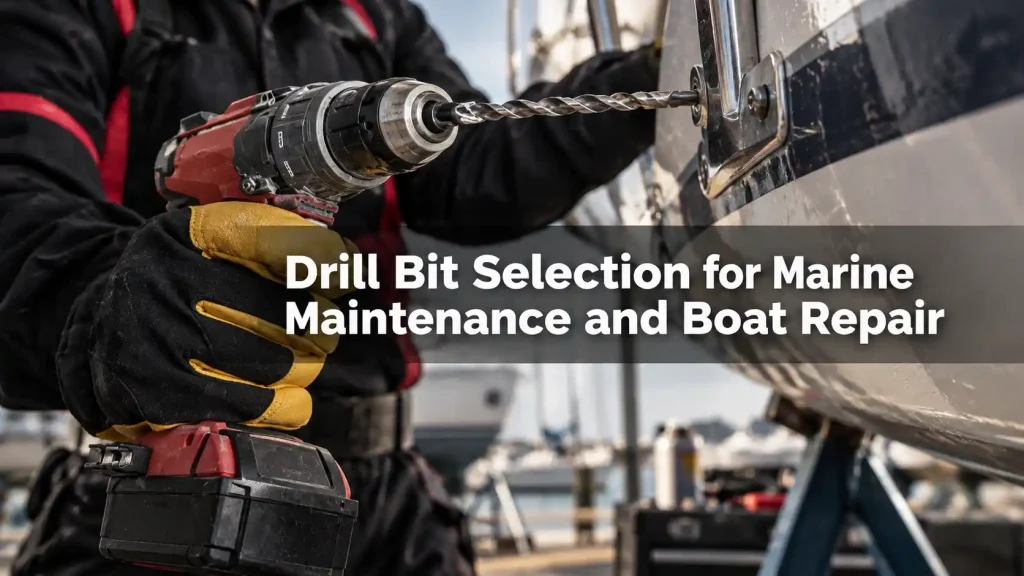
A marina service team may move from an aluminum console to a stainless handrail base, a fiberglass deck panel, a hardwood backing block, and a concrete dock within the same repair order. The hole diameter may look like the only common requirement, but each surface loads the cutting edge differently. Salt residue, confined access, thin skins, hidden cores, and finished gelcoat make a general-purpose choice unreliable. For marine maintenance distributors, boatyards, outfitters, and OEM service programs, a drill bit assortment is easier to control when every item is assigned to a specific material, hole function, tool interface, and replacement plan.
Quick Answer
A drill bit for marine maintenance needs to match the actual surface and the function of the finished hole. Metal fittings require controlled chip formation and clean breakthrough, composite panels need sharp cutting with stable backing, timber needs geometry that clears chips without tearing, and dock anchors require a hammer-compatible product matched to the holder and masonry condition. Diameter alone does not define a suitable product.
Bestwin manufactures and supplies drilling tools for distributors, equipment service programs, boatyards, OEM customers, and industrial buyers. We can match a drill bit family after reviewing the work material, coating or surface finish, hole diameter and depth, machine interface, expected quantity, packaging, and sample result. A marine assortment should separate these duties instead of presenting one mixed set as suitable for every repair.
Marine Maintenance Creates Several Different Drilling Duties
Boat and dock work often groups every hole under one maintenance budget, yet the finished connections are not interchangeable. A handrail base may need small clearance holes through stainless sheet. An aluminum console may need holes for switches, cable clips, or instrument brackets. A fiberglass locker can require a pass-through that must remain smooth under a gasket. Timber deck components may need deep pilot holes, while a dock cleat or service pedestal can require anchor holes in concrete.
The useful product question is therefore not simply which diameter is missing from the toolbox. It is which drill bit construction belongs to each repeated duty. The answer changes with the cutting material, the thickness or depth, the visible finish, the available drill, and whether the drill bit works in a production fixture or in a confined repair area.
Marine exposure adds a receiving and storage issue. Tools may travel in service vehicles, remain near salt air, or return to a humid storage room after use. A suitable product program combines cutting performance with clear identification, edge protection, and packaging that keeps different sizes and material groups separate. Surface finish and rust-prevention measures matter before the first hole is drilled, but they do not replace the correct cutting geometry.
For repeat purchasing, every duty can have a short application code: aluminum panel, stainless fitting, composite deck, timber structure, or dock masonry. That code links the approved drill bit to the surface, tool, hole dimensions, and sample record. It gives technicians a clearer drill bit choice and helps purchasing replenish the sizes that are actually consumed.
Table 1. Marine Application and Product Direction
| Maintenance duty | Product direction to discuss | Main information for matching |
|---|---|---|
| Aluminum console or frame | Metal-cutting twist or suitable multifunctional design | Alloy, wall thickness, finish, hole diameter, tool speed range |
| Stainless handrail or bracket | Heat-resistant metal-cutting design with suitable edge condition | Stainless grade, thickness, support, lubrication practice, hole quantity |
| Fiberglass or composite panel | Sharp product confirmed on representative laminate | Gelcoat, reinforcement, core, thickness, visible-side requirement |
| Hardwood or marine plywood | Wood-cutting or auger design for the required depth | Timber type, pilot or clearance function, depth, exit finish |
| Concrete dock or masonry wall | Carbide-tipped hammer product with the correct shank | Base material, anchor size, hole depth, rotary hammer holder |
| Mixed service assortment | Separate labeled groups rather than one universal tool | Repeated duties, size range, refill quantities, storage format |

Aluminum Parts Need Clean Entry and Controlled Breakthrough
Aluminum appears in consoles, hatches, rails, frames, brackets, access panels, and equipment supports. It is softer than many steels, yet it can load a cutting edge, form long chips, and grab as the point breaks through a thin wall. A drill bit that rubs rather than cuts can smear the edge, leave a raised exit burr, or pull the portable drill off line.
The product specification begins with the alloy condition, thickness, hole function, and surface finish. A clearance hole for a bolt can accept a different result from a visible opening around a switch or polished fitting. Thin sheet needs stable support close to the hole. A hollow extrusion also needs enough internal clearance for the point and chips as the tool exits the first wall.
Point geometry, lip symmetry, edge sharpness, flute finish, working length, and shank fit all influence the result. A long drill bit can reach a recessed position, but unnecessary drill bit length reduces rigidity and can increase runout in a handheld setup. The selected length should reach the work without adding avoidable flex.
Aluminum chip loading is an application condition, not a reason to choose a product by coating color alone. The approved sample needs to show that the edge starts accurately, clears chips, produces an acceptable exit, and remains easy to identify after use. If lubrication is part of the process, it must be compatible with the component finish and the boatyard’s cleaning procedure.
Bestwin can prepare sample directions from a representative aluminum coupon or actual component. The useful record includes diameter, point form, working length, shank, machine, support, speed range, feed method, and finished-hole acceptance. This makes the next drill bit order reproducible rather than dependent on a technician remembering which unmarked tool worked previously.
Stainless Fittings Put Heat and Edge Condition Under Pressure
Stainless steel appears in handrail bases, hinges, latches, brackets, hardware plates, and fabricated accessories. These parts may be thin, polished, and visible after assembly. A dull edge or unstable feed can create heat quickly, while a sudden grab at breakthrough can distort the hole or mark the surface around it.
A drill bit for stainless work needs an application-appropriate substrate and geometry, accurate cutting lips, a clean flute surface, and enough rigidity for the access condition. The product still depends on controlled use. Excessive speed, weak feed, poor support, or repeated rubbing can reduce edge life even when the nominal material specification looks suitable.
The drill bit sample should reproduce the actual plate or tube wall instead of using an unrelated workshop coupon. Tubular rail and flat mounting plate present different breakthrough conditions. A curved tube can move under load, and the exit burr may sit inside the section where it is hard to inspect. A polished plate makes surface marking more important than it would be on a hidden bracket.
Hole function also affects acceptance. A fastener clearance hole must fit the specified hardware without excessive play. A hole beneath a sealing washer needs a flat seating area. A tapped hole needs the correct pre-tap diameter and enough alignment for the following operation. These are product-matching details; the drill bit does not define the fastener system by itself.
For a distributor assortment, stainless duties should be labeled separately from general soft-material items. A sample record can note the stainless grade or representative part, thickness, diameter, tool, cooling or lubrication condition, and number of accepted holes. Packaging that protects the cutting edge also matters because a small nick can affect the first contact on a finished surface.
Fiberglass Panels Need a Product Confirmed on the Actual Laminate
Fiberglass and composite structures may combine gelcoat, resin, woven or chopped reinforcement, a foam or wood core, and a finished inner skin. Two panels with similar thickness can behave differently when drilled. The visible risks include gelcoat chipping, white fibers, a fuzzy exit edge, heat marking, and a ring of delamination around the hole.
A sharp drill bit with stable rotation is a better starting point than a worn general workshop tool, but the drill bit still has to be confirmed on the representative laminate. Diameter, cutting form, edge condition, point projection, working length, shank, and runout belong in the sample review. The backing and access arrangement also affect whether the exit skin remains intact.
Hole function helps define the acceptable result. A small hole for a fastener may need a clean edge that remains fully covered by the washer. An opening for cable routing may need clearance for a grommet. A fitting that passes through a cored panel may require an approved project procedure beyond drilling alone. The cutting tool supports the hole-making step, while the boat builder or repair specification controls sealing, core treatment, and final assembly.
Dust control is another application boundary. Composite dust can be irritating and may spread through a cabin or machinery space. The work process needs appropriate extraction and personal protection according to the material and site rules. Those controls do not change the drill bit specification, but they can influence tool access, backing, and chip or dust clearance around the hole.
Inspect the entry face, bore, and exit face after a drill bit sample. If the panel is cored, the visible rim may not reveal every internal defect, so the project owner defines any additional inspection. Record the tool identity and cycle count with the sample. A clean first hole and a damaged later hole describe a wear trend that purchasing needs to understand.

Timber Components Need the Correct Hole Function and Usable Depth
Marine plywood, hardwood trim, backing blocks, dock timbers, and structural wood members create another group of duties. The correct drill bit depends on whether the hole is a pilot, a fastener clearance hole, a dowel or locating hole, or a deep bolt passage. Treating these functions as the same size question can cause splitting, poor fastener engagement, misalignment, or an incomplete bore.
A pilot hole supports the selected fastener by reducing splitting and guiding its path. A clearance hole allows the fastener shank to pass through one component so the joint can close correctly. A deep bolt hole needs enough working length and chip space. A blind hole needs usable full-diameter depth, not only the distance reached by the point.
Wood auger drill bit designs can help in deeper timber work because the point, cutting form, and flute system are intended to advance and move chips. A screw point may feed aggressively, which can be useful in suitable timber but needs control near a visible exit. Brad-point or other wood-cutting forms may offer accurate starting and a cleaner rim for shallower work. The material, hole function, depth, and finish determine which direction deserves testing.
Moist or treated timber can change cutting behavior and tool condition. Resin, treatment chemicals, salt contamination, and wet chips may remain on the surface after use. Cleaning and dry storage protect the drill bit between jobs. The buyer should still confirm that any finish or maintenance practice is appropriate for the supplied product rather than assuming every coating tolerates the same treatment.
Hidden fasteners are a special risk in repair work. A wood-cutting product is not automatically intended to cut screws, nails, staples, or metal brackets inside a reused component. Drawings, detection, disassembly, and inspection can reduce that uncertainty. When a mixed-material obstruction is likely, the service plan may need a different product or method.
Dock and Masonry Holes Need the Correct Hammer Interface
Marine work extends beyond the vessel. Concrete docks, block walls, service pedestals, storage buildings, and quay structures may need holes for anchors, clips, brackets, bumpers, or utility supports. These duties require a product matched to the base material, anchor specification, hole diameter and depth, and rotary hammer system.
SDS Plus, SDS Max, round-shank, and other interfaces are not interchangeable labels. The shank must fit and lock in the intended holder. A carbide-tipped drill bit also needs a head, body, and flute design appropriate for the masonry condition and hole size. Choosing from diameter alone can leave the service team with a product that does not fit the machine or clear dust effectively.
Anchor instructions normally control the hole diameter, depth, cleaning, and installation procedure. The tool supplier can match a drilling product to the declared application, but the drill bit does not authorize an anchor system or determine structural capacity. For critical installations, the project specification and anchor manufacturer’s instructions remain the acceptance basis.
Hard aggregate, embedded steel, deteriorated concrete, and hollow masonry can change progress. When cutting slows suddenly, forcing the tool can damage the carbide or enlarge the hole. Stop and inspect the product and the base material. A chipped head, bent body, poor shank fit, or visible wobble requires correction before more holes are made.
For a marine maintenance set, every masonry drill bit should remain physically and visually separate from metal and wood items. Record the holder type, diameter, working length, overall length, cutter design, and approved anchor duty. That prevents a similar-looking drill bit from being issued to an incompatible tool.

Tool Interface and Access Decide Whether the Product Can Be Used
A suitable cutting edge is not useful if the shank does not fit the available machine or the complete tool cannot reach the marked location. Marine repairs often happen beside bulkheads, under decks, inside lockers, or near installed equipment. The order therefore needs both cutting dimensions and access dimensions.
Round shanks, hex shanks, reduced shanks, and SDS connections serve different holders and torque conditions. A hex shape can improve drive engagement in a compatible chuck or holder, but it does not make every drill bit suitable for impact operation. An SDS product belongs in the specified rotary hammer interface rather than a normal three-jaw chuck.
Overall length, working length, point projection, and required clearance behind the work should be recorded separately. A longer product may reach past an obstruction, yet it also needs room for the drill body and operator. In thin panels, excess point projection can approach wiring, hoses, tanks, upholstery, or finished surfaces behind the hole.
Portable drills add variation through chuck condition, battery state, speed control, and operator angle. Production fixtures can improve drill bit repeatability but may require a specific shank, rotation direction, or tool length. We review the declared machine and access condition when matching samples so that the selected product can be used in the real workspace.
Sample Approval Should Follow the Finished Connection
A useful sample is tested in the real material or a representative coupon with the intended tool and support. It is then judged by the finished connection, not only by whether the cutter passed through. The fastener, washer, grommet, fitting, bracket, or anchor should fit as intended without hiding an oversized, distorted, or damaged hole.
Start with drill bit dimensional checks. Confirm diameter, location, roundness where relevant, and full-diameter depth for blind holes. Inspect the entry edge, bore, and exit. On finished metal, check burrs and surface marking. On composite, check chipping, fibers, and visible delamination. On timber, check splitting and exit tear-out. On masonry, confirm the hole supports the specified anchor procedure.
Then inspect the drill bit. Look for chipped or rounded cutting edges, uneven wear, flute damage, bent bodies, shank marks, and identification that remains readable. A product that creates one acceptable hole but loses its edge immediately may not suit a repeat service program. Conversely, a discoloration or cosmetic mark should not be treated as failure without connecting it to function and the agreed acceptance record.
Drill bit sample quantities should reflect the purchasing decision. A one-off repair may need a basic fit check, while a distributor or OEM program needs enough cycles to compare consistency and decide replacement intervals. Record the material, machine, speed range, feed approach, cooling or lubrication condition, hole count, and observed result. That evidence helps us match the sample and maintain the approved identity for repeat supply.
Table 2. Sample Results and Details to Review
| Sample result | Product details to review | Order implication |
|---|---|---|
| Metal hole starts off center | Point condition, lip symmetry, shank seating, runout | Correct fit or compare a more suitable geometry |
| Aluminum exit shows a heavy burr | Edge sharpness, support, point form, breakthrough behavior | Approve only after representative exit quality is reached |
| Stainless cutting slows and heats | Substrate, edge condition, flute finish, length, application parameters | Separate stainless duty from general-purpose stock |
| Gelcoat chips around the entry | Cutting form, sharpness, runout, backing, laminate response | Test a revised product on the actual panel |
| Timber hole clogs at depth | Working length, flute space, wood geometry | Compare an auger or other deeper-hole direction |
| Masonry product will not lock into the hammer | Shank system and groove dimensions | Match the exact holder before performance testing |
| Similar sizes are mixed in storage | Marking, case layout, application coding | Add clear labels and refill item numbers |
A Marine Assortment Should Be Organized by Duty
Large mixed sets can look complete while leaving technicians unsure which product belongs to the material in front of them. A clearer assortment separates metal, composite, wood, and masonry duties. Within each group, the repeated diameters and lengths should reflect actual repair records, fleet types, or customer orders.
Color, finish, case position, and printed labels can support identification, but they should not be the only specification. Keep an item code that connects each drill bit to construction, geometry, diameter, working length, shank, intended application, and approved packaging. When a size is replaced, the refill should preserve that identity.
Edge protection matters in a mobile kit. Loose products can strike each other, damage carbide, dull points, or make size markings hard to read. Tubes, sleeves, trays, indexed cases, and divided packaging can protect working ends and make missing sizes visible. Corrosion-prevention material may also be appropriate for storage and shipping near humid environments.
The most frequently used drill bit sizes may need individual refill packs rather than full-set replacement. Distributors can build the initial assortment around common duties and stock separate refills for high-consumption items. OEM and private-label programs may add application labels, size sequences, case layouts, barcodes, and carton quantities after the sample range is approved.
Ordering Information That Improves Product Matching
An inquiry can begin with the vessel or facility type and a list of repeated hole duties. Material details, drawings, photographs, and representative samples help refine the recommendation, but customers do not need a complete technical file before contacting us. We can identify the missing information during application review.
Useful drill bit details include the metal grade or laminate description, timber type, masonry condition, hole diameter and depth, fastener or fitting function, visible-side requirement, machine model or holder, access limitation, expected holes per tool, quantity by size, packaging, marking, and annual or project demand. For mixed sets, state which sizes belong to each material group.
A drill bit manufacturer can then connect the declared work with product construction and factory control. For sample and production lots, Bestwin can review dimensions, shank fit, cutting-edge condition, finish, marking, packaging protection, and set composition. Application testing remains tied to the customer’s representative material and finished-hole acceptance.
A drill bit supplier also needs a repeat-order plan. Stable item codes, approved sample references, package counts, and refill rules reduce substitution between similar-looking products. When project conditions change, the new material or holder should be reviewed before the old item is carried forward automatically.
General reference information about a drill bit can help distinguish common constructions, but a marine order still needs an application-specific sample. A catalog label cannot reproduce the effect of alloy, laminate, depth, access, machine, surface finish, and storage conditions working together.
Common Purchasing Mistakes
The first mistake is buying one universal set for every surface. Mixed-material service is easier to manage when the drill bit groups are separated and labeled. The second mistake is ordering only by cutting diameter while ignoring working length, shank, point projection, and holder fit.
The third mistake is approving a sample in a convenient workshop material that does not represent the boat or dock component. Thin aluminum, polished stainless tube, cored fiberglass, treated timber, and hard dock concrete create different loads. Each important duty deserves its own sample evidence.
The fourth mistake is evaluating only the first hole. Repeat programs need a practical view of wear, edge condition, and hole quality over enough cycles to support the order. The fifth mistake is treating storage as separate from product quality. A damaged or corroded drill bit may fail before its intended construction can be evaluated.
Finally, do not let a case layout replace the specification. A complete assortment needs traceable item identities, compatible tool interfaces, application labels, edge protection, and a refill path. We can match a drill bit program to the customer’s materials, machines, sample results, packaging, OEM markings, and batch demand.
FAQ
Can one drill bit work for aluminum, stainless steel, fiberglass, wood, and concrete?
One product may cover more than one suitable material, but a marine service program should not assume universal performance. Concrete normally needs a masonry or hammer product, wood benefits from wood-cutting geometry, and finished metal or composite duties require their own sample review. Separate groups make product choice and replenishment clearer.
What information matters most for a replacement order?
Record the material, hole function, cutting diameter, working length, overall length, shank, point or head design, machine interface, and approved sample reference. Photographs and case position alone may not identify the same drill bit specification.
How should tools be stored near salt air?
Clean tools according to the supplied product guidance, dry them before storage, protect the cutting edges, and use packaging or corrosion-prevention measures suited to the environment. Inspect the edge and shank before reuse. Storage care protects the product but cannot restore a damaged cutting geometry.
Why should finished hardware be included in sample approval?
The fitting, fastener, washer, grommet, or anchor reveals whether the hole performs its real function. A visually clean opening may still be oversized, too shallow, poorly aligned, or unsuitable for the component’s seating area.
Match the Product to Each Marine Duty
Marine maintenance becomes more predictable when metal, composite, timber, and masonry holes are treated as different product duties. The right drill bit combines a suitable cutting construction with the required diameter, useful length, shank, tool interface, surface result, packaging, and refill identity.
Bestwin manufactures and supplies drilling-tool ranges for B2B customers and can match samples to representative marine materials and working conditions. Providing the repeated hole duties, machines, size range, packaging needs, and order quantity helps us prepare a focused assortment for testing, approval, and repeat supply.









 English
  العربية
  Français
  Português
  Português do Brasil
  Italiano
  简体中文
简体中文  繁體中文
繁體中文  日本語
日本語  한국어
한국어  Deutsch
  Español
  Slovenčina
  ไทย
ไทย  Türkçe