
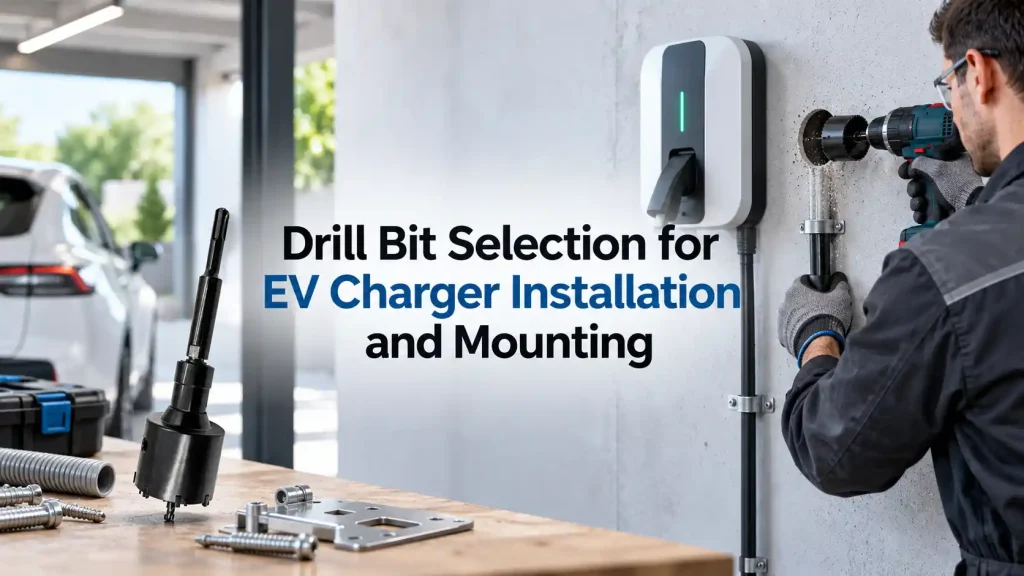
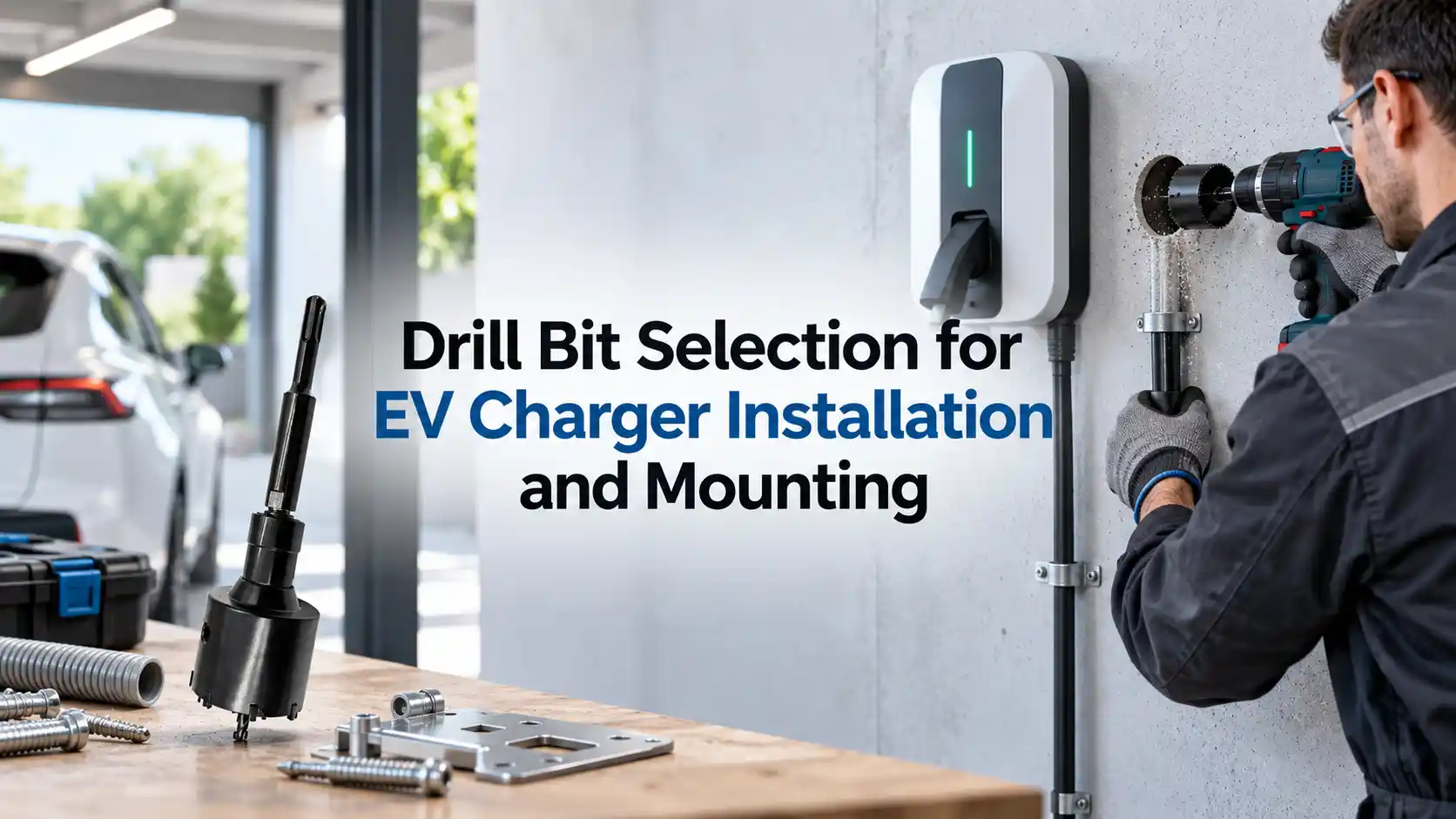
An EV charger can arrive as a complete electrical product, yet its installation still depends on a series of accurately drilled holes. Wall-mounted chargers need secure fixing points. Pedestal units require anchor holes in concrete. Cable supports, protective barriers, junction boxes, and steel mounting plates can introduce additional drilling in masonry or metal. When these holes are treated as an afterthought, the site may face slow installation, damaged finishes, poor anchor fit, or a tool assortment that does not match the equipment on hand.
The drilling work is also becoming more varied as home, workplace, fleet, and public charging projects expand. BESTWIN manufactures drilling tools for concrete, masonry, metal, wood, and mixed installation work. For installers, distributors, and OEM kit customers, the practical objective is not to find one bit for every surface. It is to match each product family to the mounting material, fixing specification, drilling machine, hole quantity, and required finish.
Quick Answer
A suitable drill bit for EV charger installation is selected from the material and fixing system, not from charger power alone. Carbide-tipped masonry or compatible SDS drill bit options are commonly considered for concrete and brick mounting surfaces. An HSS or other suitable metal drill bit may be relevant for steel pedestals, brackets, enclosures, and support frames. A wood drill bit applies only where the approved mounting structure contains timber.
Drill bit diameter, working length, shank, cutting geometry, and operating mode must match the real installation. The anchor or fixing instructions should define the required hole diameter, depth, cleaning method, edge distance, and installation conditions. A representative sample then confirms that the selected drill bit creates an acceptable hole with the tools and materials used on site.
EV Charger Projects Include Several Drilling Operations
The words EV charger installation cover more than one mounting arrangement. A compact residential charger may be attached directly to a garage wall. A workplace charger may be fixed to a steel post. Public charging equipment can use a substantial pedestal anchored to a concrete foundation. Other projects place equipment on prefabricated mounting frames, parking structures, or reinforced equipment islands.
The surrounding components can add concrete anchors for protective bollards, holes for cable-tray brackets, mounting points for junction boxes, and fixings for signage or cable-management accessories. Workshop teams may also drill steel baseplates, pedestal sections, brackets, or backboards before these items reach the site.
These operations should not be treated as one universal application. Even within one location, the installer may move from concrete to structural steel, galvanized sheet, brick, block, or timber backing. A practical drill bit program separates those materials and assigns a suitable drill bit group to each operation.
Table 1. EV Charger Installation Materials and Drill Bit Direction
| Installation material | Typical charger-related task | Product factors to review |
|---|---|---|
| Concrete | Pedestal bases, equipment islands, bollards and wall brackets | Carbide tip, SDS interface, diameter, usable length and dust removal |
| Brick or block | Wall-mounted residential and commercial chargers | Masonry condition, fixing type, percussion suitability and cavity risk |
| Mild steel | Pedestals, support frames, brackets and mounting plates | HSS grade, point geometry, coating, flute design and cutting control |
| Stainless steel | Outdoor brackets, hardware and corrosion-resistant enclosures | Heat resistance, sharpness, speed, feed and lubricant policy |
| Galvanized sheet | Covers, light brackets and cable-management parts | Accurate starting, burr control, coating protection and support |
| Wood | Approved timber framing or mounting boards | Wood-bit geometry, clean entry, working length and fastener fit |
| Layered wall | Finish layer over masonry, steel or timber | Separate material stages, total reach and concealed-service checks |
For distributors and installation-kit suppliers, this separation makes the range easier to identify and replenish. It also reduces the risk of placing similar-looking products in the same compartment when they require different machines or drilling modes.
Start With the Mounting Surface and Fixing Specification
The charger model does not determine the drilling product by itself. The mounting surface and approved fixing system are the starting points. Concrete strength, aggregate, reinforcement, masonry condition, steel thickness, coating, rear access, and surface finish can all change the requirement.
An installation on a new concrete equipment pad is different from one on an older parking-garage wall. A fabricated mild-steel pedestal presents different cutting conditions from a stainless enclosure or a thin galvanized bracket. A finished tiled wall also needs a different entry stage from the masonry behind it.
Before drill bit matching, the project team should identify the material, finished-hole diameter, hole depth, through-hole or blind-hole condition, anchor or fastener, drilling machine, holder type, working clearance, and expected hole quantity. It should also note whether reinforcement, cavities, coatings, or layered construction may be present.
The fixing documentation is particularly important for concrete anchors. The nominal anchor size does not always communicate the complete drilling requirement. Hole depth, effective embedment, cleaning procedure, edge distance, spacing, and permitted substrate need to follow the approved anchor and project instructions.
A drilling-tool manufacturer can match a product to the declared material, diameter, machine interface, and working depth. The drill bit itself does not approve the anchor system or determine structural capacity. Those decisions remain with the charger, fixing, mounting-system, and project requirements.
Concrete Pedestal Anchors Need Controlled Hole Size and Depth
Pedestal-mounted chargers depend on a stable connection to their foundation. If an anchor hole is oversized, shallow, badly aligned, or packed with dust, the anchor may not install as intended. The drilling product must therefore support a repeatable hole rather than merely remove concrete quickly.
The selected masonry or SDS drill bit should match the diameter stated for the approved anchor. Its usable drilling length must provide the required depth while accounting for the chuck or SDS holder, a baseplate template, a depth stop, and any dust-extraction attachment. Overall length and working length should not be treated as the same drill bit specification.
Flute condition matters because dust and fragments need to travel out of the hole. Packed debris can increase heat, slow penetration, and make depth control less predictable. Deep anchor holes may require staged withdrawal according to the tool and fixing procedure.
The carbide tip should be inspected before repeated work. A chipped, severely worn, or uneven drill bit can cut slowly and may not reproduce the approved sample result. Bent bodies, damaged shank grooves, or heavy flute wear also justify removing a drill bit from service.
Installers should check for reinforcement and concealed services before drilling. If unexpected rebar is encountered, a conventional masonry bit should not simply be forced through it. The location and approved response need to be reviewed under the responsible project procedure.
For repeated pedestal installations, a sample foundation or representative concrete section can confirm drill bit speed, hole diameter, depth, dust removal, shank compatibility, alignment through the baseplate template, and anchor seating. This result provides a stronger purchasing reference than a broad claim that one drill bit works in all concrete.

Tip Geometry and SDS Interface Affect Concrete Performance
Carbide-tipped electric-hammer drill bit products are available with different head and flute arrangements. A two-cutter, three-cutter, or four-cutter description can help distinguish drill bit families, but the label alone does not establish suitability. Concrete condition, aggregate, hole diameter, drilling depth, machine energy, and anchor tolerance still need to be considered.
The drill bit head should enter the surface without excessive skating and remain stable as the hole develops. For holes placed through a steel baseplate or installation template, the drill bit also needs enough clearance to operate without damaging the guide opening. The chosen diameter should be verified after realistic drilling because drill bit runout, tip wear, and machine condition can influence the finished hole.
An SDS-plus drill bit is widely used for many small and medium anchor holes. An SDS-max drill bit is associated with heavier rotary hammers and larger or more demanding work. They are different interfaces. A purchasing description that says only electric hammer drill bit is incomplete because it does not confirm which holder is required.
Shank grooves deserve the same inspection attention as the cutting end. A correct carbide head cannot compensate for a damaged or incompatible shank. In OEM kits and distributor stock, SDS-plus and SDS-max products should be clearly separated and marked so the installer does not discover the mismatch at the jobsite.
BESTWIN can match SDS and electric-hammer bit families to the stated anchor-hole range, working length, concrete condition, and machine interface. Sample approval should use the rotary hammer and substrate that represent the intended charging project.

Wall-Mounted Chargers Often Meet Layered Construction
A wall-mounted charger may appear to require only four fixing holes, yet the wall can include tile, plaster, insulation, brick, concrete, metal framing, or timber backing. The visible surface does not always reveal the load-bearing layer.
The wall build-up should be identified before drilling. A brittle finish layer may need a controlled rotary entry, while concrete or masonry behind it may require a different drill bit and operating mode. Hammer action that is appropriate in sound concrete can damage a tile or façade surface if it is activated too early.
Hollow block adds another issue. Excessive impact or uncontrolled breakthrough can damage the webs that support some fixing systems. The fixing specification should confirm that the anchor is suitable for the substrate and state how the hole should be produced.
Working length needs careful review on layered walls. A short bit may pass through the visible finish but fail to reach the required embedment. An unnecessarily long product can be harder to control and may increase deflection or contact risk in a restricted space.
The installer must locate cables, pipes, reinforcement, and other concealed elements before drilling. A longer tool is not a substitute for a surveyed and approved hole position. For distributor assortments, a controlled range of common wall-fixing diameters and lengths is usually more useful than a large collection of unrelated sizes.
Steel Pedestals and Brackets Need Metal-Cutting Bits
Not every EV charger support is drilled at the installation site. Steel pedestals, baseplates, brackets, backboards, and protective assemblies may be fabricated in a workshop. They can require pilot holes, clearance holes, cable-support fixings, or mounting patterns for several charger models.
Mild steel, galvanized steel, and stainless steel should not automatically share one drilling specification. Material grade, thickness, surface coating, heat generation, hole quantity, and finish affect the product choice.
A twist bit must start accurately where several holes form a mounting pattern. A cutting edge that walks at entry can move the finished hole away from the required position. Center punching, a guide, a fixture, a suitable point, or controlled startup speed can help, depending on the production method.
Drill bit flute length should suit the material thickness without making the product unnecessarily flexible. The shank must fit the chuck securely, and the machine needs adequate speed and torque for the diameter. Larger holes may require pilot drilling, a step drill, a hole saw, or another approved production method rather than forcing an oversized twist drill bit through the plate.
Heat deserves special attention in stainless steel. Rubbing instead of cutting can damage the drill bit edge and harden the working area. A suitable metal drill bit, controlled speed, steady feed, and an approved cutting fluid help maintain cutting action. These details should be confirmed in the sample rather than assumed after a bulk order arrives.
For coated or galvanized parts, the finished hole may expose bare metal or leave a burr. The fabrication specification should define acceptable edge condition and any required corrosion-protection treatment. The drilling product supports hole quality, but it does not provide the final protective finish.
Larger Cable Passages May Need a Separate Cutting Assembly
Small anchor holes and large cable passages are different operations. A pedestal or wall penetration for conduit, glands, or grouped cables may exceed the practical range of a normal twist or masonry bit. In these cases, a compatible core bit or hole-cutting assembly may be considered when the substrate, machine, installation design, and safety procedure support it.
The required opening should come from the conduit, sleeve, gland, or cable-entry component rather than from a familiar nominal size. Clearance, sealing, edge finishing, usable cutting depth, pilot arrangement, and rear access all affect the choice.
A rotary-hammer core assembly also introduces component compatibility. Core body, connecting rod, pilot drill, thread, and machine interface need to function as one system. Mixing parts by appearance can create poor centering or an unsafe connection.
Large openings should be planned before the charger and surrounding equipment restrict access. They also require checks for buried services, reinforcement, dust control, water entry, and the final sealing method. The core tool produces the opening; it does not define the electrical or weatherproofing design.

Tool Fit and Working Length Determine Jobsite Usability
A drill bit can have the correct cutting diameter and still be unusable when its shank does not fit the available equipment. Common charging-installation tools may use a straight-shank drill bit in a keyed or keyless chuck, a hex-shank drill bit in a compatible holder, SDS-plus bits, SDS-max bits, or specialized adapters.
The holder type should be recorded in the purchase specification. Calling a product a hammer drill bit does not confirm whether it is intended for a conventional chuck, SDS-plus, or another interface.
Restricted access can also change the preferred geometry. Chargers installed beside curbs, walls, existing equipment, or closely spaced pedestals may leave limited room for the drill body. Longer is therefore not automatically better. The shortest suitable product that safely reaches the specified depth can offer better control.
If a dust-extraction collar, template, or bracket thickness reduces effective reach, that reduction should be included in the length decision. Site teams can avoid shortages by testing the full assembly rather than checking the loose bit against the nominal hole depth.
Repeated Installations Need a Replacement and Refill Plan
A single home-charger installation and a multi-site charging rollout do not consume drilling tools in the same way. Repeated projects need a plan for inspection, replacement, packaging, and replenishment.
Tool life should not be expressed as one universal number of holes. Concrete composition, reinforcement, steel grade, diameter, depth, machine condition, operator method, and cooling or lubrication all affect wear. A more practical approach is to establish a conservative replacement limit through representative testing.
During the trial, the team can record the material, hole diameter and depth, drilling machine, operating mode, hole quantity, average drilling time, hole condition, anchor fit, visible wear, and reason for replacement. A tool may still cut but no longer be commercially useful if drilling time rises sharply or the finished result falls outside the accepted range.
Consumables should be separated by use frequency. A project may consume many common concrete-anchor sizes but only a few products for metal accessory work. Packing every diameter in equal quantities can create shortages in high-use sizes and unused inventory elsewhere.
Distributors can improve replenishment with stable item codes, clear diameter and shank markings, material identification, and separate refill packs. The installer should be able to replace a frequently used size without buying the complete assortment again.
OEM and Installer Kits Need Batch Consistency
Companies supplying EV charger installation kits may combine bits with anchors, fasteners, templates, marking tools, or protective accessories. In this format, the drilling product is part of a repeatable installation package rather than an isolated retail item.
The approved sample should define the product that later batches need to match. Useful inspection points include nominal diameter, working length, overall length, shank dimensions, tip alignment, carbide condition, flute formation, surface finish, size marking, packaging protection, and set composition.
For a metal drill bit, cutting-edge symmetry and straightness influence starting and hole position. For a masonry or SDS drill bit, carbide attachment, body straightness, flute condition, and shank-groove quality deserve attention.
Packaging must protect the cutting end and prevent mixed sizes. A damaged carbide tip or chipped metal-cutting edge can make a new product unsuitable before it reaches the site. Clear labels are particularly important where metric and inch sizes are both sold.
As a drill bit manufacturer, BESTWIN can support OEM, private-label, distributor, and installation-kit requirements. Once the application and sample are confirmed, product markings, assortment structure, packaging quantity, and refill items can be aligned with the intended sales channel.
Table 2. Information for an EV Charger Drill Bit Order
| Specification item | Information to provide | Purchasing value |
|---|---|---|
| Workpiece | Concrete, brick, steel, stainless, wood, or layered wall | Identifies the appropriate cutting family |
| Hole requirement | Diameter, depth, through or blind hole | Defines size and usable length |
| Fixing system | Anchor or fastener reference | Connects the product to the finished hole requirement |
| Power tool | Drill, hammer drill, SDS-plus or SDS-max rotary hammer | Confirms shank and operating compatibility |
| Quantity | Holes per charger and chargers per project | Supports pack size and replacement planning |
| Site condition | Indoor, outdoor, wet, dusty or restricted access | Affects practical product and packaging decisions |
| Acceptance | Anchor fit, burr level, position and surface condition | Provides a sample-testing target |
| Supply format | Individual sizes, sets, refills or OEM kits | Aligns the order with the distribution plan |
An inquiry does not need every detail finalized. The mounting material, hole range, available machines, and estimated quantity are enough to begin matching. Remaining items can be confirmed during sample review.
Common Selection Mistakes
The first mistake is choosing one multipurpose product for every material. A mixed installation is usually easier to control with clearly assigned groups: masonry or SDS products for anchor holes, metal-cutting bits for brackets, and a separate solution for brittle finish layers or large service passages.
The second mistake is ordering by anchor diameter without checking the specified hole. The anchor documentation should provide the required drilling diameter and depth. Guessing from the visible fastener can produce a hole that does not accept or retain the fixing as intended.
Another mistake is confusing overall length with working length. This can leave the drill bit unable to reach the required depth after passing through a template, surface finish, mounting plate, or dust-control attachment.
Shank mismatch is equally common. Straight, hex, SDS-plus, and SDS-max products are not interchangeable merely because their cutting ends have the same diameter.
Finally, comparing only unit price can hide the cost of slow drilling, early wear, broken tips, missing refill sizes, damaged packaging, or unclear identification. A representative sample provides a better basis for comparison because it shows whether the product fits the tool, reaches the depth, creates an acceptable hole, and remains practical over the expected working quantity.
Frequently Asked Questions
Which drill bit is suitable for an EV charger concrete base?
A carbide-tipped masonry or compatible SDS product is commonly considered for concrete anchor holes. The exact diameter, depth, shank, and operating mode should follow the approved anchor specification and match the rotary hammer used on site.
Can the same bit drill the concrete base and steel pedestal?
Normally these materials require different cutting systems. Concrete is generally drilled with a masonry or SDS product, while a suitable twist bit is used for steel. Equal diameter does not make the two products interchangeable.
Is SDS-plus or SDS-max better for charger installation?
The answer depends on hole diameter, depth, concrete condition, machine size, and work volume. SDS-plus covers many small and medium anchor holes. SDS-max is associated with heavier work. The selected interface must match both the rotary hammer and the installation requirement.
How many bits should be included in an installation kit?
Quantity should follow the number of holes per charger, expected project volume, substrate variation, sample-tested replacement limit, and availability of refills. High-use sizes may need spare products or separate refill packs.
Can drilling continue after reinforcement is encountered?
Unexpected reinforcement should trigger a review of the hole position and project requirements. The installer should not force a standard masonry product through reinforcement or relocate the hole without authorization.
What information helps with a quotation?
Useful information includes workpiece materials, hole diameters and depths, anchor references, drilling machines, shank types, expected hole quantity, preferred assortment, packaging requirements, and target order quantity. Photos or samples of the mounting components can also clarify the application.
Match the Drill Bit to the Mounting Work
EV charger installations combine electrical equipment with concrete, masonry, steel, and other building materials. Reliable drilling begins by separating those operations and selecting a product for each real workpiece and fixing requirement.
The final choice should match diameter, depth, cutting structure, shank, power tool, access condition, and expected workload. Representative testing confirms whether the bit creates an acceptable hole and supports practical replacement planning.
As a drill bit supplier, BESTWIN can match drill bit families for charger anchors, wall fixings, metal brackets, pedestals, support frames, and larger service openings. Sharing the mounting materials, fixing details, machine interfaces, project quantity, and packaging needs helps us prepare a suitable combination for samples, distribution, OEM kits, and repeat orders.







 English
 العربية
 Français
 Português
 Português do Brasil
 Italiano
 简体中文
 繁體中文
 日本語
 한국어
 Deutsch
 Español
 Slovenčina
 ไทย
 Türkçe