
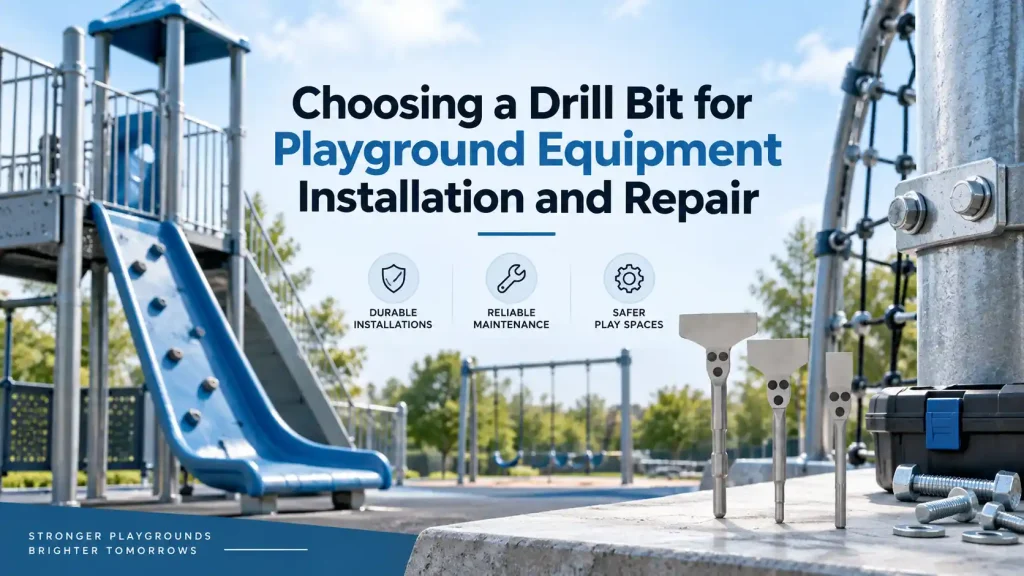
Installers often discover a drilling problem only after a playground structure is partly assembled. A replacement platform bracket does not match the old hole pattern, a coated steel tube is difficult to hold square, or a plastic activity panel begins to flex as the tool breaks through. The nominal diameter may be correct, yet the finished hole still affects fastener fit, coating protection, panel support, and the appearance of a public-facing component. Playground equipment manufacturers, installation contractors, maintenance teams, and distributors therefore need a drill bit range organized by material and hole function rather than by diameter alone.
Quick Answer
Choose the drill bit by checking four things in order: the component material, the purpose of the hole, the available access, and the required finish. Coated steel frames usually need a stable metal-cutting point and controlled breakthrough. Plastic panels need support and low heat. Timber parts need clean entry and reliable chip clearance, while concrete anchor holes need masonry geometry and the correct working length. Bestwin recommends approving each drill bit on representative playground parts before building a field kit. A practical range should separate these duties clearly, even when several products share the same nominal diameter. Start with the drill bit category, then narrow the selection by substrate and fastening task.
Give Every Hole a Clear Function
A hole in playground equipment is rarely just an opening. It may locate a handrail bracket, accept a through bolt, prepare a pilot for a timber screw, provide clearance for a panel fixing, or establish an anchor position in a concrete footing. Each function places a different demand on the cutting tool.
For example, a clearance hole in a powder-coated steel tube should let the fastener pass without forcing, but it should not be so large that the washer has little bearing area. A pilot hole in a timber post must guide the screw while leaving enough wood for the thread to grip. A concrete hole must match the anchor system and reach the required depth without excessive widening at the surface. The same diameter printed on a package does not make these operations equivalent.
Before choosing a drill bit, record the component name, material, approximate thickness, fastener type, final hole purpose, machine type, and access condition. This short duty description helps purchasing teams compare samples on the same basis. It also makes replenishment easier because technicians can ask for the item assigned to a known repair rather than describe only a diameter and color.
Match the Cutting Direction to the Component Material
Playground assemblies combine materials that behave differently under a rotating edge. A practical kit therefore begins with separate drill bit families for metal, plastics, timber, and masonry.
Coated Steel Frames and Brackets
Steel posts, guardrails, ladder frames, roof supports, and connection plates need a metal-cutting geometry that enters accurately and removes chips without excessive rubbing. Surface coatings can make the starting point slippery, especially on round tube. A short, rigid working section is useful when the hole is close to a weld or when a cordless machine must be held at an awkward angle.
When drilling an installed tube, access may be more important than maximum flute length. Too much projection increases leverage and makes it easier to enlarge the entry. For thicker brackets or stacked plates, the usable flute must still carry chips out of the full cutting depth. The purchase specification should state whether the common job is thin tube, a solid connection plate, or both.
Aluminum Ramps and Trim
Aluminum components cut more easily than steel, but soft chips can load the cutting edges if the drill bit rubs instead of cutting. A sharp edge, suitable flute space, and steady feed help maintain a round hole. Thin aluminum panels also need backing near breakthrough so they do not pull upward or leave a heavy burr.
Maintenance kits should keep aluminum work separate from heavily worn products used on steel. A cutting edge that still seems acceptable on a rough steel bracket may produce a poor finish on a visible aluminum trim piece.
HDPE and Polycarbonate Panels
Activity panels, side barriers, roofs, and decorative features may be made from high-density polyethylene or clear polycarbonate. These materials can flex, heat, smear, or chip depending on the drill bit geometry and operating method. The panel should be supported close to the hole, and the cutting action should remove material cleanly rather than melt it.
A trial hole should be checked on both faces. The entry should not show a raised ring, and the exit should not have a torn lip that prevents a washer from sitting flat. If the panel is exposed to temperature changes, the hole specification may also require deliberate clearance around the fastener. That allowance belongs to the assembly design and should not be guessed by the installer.
Timber Posts and Play Features
Timber roofs, posts, bridges, balance elements, and replacement boards often require both small pilots and larger through holes. A wood-specific point helps start accurately on grain, while suitable flute volume clears chips from deeper work. Long holes through posts demand particular attention to straightness because a small angular error at entry becomes a large offset at the far face.
Concrete Footings and Pads
Foundation holes are abrasive and may contain hard aggregate. They require a masonry-oriented drill bit and a machine mode compatible with the anchor instructions. The usable length must cover the specified embedment plus chip space. Concrete work should not be treated as an extension of the metal-frame task simply because the same installer performs both operations.
Table 1. Playground Component and Drill Bit Direction
| Playground component | Common material | Typical hole duty | Drill Bit direction | Main approval point |
|---|---|---|---|---|
| Handrail or platform frame | Powder-coated steel tube | Bolt clearance or bracket location | Rigid metal-cutting geometry | Accurate start and controlled exit |
| Ramp trim or access panel | Aluminum sheet or extrusion | Fastener clearance | Sharp metal-cutting geometry with open chip flow | Low burr and round hole |
| Activity or barrier panel | HDPE or polycarbonate | Bolt or screw clearance | Sharp drill bit proven on the specific polymer | Clean faces without melting or cracking |
| Timber post or bridge part | Softwood or hardwood | Pilot or through bolt hole | Woodworking point and adequate flute capacity | Straight hole and clean entry |
| Concrete pad or footing | Concrete or masonry | Mechanical or chemical anchor hole | Masonry geometry with required working length | Correct diameter, depth, and surface condition |

Protect Coated Tube During Entry and Breakthrough
Powder coating and painted finishes make playground structures attractive and corrosion resistant, but drilling can expose bare metal. A well-selected drill bit reduces unnecessary damage around the hole, while the installation process must include the coating repair method specified for the structure.
Start control matters most on round tube. A wandering point can scratch a crescent through the finish before the cutting edges establish a full circle. A location jig, clamped guide, or properly prepared starting mark may be appropriate for repeat work. The operator should also support the machine so its weight does not pull the drill bit sideways.
Breakthrough deserves equal attention. As the remaining wall becomes thin, an aggressive feed can grab, distort the edge, or drive the machine into the opposite wall of the tube. Reducing feed near the exit and using a depth stop where possible gives better control. After drilling, remove loose chips from inside accessible sections, deburr as required, and apply the approved touch-up protection. Do not leave sharp swarf where children, installers, or future maintenance teams may contact it.
For a replacement bracket, compare the new hole position with welds, tube edges, existing openings, and internal fasteners before drilling. Moving a hole by a few millimeters may solve an alignment problem but create a weak edge distance or interfere with another component. Structural changes should follow the equipment documentation or an authorized engineering decision.
Keep Polymer Panels Supported and Cool
Plastic playground panels can look simple, yet their drilling behavior changes with resin type, thickness, temperature, and support. A panel that drills cleanly on a bench may vibrate when installed vertically between posts. The sample procedure should therefore reproduce the real clamping and access conditions.
Place support close to the cutting zone without scratching the visible face. Use a sharp drill bit and a controlled feed that creates chips instead of heat-polished smears. If the swarf softens and wraps around the tool, stop and clear it rather than forcing the cut. Excess heat can mark the surface, enlarge the hole, or leave a hardened lip.
Clear polycarbonate needs special visual review because small edge damage is easy to see and may become a crack origin. The final acceptance standard should cover both sides of the panel, not only the operator side. For decorative HDPE, color contrast can make a rough white stress ring especially noticeable.
Stack drilling may appear efficient, but multiple panels can shift and trap chips between surfaces. Approve that process only when the fixture keeps every layer flat and the finished holes remain aligned. For field repairs, drilling panels one at a time is often easier to control and inspect.
Separate Timber Pilots From Through Bolt Holes
Timber duties should be divided by fastening method. Small pilots for screws require predictable location and sufficient depth, while through holes for bolts demand straight tracking and clean breakout. Counterbored or recessed hardware introduces another step and should have its own approved tool sequence.
Grain direction affects the result. Entry near a board edge can split if the point pushes fibers apart, while exit on an unsupported face can tear. Backing material and a reduced feed near breakthrough improve the far-side finish. In visible parts, installers may drill from both faces using a verified guide, but only when the two paths can meet accurately.
Deep post holes need chip removal. Even a suitable woodworking drill bit can bind if packed chips remain in the flutes. A planned withdrawal cycle keeps the cut clear and gives the operator a chance to confirm alignment. Working length should be selected from the real post size and fixture clearance, not from overall drill bit length alone.
For treated timber, the drilling operation exposes fresh material. Any required end-grain or preservative treatment should be part of the maintenance instruction. The cutting tool selection cannot replace that protective step.

Treat Foundation Anchors as a Separate Drill Bit Duty
A playground frame may use surface-mounted base plates, embedded posts, or retrofit anchors. Each system has its own approved dimensions and installation instructions. The cutting drill bit is only one part of that system, so diameter and depth should come from the anchor documentation rather than from a general field habit.
Masonry products are designed to work against abrasive concrete and aggregate. A worn tip may still make a hole, but the result can be slow, oversized, shallow, or poorly cleaned. Those conditions affect how an anchor seats and how reliably the installer can follow the specified procedure. Replacement criteria should therefore include hole condition and drilling time, not only visible breakage.
Access around a base plate is often restricted by posts, panels, or landscaping. Check that the chuck, body, and working length can reach the intended position without forcing the machine at an angle. A right-angle accessory may solve access, but it changes the tool setup and should be tested before field deployment.
Hole cleaning, depth verification, edge distance, and anchor installation remain part of the approved anchor process. Bestwin can organize masonry choices by diameter, flute length, and shank style, but the equipment owner or installation specification must define the anchor system and the final acceptance requirements.

Fit the Shank and Length to the Work Area
A correct cutting end can still be inconvenient if the shank does not match the available machine. Procurement records should identify chuck type, capacity, impact or hammer compatibility, and any quick-change interface used by maintenance crews. A mixed fleet may require more than one shank option for the same cutting duty.
Overall length is not the same as usable cutting length. The required reach includes the component thickness, fixture or guide thickness, and enough flute exposure to remove chips. On the other hand, unnecessary length reduces stiffness and increases the chance of an angled start. The shortest drill bit that safely completes the approved hole is usually easier to control.
The general drill bit classification is useful background, but a purchasing description should be more specific. Record substrate, diameter, usable length, shank, machine mode, hole type, and finish expectation. Where installers work inside an assembled structure, add the available clearance around the chuck and handle.
Packaging should make these distinctions visible. Color bands, compartment labels, and printed duty cards can prevent a masonry item from being used on a plastic panel or a worn steel item from being moved into the aluminum tray. Clear kit organization protects both drill bit life and hole quality.
Approve Samples on Real Playground Components
Catalog data narrows the options, but sample approval should reproduce the actual job. Use representative tube coatings, panel grades, timber species, concrete strength ranges, fasteners, machines, and access angles. A sample cut in flat scrap does not fully represent a hole drilled overhead into an installed round rail.
The review should include entry location, cutting stability, chip behavior, exit condition, measured diameter, burr or tear-out, tool temperature, and the condition of the component finish. Repeat enough holes to reveal whether performance changes quickly. If a drill bit will be supplied in several diameters, test both a common small size and a larger, more demanding size.
Bestwin is a drill bit manufacturer that manufactures metal, woodworking, masonry, and multifunctional ranges for OEM and distributor programs. Compare samples against a consistent specification and traceable production description tied to the component duty: coated steel tube, visible plastic panel, deep timber post, or concrete anchor. OEM customers should record component material, dimensions, fastener requirements, hole quantity, machine interface, and finish standard. These parameters create a clear basis for confirming geometry, material, coating, shank, packaging, and repeat supply.
Table 2. Playground Drilling Sample Checks
| Check | What to observe | Why it matters | Record for approval |
|---|---|---|---|
| Starting behavior | Wandering, skating, or surface scratching | Affects location and visible finish | Component, position, guide method |
| Cutting action | Smooth chips, rubbing, grabbing, or chatter | Indicates geometry and setup suitability | Machine, speed range, feed approach |
| Breakthrough | Burr, tear-out, cracking, or sudden pull-in | Affects safety, washer seating, and appearance | Exit support and operator method |
| Hole size and shape | Roundness, diameter, taper, or surface widening | Affects fastener and anchor fit | Measuring method and tolerance |
| Drill Bit condition | Edge wear, heat marks, chipping, or bending | Supports replacement planning | Number and type of completed holes |
| Component protection | Coating damage, plastic stress, exposed timber | Connects drilling to finishing steps | Required deburring or touch-up action |
A supplier sample report does not need to be complicated. Photographs of both faces, a short result table, and the approved machine setup are more useful than broad claims. Keep the approved reference with the purchasing code so later batches can be compared with the same duty.
Build the Kit Around Recurring Repair Duties
A field kit should reflect the repairs teams actually perform. One compartment might contain short metal products for frame brackets, another sharp items reserved for aluminum and plastics, another wood products for pilots and through holes, and a separate masonry group for foundation work. The labels should show both material and task.
High-use diameters deserve spare quantities, but assortment depth should not hide critical gaps. A kit with many neighboring metal sizes may still fail if it lacks the length needed for a timber post or the correct shank for the rotary hammer. Review maintenance records, replacement part drawings, and anchor instructions together before deciding the range.
When evaluating a drill bit supplier, confirm how individual sizes are replenished, how sets are labeled, and whether packaging can remain organized in a service vehicle. Also check batch identification, protective storage, and the availability of consistent replacements. These details reduce improvised substitutions during urgent repairs.
Used products should return to a defined location for inspection rather than being mixed with new stock. Bent items, chipped masonry tips, dulled plastic-use edges, and products contaminated with coating residue should be removed or reassigned only under an approved rule. A simple check-in process helps crews preserve the distinctions established during sample approval.
Read Hole Defects as Drill Bit Clues
A poor hole often reveals whether the problem comes from selection, setup, or wear. Wandering on coated tube may indicate insufficient start control, too much projection, or a point unsuitable for the curved surface. Heavy burrs may come from a dull edge, poor support, or excessive feed near breakthrough.
Melted plastic suggests rubbing, heat accumulation, or trapped swarf. Cracks can point to an unsuitable geometry, cold material, poor backing, or excessive pressure. Timber tear-out usually directs attention to exit support, grain direction, or a worn cutting edge. A concrete hole that progresses slowly or measures inconsistently may indicate wear, hard aggregate, an unsuitable machine mode, or incomplete chip removal.
Do not correct every defect by applying more force. Extra pressure can hide the original cause and create a second problem, such as bending, overheating, or sudden breakthrough. Stop, inspect the drill bit and component, compare the setup with the approved reference, and change one factor at a time.
Defect records are valuable for purchasing. If the same issue appears across several technicians and batches, the specification or drill bit choice may need review. If it appears only in one access position, a guide, shorter length, or different machine arrangement may be the better solution.
Frequently Asked Questions
One Drill Bit for Every Playground Material
A single drill bit may make holes in more than one material, but that does not mean it gives an acceptable finish or service life in every playground duty. Separate products are normally easier to approve for coated steel, polymers, timber, and concrete. Multipurpose options should still be tested on each exact component and hole function.
Drilling a Finished Coated Frame
Use an approved location method, keep the working section as short and rigid as practical, support the machine squarely, and reduce feed near breakthrough. Afterward, deburr and restore exposed metal using the equipment maker’s approved process. Confirm that the new hole does not conflict with welds, edges, or structural requirements.
Holes in HDPE and Polycarbonate Panels
Support the panel close to the hole and use a sharp drill bit that cuts without melting. Check both faces for raised lips, chips, cracks, and stress marks. Any thermal-expansion clearance should come from the assembly design rather than an operator estimate.
Wood Products for Deep Post Holes
Choose a woodworking geometry with enough usable length and chip capacity. Use a guide or fixture when straightness is important, withdraw at planned intervals to clear chips, and support the exit where possible. Confirm treatment requirements for newly exposed timber.
Masonry Products for Anchor Installation
Match diameter, depth, shank, and machine mode to the approved anchor system. Verify working length and access around the base plate. Drilling is followed by the specified cleaning, depth checking, and anchor installation steps; drill bit choice does not replace those requirements.
Information Kept With a Replacement Item
Keep the substrate, hole purpose, diameter, usable length, shank style, machine mode, approved sample reference, and replacement criterion. For visible parts, add the entry and exit finish standard. For foundation work, reference the applicable anchor instruction.
Match Each Drill Bit to One Verified Playground Duty
A dependable playground kit is built from verified tasks, not from a collection of diameters. Coated steel, aluminum, plastic, timber, and concrete each require a drill bit choice that reflects their cutting behavior and the function of the finished hole. Access, working length, shank fit, breakthrough control, and component protection are part of that choice.
For procurement teams, the most useful specification names the real component and the expected result. For installers, clear kit labels and approved setup notes reduce substitutions. For maintenance managers, hole-defect records and replacement criteria make drill bit life easier to control.
Bestwin can support these decisions with metal, woodworking, masonry, and multifunctional options within its drill bit range. Confirm the component material, fastening duty, machine interface, and sample acceptance standard before ordering. That approach keeps selection practical and gives every playground hole a clear, repeatable purpose.








 English
  العربية
  Français
  Português
  Português do Brasil
  Italiano
  简体中文
简体中文  繁體中文
繁體中文  日本語
日本語  한국어
한국어  Deutsch
  Español
  Slovenčina
  ไทย
ไทย  Türkçe