
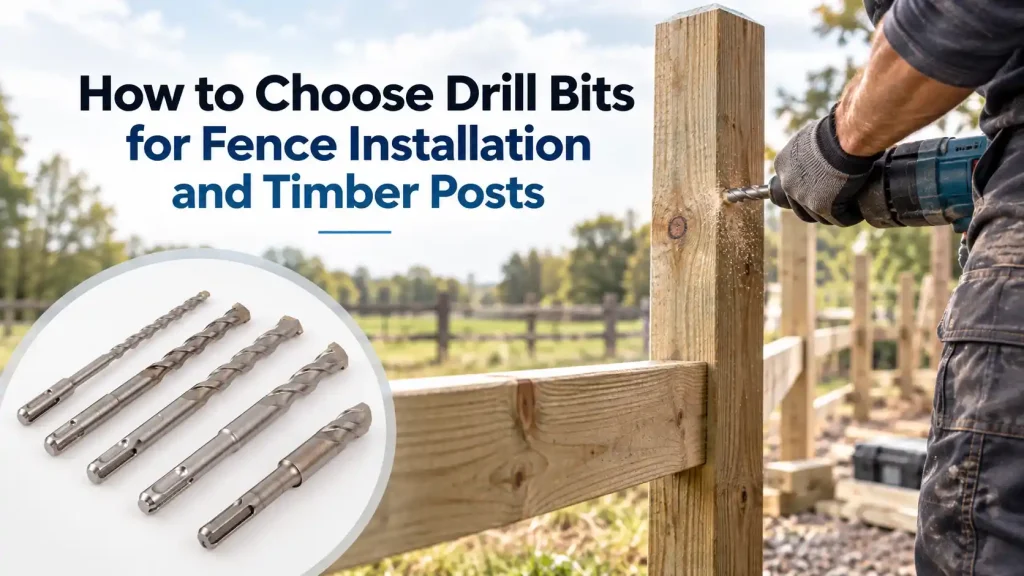
Fence installation involves much more drilling than it may appear from the finished structure. Timber posts may need through-holes for bolts, rails may require pilot holes for screws, brackets need accurate fixing points, and gate hardware often introduces larger or deeper holes into thick wood.
The wrong drill bits can turn these repetitive tasks into slow work. Poor chip removal may cause a bit to bind inside a deep timber post. An unsuitable point design may wander before entering the wood. A short bit may not reach through a thick post, while an unnecessarily large or aggressive tool can leave rough edges around visible fixing points.
For contractors, landscapers, fencing installers, distributors, and tool buyers, choosing drill bits should therefore begin with the actual hole rather than simply choosing a general-purpose wood bit.
At BESTWIN, we supply drilling tools for woodworking, construction, gardening, and outdoor applications. This guide explains how to match drill bits with common fence installation tasks and how to build a practical tool selection for timber posts, rails, panels, and outdoor fixing work.
What Drilling Jobs Are Common in Fence Installation?
A fencing project usually involves several different hole types. Even when most components are made from timber, the diameter, depth, accuracy, and required finish can vary considerably.
Typical drilling operations include:
- Pilot holes for screws in rails and fence boards
- Through-holes for bolts connecting posts and structural members
- Larger holes for gate hardware
- Deep holes through thick timber posts
- Holes for brackets, hinges, and latches
- Repetitive fixing holes during panel installation
- Drilling into treated timber used outdoors
This means a single set of general-purpose drill bits may not be efficient for every stage.
A small pilot hole requires control and accuracy. A large hole through a thick wooden post requires much better chip evacuation and sufficient working length. Repeated installation work also places greater importance on durability because contractors may drill dozens or hundreds of similar holes during one project.
Before choosing the bit, define four basic requirements:
| Drilling Requirement | What to Confirm |
| Hole diameter | Screw, bolt, bracket, or hardware size |
| Hole depth | Pilot hole, partial-depth hole, or through-hole |
| Timber thickness | Fence board, rail, or structural post |
| Work quantity | Occasional repair or repetitive installation |
This simple distinction helps prevent both under-specifying and over-specifying the drilling tool.
Which Drill Bits Work for Timber Fence Posts?
Different drill bits solve different problems in timber.
For typical fence work, the most useful options include twist drill bits, brad-point bits, spade bits, and auger bits. The choice depends mainly on hole diameter, depth, finish requirements, and how many holes must be drilled.
Twist Drill Bits
Twist drill bits can handle smaller holes and general fixing work. They are useful when drilling pilot holes for screws, brackets, or smaller bolts.
They are a practical option when:
- Hole diameter is relatively small
- Drilling depth is limited
- High chip volume is not expected
- The installer needs a versatile bit for several materials or tasks
For thick posts, however, conventional twist drill bits may become less efficient because chips have a longer distance to travel out of the hole.
Brad-Point Drill Bits
Brad-point drill bits are useful when positioning accuracy matters.
The center point helps the bit start at the intended location rather than sliding across the timber surface. This can be valuable when fixing decorative hardware, hinges, or components where visible hole placement needs to remain consistent.
They are particularly useful for controlled woodworking rather than very large or very deep structural holes.
Spade Bits
Spade bits are a straightforward choice for relatively large holes in timber.
They are commonly useful for:
- Fence posts
- Timber rails
- Bolt clearance holes
- Utility openings
- General outdoor wood installation
Their simple cutting structure makes them suitable when speed is more important than producing a highly finished furniture-grade hole.
For contractors drilling repeated holes in fence components, spade bits can provide a practical balance between drilling speed and tool cost.
Auger Drill Bits
Auger drill bits become especially useful when the hole must travel deeper through thick timber.
A typical auger design helps pull the cutter into the wood while the flute carries chips toward the surface. This makes auger drill bits well suited to structural timber and thick fence posts where chip removal becomes a major part of the drilling process.
For deep outdoor woodworking, the question is therefore not simply, “Can this drill bit cut wood?” It is also, “Can it continue removing chips effectively for the full required depth?”

Why Are Auger Drill Bits Useful for Deep Timber Posts?
A thick fence post creates a different drilling condition from a thin fence board.
As drilling depth increases, more chips must leave the hole. Friction can also rise as the cutting section moves deeper into the timber. If chips accumulate around the bit, drilling becomes slower and the operator may need to withdraw the tool repeatedly.
This is where auger drill bits have an advantage.
Their geometry is designed around both cutting and chip evacuation. For installers making bolt holes through substantial timber sections, this can make drilling more predictable.
Several factors are particularly important.
Working Length
The usable drilling length must exceed the required hole depth.
Do not select a drill bit based only on overall length. Part of the overall length includes the shank and other non-cutting sections.
For through-holes, allow enough working length to pass completely through the post without forcing the chuck or tool body against the timber.
Flute Space
Deep drilling produces a substantial volume of chips.
A suitable flute provides space for this material to move toward the surface. When the flute becomes packed, heat and resistance increase.
For repetitive work, efficient chip removal can affect productivity just as much as cutting sharpness.
Straightness
A long drill bit must remain sufficiently straight during rotation.
Excessive runout becomes increasingly noticeable as drilling depth grows. This can produce an angled hole or an oversized exit point.
Where bolts must align with brackets or a second timber member, hole direction becomes especially important.
How Should Drill Bit Diameter Be Selected for Fence Hardware?
Drill bit diameter should follow the connection being installed.
A hole for a wood screw serves a different purpose from a clearance hole for a structural bolt. Choosing the diameter simply because it is close to the fastener size can result in loose connections or unnecessary installation resistance.
Pilot Holes for Screws
Pilot holes reduce the amount of wood that must be displaced when a screw enters the timber.
They can be especially useful near the edge of a fence rail or board, where excessive expansion may contribute to splitting.
The required pilot hole diameter depends on:
- Screw diameter
- Timber density
- Screw thread design
- Required holding strength
- Distance from the timber edge
Harder or denser wood may require a different pilot-hole approach from soft timber.
Clearance Holes for Bolts
When a bolt needs to pass through the timber rather than thread directly into it, the drill bit should create sufficient clearance without leaving excessive movement.
This is common on:
- Gate posts
- Heavy hinges
- Post-to-rail connections
- Steel brackets
- Structural fence hardware
For projects using standardized hardware, contractors and distributors can simplify procurement by matching common bolt sizes with corresponding drill bits in the same kit.
Larger Hardware Openings
Some gate or fence components need larger holes that may exceed the comfortable range of a standard twist drill bit.
Depending on the hole diameter and finish requirement, a spade bit, auger bit, Forstner-type bit, or hole saw may provide a more practical solution.
The important point is to select according to the finished opening rather than forcing one bit family to cover every diameter.
What Changes When Drilling Pressure-Treated or Outdoor Timber?
Fence posts spend their service life outside, so outdoor timber may differ from dry interior woodworking material.
Moisture content, treatment chemicals, grain variation, knots, and weather exposure can all influence how the material drills.
A drill bit that moves smoothly through one timber section may encounter greater resistance when it reaches a dense knot or an irregular grain area.
For outdoor work, installers should pay attention to three practical issues.
Chip Removal
Moist or treated timber can produce chips that behave differently from dry workshop material.
If chips begin packing into the flute, withdraw the drill bit periodically instead of continuously increasing pressure.
Tool Surface Protection
Outdoor tools may encounter damp timber, soil, rain, or humid storage conditions.
After use, drill bits should be cleaned and stored in a dry condition. Surface protection and corrosion-resistant finishes are useful considerations for tools intended for regular landscaping and outdoor use.
Cutting Condition
If drilling speed suddenly drops, additional pressure is not always the correct solution.
The bit may have reached a knot, the cutting edge may be worn, or the flute may be full of chips.
Checking the cutting condition first helps reduce unnecessary stress on both the drill bit and the power tool.
How Can You Get Straighter Through-Holes in Thick Posts?
One of the most common problems when drilling a thick timber post is starting in the correct position but exiting several millimeters away from the intended point.
This matters when the hole must align with:
- A steel plate
- A gate hinge
- A second timber member
- A bolt on the opposite side
- Pre-drilled installation hardware
The deeper the hole, the more a small angular error at the entry point can affect the exit position.
A few practices can improve consistency.
First, mark the entry position clearly and start the drill perpendicular to the timber surface. Avoid allowing a long drill bit to enter the wood at an angle.
Second, use drill bits with suitable stiffness and straightness for the required depth. Extremely long bits should not be selected unless the application actually requires the extra length.
Third, maintain controlled feed pressure. Forcing the drill sideways may cause the bit to follow the grain instead of maintaining the intended path.
For critical through-holes, installers may also mark both sides of the post and verify alignment before completing the full depth.
Accuracy becomes even more important when a project includes many identical fence sections. A small drilling error repeated across multiple posts can create significant assembly problems later.

Cordless Drilling or Corded Drilling for Fence Installation?
Fence installation often happens far from a fixed power source, which makes cordless drills attractive.
BESTWIN’s outdoor application range includes drilling tools intended for use with common cordless systems, making portability an important consideration for fencing and landscaping work.
For routine screw pilot holes and moderate timber drilling, cordless tools can provide convenient mobility along a long fence line.
However, the drill itself should still be matched to the bit and hole size.
Large auger drill bits and deep holes require more torque than small pilot holes. A drill that works comfortably with a small twist bit may struggle when driving a large-diameter auger through a thick post.
Before combining the drill and drill bit, consider:
- Chuck capacity
- Bit shank diameter
- Available torque
- Battery condition
- Hole diameter
- Timber density
- Required drilling depth
- Number of holes per work period
For professional contractors, drilling efficiency should be evaluated across the complete tool system rather than the drill bits alone.
A high-capacity battery does not compensate for an unsuitable cutting edge, and a good auger bit cannot deliver its intended performance if the drill lacks sufficient torque.
What Should Contractors and Distributors Look for When Buying Drill Bits in Volume?
For a single fence repair, buying one replacement bit may be enough. Commercial fencing companies, landscaping contractors, hardware distributors, and tool retailers have different requirements.
They need drill bits that can be replenished consistently across repeated orders.
Consistent Dimensions
Diameter, total length, working length, and shank dimensions should remain consistent from batch to batch.
This becomes important when customers are replacing individual drill bits from an established set or using them with standardized hardware.
Appropriate Product Range
A practical fence installation range may include:
- Small twist drill bits for pilot holes
- Brad-point bits for controlled wood drilling
- Spade bits for larger timber holes
- Long auger drill bits for thick posts
- Hole saws for larger openings
A distributor does not necessarily need every possible diameter. A better range can be built around the actual fixing sizes used by its target customers.
Packaging
Retail requirements differ from contractor packs.
Retail customers may need clearly marked individual sizes or multi-piece sets. Professional users may prefer economical bulk packaging or replacement quantities for high-consumption sizes.
Sample Evaluation
For regular procurement, samples should be tested in representative timber before approving a larger order.
Useful checks include:
- Starting accuracy
- Drilling speed
- Chip evacuation
- Hole diameter
- Exit condition
- Straightness in deep holes
- Cutting-edge wear after repeated drilling
A sample test becomes much more useful when the timber, hole size, drilling depth, and number of test holes are documented.
How BESTWIN Supports Drill Bit Sourcing for Fence and Outdoor Projects
Fence installation shows why drill bits should be selected according to real applications rather than product names alone.
A fencing contractor may need small pilot holes in rails, larger clearance holes through gate posts, and deep structural holes through heavy timber—all within the same project.
BESTWIN supplies drill bits and related drilling tools for woodworking, construction, gardening, and outdoor applications. Our product range allows distributors, importers, retailers, and project buyers to build selections around different hole sizes and working conditions.
For fence installation and timber-post applications, buyers can consider wood drill bits, spade-type products, auger drilling tools, and related hole-making accessories according to the required diameter and depth.
For OEM and wholesale projects, the most useful starting information includes the target material, required diameter range, working length, shank type, expected order quantity, and packaging requirement. This allows the product selection to be based on the actual application rather than simply quoting a general drill bit assortment.
Whether the target market is professional fencing, landscaping, woodworking, or general outdoor maintenance, a well-planned drill bit range helps users choose the right tool faster while giving distributors a clearer structure for stocking and replenishment.

FAQ
What drill bits are commonly used for wooden fence posts?
Auger drill bits and spade bits are practical choices for many timber-post applications. Auger bits are particularly useful for deeper holes because their flute structure helps remove chips, while spade bits are often suitable for larger general-purpose holes in wood. Smaller twist or brad-point bits can be used for pilot holes and lighter fixing work.
Are auger drill bits suitable for drilling completely through a timber post?
Yes, provided the drill bit has enough working length for the post thickness. Long auger drill bits are useful for deep timber holes because they combine cutting action with chip evacuation. The drill should also provide sufficient torque for the selected diameter.
Should I use the same drill bit diameter as the bolt?
It depends on how the connection is designed. A bolt clearance hole normally needs enough space for the bolt to pass through without excessive movement, while a pilot hole for a screw serves a different purpose. The hole diameter should therefore follow the specific fastener and joint design.
Why does a drill bit become difficult to turn inside a deep wooden post?
Chip accumulation is a common reason. As the hole becomes deeper, chips have farther to travel before leaving the flute. Dense knots, wet timber, a worn cutting edge, or insufficient drill torque can also increase resistance. Withdrawing the bit periodically can help clear accumulated chips.
Can cordless drills be used with auger drill bits for fence installation?
Yes, but drill capacity should be matched to the diameter and depth of the hole. Small and moderate holes may be practical with cordless equipment, while larger auger bits in thick timber require greater torque. The chuck size and drill bit shank should also be compatible.
Which drill bits should a fencing contractor keep in a basic tool set?
A practical set can include smaller twist drill bits for pilot holes, brad-point bits for accurate wood drilling, several spade-bit sizes for larger openings, and long auger drill bits for deep holes through timber posts. The exact sizes should correspond to the screws, bolts, hinges, and brackets used most frequently.
Can the same drill bits be used for timber posts and steel fence brackets?
Not always. Wood and steel require different cutting conditions and often different drill bit designs. If a project includes both timber posts and metal brackets, it is better to select drill bits specifically for each material instead of expecting one bit type to handle every operation.
How important is drill bit length for fence installation?
Length becomes critical when drilling through thick posts. The working length must be sufficient to reach the required depth while still allowing chips to escape effectively. Selecting an excessively long bit for a shallow hole is also unnecessary because greater length can make precise control more difficult.









 English
 العربية
 Français
 Português
 Português do Brasil
 Italiano
 简体中文
 繁體中文
 日本語
 한국어
 Deutsch
 Español
 Slovenčina
 ไทย
 Türkçe