
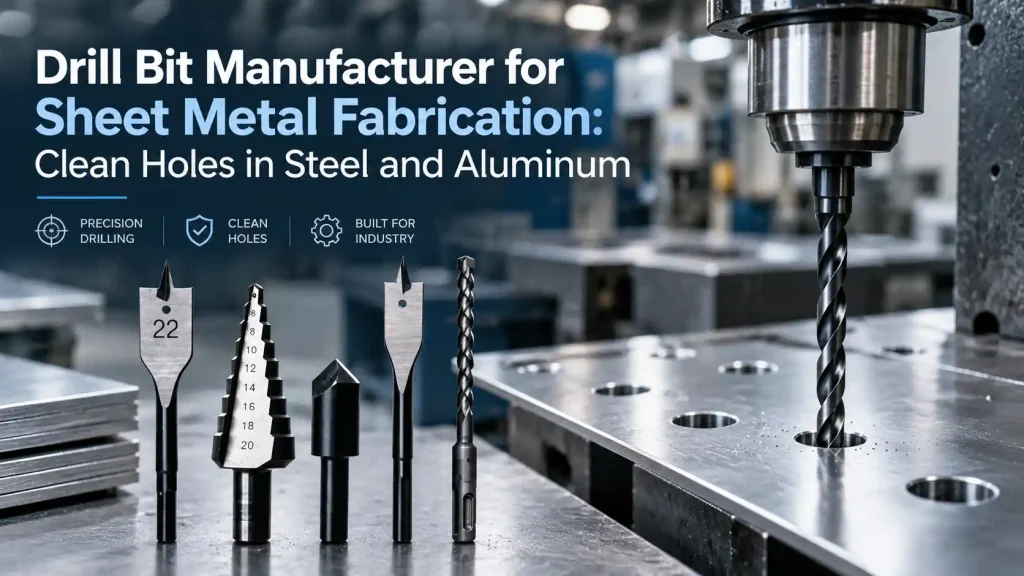
Sheet metal fabrication often looks straightforward until the same hole has to be produced again and again with the same quality. A mounting bracket, control cabinet, machine cover, aluminum panel, or metal enclosure may contain dozens of drilled holes, and even small differences in hole size, burrs, or edge condition can affect the next assembly step.
At BESTWIN, we manufacture drill bits for metalworking applications including steel and aluminum. For sheet metal work, we usually look beyond the nominal hole diameter because the material, sheet thickness, drilling equipment, production quantity, and required finish all influence how the drill bit should perform.
A suitable drill bit should cut cleanly, remove chips smoothly, control heat, and maintain stable hole quality over repeated use. In many fabrication applications, this is more important than simply choosing the lowest-priced bit or the hardest available material.
What Makes a Good Drill Bit for Sheet Metal?
For most sheet metal work, a good drill bit needs to do several things at the same time.
It should enter the surface without excessive wandering, cut efficiently through the material, remove chips without clogging, and break through the back of the sheet without creating unnecessary burrs or deformation.
This becomes especially important in repeated production.
A drill bit may work well for the first few holes but begin to produce larger burrs as the cutting edge wears. The operator may then need to increase pressure, which raises heat and makes the drill bit wear even faster.
The hole may still look acceptable at first, but the process is already becoming less stable.
In sheet metal fabrication, this can gradually affect:
- hole consistency
- bolt or rivet fit
- assembly alignment
- deburring time
- coating quality around the hole
- production speed
- drill bit replacement frequency
The useful question is therefore not simply whether a drill bit can cut steel or aluminum.
It is whether it can produce the required hole quality consistently under the actual production conditions.
Why Steel and Aluminum Need Different Drilling Conditions
Steel and aluminum are both common sheet materials, but they behave differently during drilling.
That difference has a direct effect on cutting temperature, chip formation, tool wear, and the final condition of the hole.
Mild Steel Usually Creates More Heat and Tool Wear
Mild steel is widely used in equipment panels, brackets, electrical enclosures, machine guards, support structures, and many other fabricated components.
During drilling, the cutting edge needs to remove material continuously while controlling heat.
As the drill bit becomes dull, the cutting force increases. The bit starts to rub more and cut less efficiently, which creates additional heat.
The first visible sign may not be tool failure. It may simply be larger burrs, slower drilling, or the need to apply more pressure.
For general mild steel sheet, HSS drill bits remain a practical choice because they provide a useful balance between cutting performance, toughness, and cost.
The drilling result still depends heavily on how the tool is used.
A sharp bit, suitable spindle speed, stable feed, secure workpiece support, and lubrication where necessary can normally produce a much cleaner and more consistent hole than the same bit used under unsuitable conditions.
Aluminum Is Softer, but Chip Control Becomes More Important
Aluminum is often easier to cut than steel, but that does not mean every drill bit will perform well in aluminum sheet.
One common issue is material sticking to the cutting edge.
When aluminum begins to build up around the drill bit, friction increases and chip removal becomes less efficient. The hole may become rougher, and drilling can feel less smooth even though the material itself is relatively soft.
Thin aluminum sheet can also move or flex more easily.
If the panel is not supported properly, the drill bit may pull the sheet upward near breakthrough. This can leave a rough exit edge or slight deformation around the hole.
For aluminum, keeping the cutting edge sharp and allowing chips to leave the hole smoothly is especially important.
Lubrication may also help reduce friction and material buildup in repeated drilling.
This is why we do not treat steel and aluminum as exactly the same application.
The hole diameter may be identical, but the cutting behavior is different.

Why Sheet Thickness Changes the Result
Sheet thickness is one of the most important details in drill bit selection because a thin panel and a thick steel plate behave very differently.
Thin Sheet Is More Sensitive at Breakthrough
Thin sheet does not provide much material to support the drill bit near the end of the cut.
As the point breaks through, the remaining metal becomes weak and the cutting edges can suddenly pull into the sheet.
This is when irregular holes, larger exit burrs, or local deformation are more likely to appear.
Secure clamping helps, and backing the workpiece can also improve stability.
The operator should also avoid forcing the tool through the last part of the material.
A sharp bit usually requires less pressure and gives better control.
This matters particularly for enclosure panels, thin brackets, decorative metal parts, light aluminum sheets, and other applications where the surrounding surface should remain flat.
Thicker Material Creates More Heat and Longer Chip Paths
As the material becomes thicker, the drill bit remains engaged in the hole for longer.
Heat and chip evacuation therefore become more important.
If chips are not removed efficiently, they can remain in contact with the cutting edge and increase friction.
This can shorten tool life and make drilling less stable.
In thicker steel, the effect becomes more noticeable because the cutting edge is exposed to greater heat for a longer period.
Suitable speed, controlled feed, chip removal, and lubrication where appropriate become increasingly important as the drilling depth increases.
This is also why two jobs using the same 8mm drill bit may still require different drilling conditions.
An 8mm hole in a thin aluminum panel is not the same job as an 8mm hole through a much thicker steel mounting plate.
How to Reduce Burrs Around Sheet Metal Holes
Burrs are one of the most common complaints in sheet metal drilling.
Some burr formation is normal, especially on the exit side, but large or irregular burrs often indicate that something in the drilling process needs attention.
A worn drill bit is one of the first things to check.
As the cutting edge loses sharpness, the bit removes material less cleanly. More pressure is required, heat increases, and the exit edge becomes rougher.
Drilling speed can also affect burr formation.
Running too fast may increase heat, while applying excessive pressure can make the drill break through too aggressively.
Workpiece support is another important factor.
If the sheet moves as the drill exits, the material can tear instead of being cut cleanly.
For thin sheet, this can make the difference between a small manageable burr and a distorted hole that requires additional finishing.
A practical way to control burrs is to look at the whole drilling process together.
The drill bit condition, spindle speed, feed pressure, workpiece support, material thickness, and breakthrough behavior should all be considered rather than trying to solve the problem by changing only one factor.
This is often more effective than simply moving to a more expensive drill bit.
Clean Holes Matter Beyond the Drilling Step
In fabrication, a drilled hole is rarely the final operation.
The part may still need riveting, bolting, tapping, painting, powder coating, welding, or final assembly.
Poor hole quality therefore creates work later in the process.
A large burr may prevent two surfaces from sitting flat against each other.
An oversized hole may reduce assembly accuracy.
An irregular hole can cause a rivet or fastener to sit differently from one component to another.
Heavy deburring can also slow production, especially when the same part contains many holes.
For painted or powder-coated parts, excessive burrs or rough edges may affect the coating around the hole.
This is why drilling performance should not be judged only by how fast the bit passes through the metal.
A slightly faster drill bit is not necessarily more efficient if every finished part then requires additional deburring.
In many production environments, a more useful comparison is to look at the overall drilling result, including drill bit cost, tool life, drilling speed, hole quality, deburring work, rejected parts, and the time lost when tools need to be changed.
Looking at these factors together gives a much more realistic picture of the actual cost of drilling.
How Drill Bit Wear Shows Up in Production
Drill bits usually show signs of wear before they fail completely.
One of the earliest signs is often a change in cutting feel.
A bit that previously entered the material smoothly may begin to require more pressure.
Drilling time may increase slightly.
Burrs may become larger.
The drill bit may also become noticeably hotter than before.
If production continues without replacing or resharpening the tool, these small changes can gradually affect hole quality.
This is why drill bit life should not always be measured only by the point at which the tool breaks.
For repeated sheet metal work, it is often more useful to judge tool life by how long the drill bit can maintain an acceptable hole.
Once burr size, drilling time, hole diameter, or cutting force begins moving outside the normal range, the drill bit may already be near the end of its useful production life.
This approach helps keep parts more consistent.
It can also reduce the amount of rework caused by continuing to use a drill bit that is technically still cutting but no longer producing the same result.
Is HSS Enough for Sheet Metal Drilling?
For many mild steel and aluminum applications, HSS drill bits are enough.
They are widely used because they offer a practical balance of hardness, toughness, and cost.
For general fabrication, maintenance work, workshops, enclosure production, brackets, panels, and similar applications, HSS often provides a suitable starting point.
However, the material being drilled still matters.
Harder steels, stainless steel, longer drilling cycles, or higher production quantities may place greater demands on heat resistance and tool life.
In these situations, a different drill bit specification may be more suitable.
The important point is not to assume that a more advanced drill bit is automatically better.
If a standard HSS drill bit can already produce clean holes at an acceptable speed and maintain suitable tool life, changing to a more expensive option may not improve the overall result enough to justify the additional cost.
We prefer to select the specification around the actual application.
The material, sheet thickness, hole diameter, machine, production quantity, and expected tool life usually tell us more than the product category alone.

What Affects Drill Bit Life the Most?
Drill bit life is usually influenced by several conditions working together.
Material hardness is one factor, but it is not the only one.
A good-quality bit used at excessive speed can wear quickly.
A sharp drill bit can still perform poorly if chips remain trapped around the cutting edge.
A suitable drill bit can also lose life quickly if the workpiece moves during drilling or if the spindle has excessive runout.
In repeated sheet metal production, the most stable results usually come from controlling several things at the same time.
The drill bit should match the material, the drilling speed should suit the diameter, the feed should remain steady, chips should leave the hole efficiently, and lubrication should be used when the application requires it.
This is especially important when drilling steel for long periods.
Heat builds gradually, and even a small change in cutting conditions can affect how quickly the edge begins to wear.
For aluminum, chip buildup can become the bigger concern.
If material starts sticking to the cutting edge, drilling quality may deteriorate even before visible wear becomes severe.
The goal is not simply to make the drill bit last as long as possible.
It is to keep it producing acceptable holes for as long as possible.
That difference is important in production.
When Should a Fabricator Change the Drill Bit?
There is no single replacement interval that works for every sheet metal application.
A drill bit used for occasional holes in thin aluminum may last a long time.
The same type of bit used continuously in thicker steel may need replacement much earlier.
Instead of relying only on a fixed number of holes, it is usually better to watch for changes in performance.
If drilling takes noticeably longer, burrs become heavier, more force is required, chips change appearance, or hole quality becomes less consistent, the tool should be checked.
In a production line, these signs can be recorded over time.
This makes it easier to establish a practical replacement interval based on actual working conditions.
The result is usually more reliable than waiting until the drill bit finally becomes unusable.
It also helps prevent one worn tool from affecting a large batch of finished parts.
What Should Be Considered When Buying Drill Bits for Repeated Sheet Metal Work?
For occasional maintenance, drill bit selection is relatively simple.
For repeated fabrication, consistency becomes much more important.
A drill bit that performs well in one sample is only useful if the same performance can be repeated across the rest of the batch.
Diameter accuracy, cutting edge consistency, hardness, heat treatment, surface finish, and manufacturing control all influence how one drill bit performs compared with the next.
For buyers ordering drill bits for regular production, it is therefore worth looking beyond the first sample.
The more useful question is whether the supplier can maintain consistent performance across repeated orders.
Material should also be considered realistically.
If most of the work is mild steel and aluminum, a general metal drill bit range may be suitable.
If a large percentage of the work involves harder materials, stainless steel, or longer drilling cycles, the specification may need to be adjusted.
Packaging and size combinations may matter for distribution, but they should come after the drilling requirement itself.
The first priority should always be whether the drill bit suits the material and working condition.
BESTWIN Drill Bit Manufacturer for Steel and Aluminum Fabrication
At BESTWIN, we manufacture drill bits for metalworking and other drilling applications.
For sheet metal fabrication, we normally begin with the actual workpiece rather than recommending a drill bit only from the required diameter.
Material type, sheet thickness, hole size, drilling machine, approximate daily quantity, and required hole quality all help determine what kind of drill bit will be more suitable.
If an existing drilling process already has a problem, that information is also useful.
Short tool life, large burrs, overheating, poor chip removal, material buildup, or inconsistent hole diameter can all point to different causes.
In many cases, the most suitable solution is not simply a harder drill bit.
A better match between the drill bit and the actual drilling condition often makes a bigger difference.
For steel and aluminum fabrication, our focus is on stable cutting, practical tool life, and consistent hole quality.
That is especially important when the same hole needs to be produced hundreds or thousands of times rather than only once.
Conclusion
Clean sheet metal drilling depends on more than choosing the correct diameter.
Steel and aluminum behave differently during cutting, thin and thick materials create different breakthrough conditions, and drill bit wear can gradually affect burrs, hole quality, and production speed.
For repeated fabrication, the more practical approach is to consider drill bit cost, tool life, drilling efficiency, hole consistency, deburring work, rejected parts, and production interruptions together.
This gives a much clearer picture of whether a drill bit is actually suitable for production.
At BESTWIN, we manufacture drill bits for steel, aluminum, and other metalworking applications with these real working conditions in mind.
Whether the application involves brackets, panels, enclosures, machine parts, or other fabricated components, the goal is the same: keep drilling stable, keep hole quality consistent, and make the tool perform reliably through repeated production.
FAQ
What drill bit is suitable for sheet metal?
HSS drill bits are commonly used for mild steel, aluminum, and many general sheet metal applications.
The most suitable specification still depends on the material, sheet thickness, hole diameter, drilling equipment, and production quantity.
Can the same drill bit be used for steel and aluminum?
In many cases, yes.
A general-purpose HSS drill bit can be used for both mild steel and aluminum, but the drilling conditions should be adjusted.
Steel usually creates more heat and wear, while aluminum requires greater attention to chip removal and material buildup.
Why does a drill bit grab thin sheet metal?
This usually happens near breakthrough.
As the drill reaches the back of a thin sheet, very little material remains to support the cutting edge. The drill bit can suddenly pull itself into the workpiece.
A sharp drill bit, stable clamping, backing support, and controlled feed can help reduce this problem.
Why do drilled holes have large burrs?
Large burrs can be caused by a worn drill bit, excessive speed, too much feed pressure, poor sheet support, spindle runout, or unstable breakthrough.
If burrs become larger as more holes are drilled, tool wear is often one of the first things worth checking.
Is HSS suitable for drilling steel sheet?
Yes.
HSS drill bits are widely used for mild steel sheet and general fabrication.
For harder materials, stainless steel, or more demanding production conditions, another specification may provide better heat resistance or tool life.
What drill bit works well for aluminum sheet?
A sharp drill bit with good chip evacuation is important for aluminum.
The main concern is often preventing material from building up around the cutting edge.
Suitable lubrication can also help in repeated drilling.
How can drill bit life be improved?
Use the correct drill bit for the material, maintain suitable drilling speed and feed, keep the workpiece stable, remove chips effectively, and use lubrication where required.
It is also important to replace the drill bit before excessive wear begins affecting hole quality.
What information helps when selecting drill bits for sheet metal?
The most useful information includes the material, sheet thickness, required hole diameter, drilling machine, approximate production quantity, and expected hole quality.
If the current drill bit has problems such as short life, heavy burrs, overheating, or inconsistent holes, those details can also help us determine a more suitable specification.







 English
  العربية
  Français
  Português
  Português do Brasil
  Italiano
  简体中文
简体中文  繁體中文
繁體中文  日本語
日本語  한국어
한국어  Deutsch
  Español
  Slovenčina
  ไทย
ไทย  Türkçe