
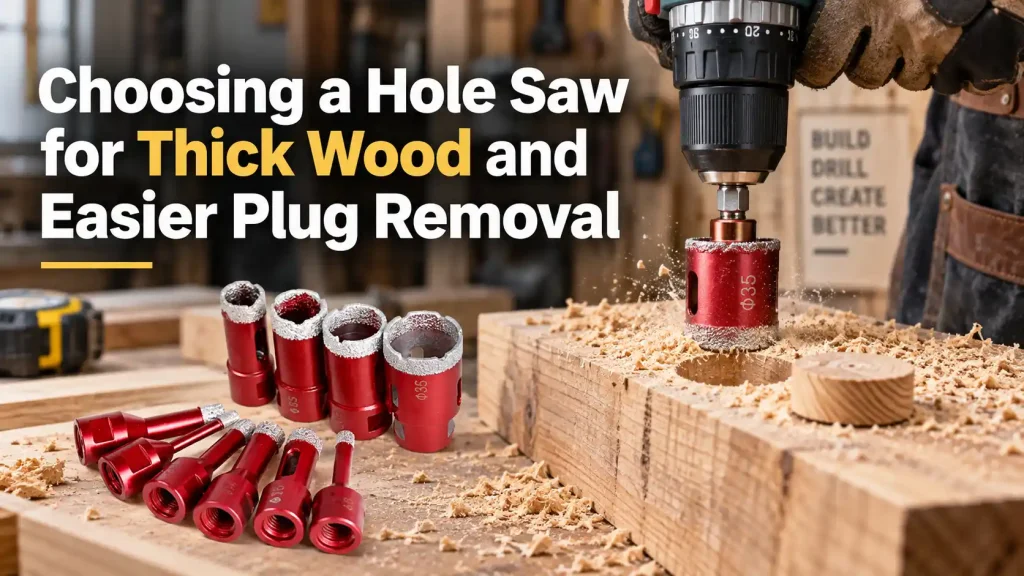
A thick timber desktop can expose a tool mismatch that never appeared on thinner boards. The circular cut starts normally, then progress stops while solid wood still joins the centre plug to the underside. On another piece, the cutter breaks through but holds the plug so tightly that clearing it takes longer than making the opening. For furniture workshops, joinery contractors, and distributors assembling woodworking ranges, these problems make cutting depth and plug access important purchasing details. A hole saw needs enough usable space for the actual stock, a suitable cutting edge, and an arbor arrangement that remains practical between repeated holes.
Quick Answer
Choose a hole saw for thick wood by comparing the maximum finished board thickness with the manufacturer’s rated cutting depth. Cup height, pilot length, and extension length describe different dimensions and cannot substitute for that rating. Then confirm that the teeth suit the timber or board material, the arbor fits both cutter and drill, and the plug can be removed with the supplied arrangement.
Where both faces are accessible, a properly aligned cut from each side may suit the work. Where only one face is accessible, the selected cutter needs an approved method and adequate depth for that condition. Bestwin supplies bi-metal cutters and matching accessories for woodworking applications.
Matching a hole saw to the board, opening diameter, and available drill helps narrow the choice before a sample cut.
Hole Saw Cutting Depth Matters More Than Cup Height
The useful dimension is how far the hole saw cutting edge can advance before the tool’s internal construction or another component limits the cut. A tall-looking cup does not establish a usable depth. Backplate thickness, the mounted arbor, and any ejector components can affect the available space. The published cutting-depth rating remains the starting point, followed by confirmation for the assembled combination.
A hole saw extension moves the complete cutting assembly farther from the drill. It can improve reach past an obstruction, but it does not make the cup deeper. Similarly, a longer pilot drill can establish guidance through thicker stock without allowing the surrounding teeth to travel through that stock in one pass. These distinctions matter when ordering replacement accessories by overall length.
Board thickness includes the finished build
Measure the finished section at the intended opening, including bonded layers that the cutter must pass through. A laminated top, edging detail, or local reinforcement can be thicker than the main panel. Separate loose sheets also behave differently from one bonded workpiece and require suitable support. Do not infer the whole cut from the thickness printed on one sheet’s label.
For a hypothetical comparison, a 45 mm finished panel exceeds a cutter rated for 38 mm of cutting depth, even if its outside body appears taller. A deeper rated option or a suitable two-sided approach is needed. Extra pressure cannot recover missing capacity, and choosing a different diameter does not automatically resolve the depth limitation.
Access determines the usable approach
A loose desktop can often be turned over. An installed worktop may have a support directly beneath the proposed opening, leaving no access for a second cut. Establish that difference before selecting the product. The same hole saw can be practical on an unassembled furniture panel and unsuitable once the panel is fixed into place.
Hole Saw Teeth Must Suit the Wood and Its Surface
Solid timber, plywood, and faced particleboard can require different compromises between cutting speed, edge appearance, and resistance to wear. A product described as suitable for wood may cover more than one of these materials, but its rating still needs to match the actual board. The cutting edge and the spaces that carry chips away both influence how the cutter behaves as engagement becomes deeper.
A bi-metal hole saw is a useful starting point where a workshop needs one product family for timber and other listed materials. Its suitability for a particular board follows the product’s material guidance, not the bi-metal label alone. Hardwood, resinous timber, and abrasive board faces can make a successful trial on softwood a poor predictor of the next job.
Coarser tooth arrangements can provide more space for larger wood chips. Finer or variable-pitch designs may offer a different balance of engagement and finish. Neither tooth count nor a claim of aggressive cutting is enough to choose a hole saw without considering the material thickness and the drill’s control. A visible furniture opening may justify slower production if it reduces edge repair.
Table 1. Product priorities for thick wooden parts
| Workpiece condition | Product detail to compare | Practical selection consequence |
|---|---|---|
| Thick solid timber | Rated depth and chip space | Choose capacity for the finished thickness and room to clear chips |
| Plywood or laminated board | Material approval and cutting-edge condition | Trial the actual face and bonded layers before repeat work |
| Finished desktop with two accessible faces | Pilot guidance and consistent cutter diameter | Consider a controlled two-sided cut with accurate alignment |
| Installed top with access from one face | Usable depth and assembly clearance | Select a cutter and method rated for the full accessible cut |
| Timber with suspected metal inclusions | Explicit material rating | Identify inclusions and confirm suitability before cutting |

Plug Access Affects Work Between Every Opening
In a deep cut, the central piece of wood occupies much of the cup. The remaining space can also collect compacted chips. Once the cut is complete, the plug may grip the pilot drill, press against the cup, or lodge at an awkward angle. This makes the design of a hole saw relevant after the teeth have finished their work.
Side slots in a hole saw provide access, but their presence alone does not promise easy removal. Compare their width, position, and accessibility with the expected plug thickness. An opening close to the backplate may be useful for a deep plug while giving little access to a shallow disc. The removal tool and method need to suit the manufacturer’s instructions without bending the cutting body or damaging its teeth.
Quick change and plug ejection are different features
A quick-change arbor usually simplifies attaching and releasing a hole saw. It does not necessarily push the plug out. Some arrangements provide a separate ejector or other removal feature, while others still require manual clearing. When comparing products, ask what each mechanism actually does and whether it works with the selected diameter, pilot drill, and cutting depth.
An ejector occupies physical space and has its own operating limits. Confirm whether the quoted depth applies with that accessory installed. There is little benefit in solving a removal problem with an attachment that leaves inadequate cutting capacity for the job. A hole saw assembly is best assessed as a complete combination rather than as several independently attractive components.
For repeat openings, include clearing and resetting time in a sample comparison. Two cutters may make a single hole at a similar rate yet differ substantially in the effort needed before the next cut. A straightforward cup and arbor that can be cleared predictably may be more useful than a larger kit containing an unproven release mechanism.
Hole Saw Arbor Fit Includes Both Connections
The arbor links the cutter to the machine and carries the pilot drill. Its fit determines whether the assembly can be mounted correctly and held concentrically. A compatible shank at the drill end does not establish compatibility at the cutter end. Thread size, engagement, any drive pins, and the recommended cutter-diameter range all need to agree.
Two common thread descriptions in our accessory range are 1/2-20 UNF and 5/8-18 UNF. These are connection specifications, not opening diameters. Check the actual cutter and arbor combination instead of assuming that all products described as universal share the same connection. A hole saw fitted to an incorrect adapter can have inadequate engagement even when it appears to screw into place.
As a hole saw supplier, Bestwin provides the BY600102 accessory range with different shanks, adapters, extension shanks, pilot drills, and plug-removal accessories. Those choices make the existing machine and desired cutter sizes useful information for matching. A photograph of the present arbor and its markings can help establish the starting point without requiring a complete technical drawing.
Pilot projection and machine clearance
The pilot tip needs to establish guidance before the teeth engage, according to the assembly instructions. Too little useful projection can make starting difficult; simply extending the pilot excessively introduces another unsupported condition. Check its secure mounting and the clearance beyond the far face, particularly when a finished panel rests on a bench or installed furniture contains hardware underneath.
A larger hole saw also needs a drill whose stated capacity covers that diameter and material. Low-speed operation, adequate control, and room for the assembled tool matter more than the battery-voltage label alone. An SDS-style connection does not mean percussion should be used. A toothed cutter for wood normally operates in rotary drilling mode with hammer action off, following the tool instructions.

A Sample Cut Reveals Whether the Depth Match Works
Use a representative offcut to evaluate the proposed hole saw combination before cutting a finished panel or committing to a repeat order. The offcut needs to match the thickness, material, face finish, and support conditions that matter in production. Testing a thinner piece removes the very depth constraint that the evaluation is intended to resolve.
A hole saw cuts an annular path and leaves a solid centre plug. That basic hole saw arrangement makes both chip removal and access to the retained wood relevant. A sample establishes whether the assembled cup has usable room throughout the cut and whether the chosen removal method remains accessible afterward.
Secure the workpiece and use the drill’s recommended auxiliary handle where required. Wear appropriate eye protection, keep hands clear of the underside, and disconnect power before changing the cutter or removing a lodged plug. If the assembly jams, stop and isolate the machine rather than repeatedly pulsing the trigger. These precautions also prevent an unstable setup from obscuring the product comparison.
One-sided and two-sided cuts require different evidence
For a one-sided opening, confirm that the hole saw can complete the required depth without the cup bottoming against retained material. Follow the manufacturer’s chip-clearing guidance and watch for a loss of cutting progress. If the assembly reaches its rated limit, forcing it farther risks damage and does not establish that it is suitable for deeper stock.
With access to both faces, the pilot hole can provide a reference for an accurately aligned second cut. The workpiece must remain securely supported after turning, and the two annular cuts need to meet on the same axis. This approach can also protect a visible exit face. It does not make unlimited thickness possible or guarantee that an inaccurately started hole will meet cleanly.
Compare the bore wall and the position where the two cuts meet. A step or ridge can interfere with a fitted sleeve even when the opening looks acceptable from above. The finished part, rather than the discarded plug, determines whether the cut is useful. The plug is smaller than the opening because the cutting path removes material between them.
Lost Cutting Progress Has Several Possible Causes
An abrupt stop at a repeatable depth can indicate inadequate capacity. A gradual loss of progress accompanied by packed chips may point toward clearance or edge condition. These observations help separate a product limitation from a setup problem. Replacing the hole saw with an identical unit will not solve a depth mismatch, while ordering a deeper version will not correct a loose arbor.
Heat, scorched wood, or excessive effort justify stopping to identify the cause. They are not reliable proof that the material requires a premium tooth alloy. A blunt edge, unsuitable speed, poor chip clearance, or misalignment can create similar symptoms. Begin with the visible condition and relate it to the specification that would change the product choice.
Table 2. Symptoms that affect cutter or accessory selection
| Observation during the sample | Possible issue | Detail to resolve before repeat use |
|---|---|---|
| Progress stops at the same depth | Rated capacity or internal obstruction | Cutting depth of the complete assembly |
| Packed chips and increasing effort | Clearance, edge condition, or operating settings | Tooth arrangement, slot access, and material guidance |
| Plug cannot be reached after cutting | Removal access does not suit plug thickness | Slot position or compatible ejector arrangement |
| Cutter runs visibly off centre | Seating, arbor damage, or machine connection | Correct mounting and concentric assembly |
| Second-side cut leaves a ridge | Alignment or workpiece movement | Pilot guidance and secure support from both faces |
Retire damaged components from the comparison. A bent pilot, cracked cup, missing tooth, or worn connection can invalidate an otherwise reasonable specification. Equally, a clean first cut does not establish useful life across a batch. The number of openings between noticeable changes depends on the material, diameter, operating conditions, and cutting-edge condition.
Hole Saw Kits Need the Right Depth Across All Sizes Used
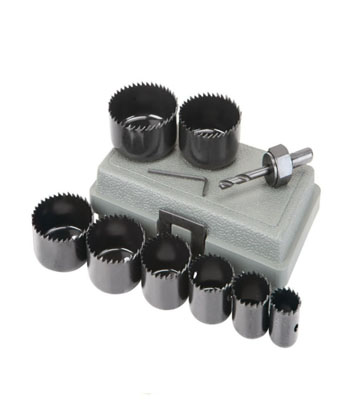
A hole saw kit is convenient when the work involves several recurring diameters, but the piece count does not describe its useful capacity. Accessories may be included in the total, and the actual cutter assortment may differ from expectations. Compare the listed diameters, cutting depths, arbors, and pilot drills with the openings that the workshop repeatedly makes.
For a desktop grommet, use the fitting manufacturer’s required cut-out dimension. The visible cap diameter is not necessarily the mounting-hole diameter. A sample with the intended fitting is valuable when the board face is fragile or the installation uses a close-fitting sleeve. Do not enlarge the opening simply to make plug removal easier.
Where one diameter accounts for most of the work, an individual replacement hole saw can complement the kit. That avoids changing a proven arbor arrangement whenever one size wears out. Store the assembled components and their identifiers so that later replacements retain the same thread, depth, and pilot arrangement. A similar-looking cutter from the same broad family may still have different usable dimensions.
Bestwin supports OEM orders and supplies woodworking cutters and accessories across its product range. As a cutting tool manufacturer, we can discuss the selected sizes and accessory combination alongside packaging needs. For a buyer comparing options, the board material, maximum thickness, intended openings, and current drill give a useful starting point; details can be refined as the product match develops.
Frequently Asked Questions
Does a longer extension increase cutting depth
No. An extension increases reach between the drill and cutter. The hole saw still has the same cup capacity and rated cutting depth. Use an extension only where the connection, diameter, and tool instructions permit it, and confirm that the complete assembly can be controlled in the available space.
Can a quick-change arbor remove every wood plug
No. Quick change describes the attachment mechanism, and plug ejection is a separate function unless the product explicitly combines them. Check whether an ejector is included, which cutter sizes it supports, and whether installing it affects the available cutting depth. Dense or wedged plugs can still require the specified manual removal method.
Is a carbide cutter always better for thick wood
Thickness alone does not determine tooth material. A wood-rated bi-metal hole saw can be suitable when its cutting capacity and operating guidance match the work. Carbide products also vary in design and approved materials. Compare the actual board, finish expectations, usable depth, and drill compatibility before changing product families.
Can the same cutter make a flat-bottom recess
A conventional hole saw cuts around a central plug rather than removing the complete bottom of a recess. It is therefore not the default choice for a clean, flat-bottom blind bore. Confirm the required hole form first; another woodworking cutter may be more suitable when the centre material must be removed to a controlled depth.
Match the Complete Cutter Assembly to the Finished Part
Thick wood makes usable depth, chip space, and plug access visible parts of product selection. Confirm those details together with the thread, pilot, and drill connection, then assess the complete cutting and clearing cycle on representative stock. Bestwin can match its hole saw range and related accessories to that information, helping workshops carry a suitable combination into the next order.










 English
  العربية
  Français
  Português
  Português do Brasil
  Italiano
  简体中文
简体中文  繁體中文
繁體中文  日本語
日本語  한국어
한국어  Deutsch
  Español
  Slovenčina
  ไทย
ไทย  Türkçe