
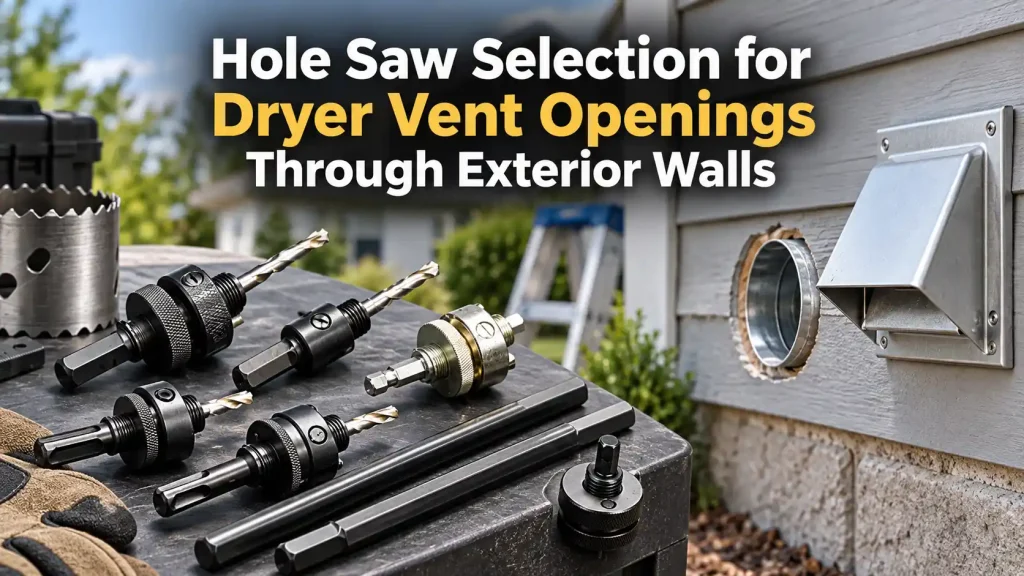
A dryer vent opening can become the most visible mistake in an otherwise tidy installation. The duct collar will not pass through the wall, the exterior hood cannot sit flat, or the finish splinters beyond the flange because the cutter was chosen from the duct’s nominal size rather than the actual fitting and wall build-up. For HVAC contractors, appliance installers, property-maintenance teams, and distributors, the useful question is not simply whether a large cutter is available. The hole saw must match the vent component, every layer in the wall, the available drill, and the finish expected on both sides. Those details determine whether one product is suitable for a single repair or a repeat installation program.
Quick Answer
Choose a hole saw for a dryer vent from the vent hood or wall sleeve manufacturer’s required cutout, not from the nominal duct diameter alone. Confirm the total wall construction, including drywall, sheathing, siding, and any air gap. Then match the cutter material, usable depth, arbor, pilot drill, and power-tool capacity to the layers that the cutter is actually intended to cross.
Bestwin manufactures hole-making tools for contractors, distributors, OEM programs, and maintenance supply. We can match a hole saw and arbor arrangement after reviewing the required opening, wall materials, drill interface, number of cuts, packaging, and replacement needs. The cutter is one part of a complete cutting assembly, and the approved sample should be judged with the real vent fitting.
Let the Vent Fitting Define the Cutout
Dryer duct is commonly described by a nominal diameter, but a completed wall opening must accommodate the component that passes through it. A wall hood may have a neck, seam, bead, collar, or transition that is slightly larger than the duct designation. A telescoping sleeve may also need working clearance. The installation drawing or product template therefore provides a better starting dimension for the hole saw than the name printed on a duct carton.
This distinction prevents two opposite problems. If a hole saw is too small, the installer may crush or deform the collar while forcing it through. If it is too large, the exterior flange may not cover the edge as intended, and the surrounding wall may offer less material for fasteners or sealing. A cut that looks circular can still be functionally wrong.
Record the required cutout as a finished-hole dimension, including its acceptable tolerance. Metric and inch sizes that appear close should not be treated as interchangeable without comparing the actual difference. A distributor assembling kits for several markets also needs clear size markings so that a 105 mm cutter is not casually substituted for a nearby inch size.
The flange footprint matters as much as the circular opening. It needs a reasonably flat surface and enough undamaged material around the cut. Lap siding, trim boards, wall corners, utility boxes, and exterior joints can restrict the location even when the hole saw cup itself fits. Product matching becomes much more reliable when the fitting drawing, wall section, and available cutting area are reviewed together.
Before releasing a size for repeat work, make one representative opening and install the actual hood or sleeve. The fitting should pass through without distortion, the flange should cover the cut edge, and the fastener positions should remain on sound material. That completed assembly is the useful acceptance standard for the hole saw diameter.
Wall Layers Decide Which Cutter Belongs in the Kit
An exterior wall is rarely one uniform material. The interior may begin with painted gypsum board, followed by insulation space, wood-based sheathing, and an exterior finish such as timber, vinyl, fiber cement, thin metal, stucco, or masonry. One hole saw should not be assumed to cut every layer simply because its diameter is correct.
For many drywall, plywood, oriented-strand board, and timber applications, a sharp bi-metal or appropriate HSS construction can provide a practical balance of cutting speed, edge quality, and durability. The product data still needs to cover the material and thickness. A cutter designed mainly for thin sheet metal can behave differently in deep wood, while an aggressive wood-cutting pattern may not be suitable for a steel facing.
Thin aluminum or steel siding introduces a different requirement. The panel can flex when the pilot enters or the teeth engage, producing chatter and a distorted edge. A material-rated bi-metal or carbide-tipped direction may be considered according to the specific siding, backing, diameter, and support. The hole saw must be run within the product maker’s guidance rather than selected only from the tooth alloy name.
Fiber-cement board, dense composites, stucco, brick, and concrete are more abrasive and may require a dedicated carbide, grit, diamond, core-drilling, or another approved cutting method. A general wood-and-metal cutter should not be pushed through an abrasive outer layer simply because it has already crossed the interior sheathing. Where one assembly cannot cover the complete wall, contractors may need separate material-rated cutters that share the same center reference.
The wall manufacturer, building requirements, and jobsite conditions can also restrict how an opening is made. The supplier can match cutters to declared materials, but the cutter cannot confirm whether the proposed location is clear of structural framing, electrical wiring, plumbing, or other concealed services. Those checks belong to the installation plan before any product is approved.
Table 1. Product Direction by Wall Condition
| Wall cutting condition | Product direction to discuss | Information needed before selection |
|---|---|---|
| Gypsum board over wood sheathing | Material-rated bi-metal or HSS cutter | Total board thickness, sheathing type, finish quality |
| Solid timber or engineered wood wall | Wood-capable cup with sufficient usable depth | Species or board type, thickness, entry and exit finish |
| Vinyl or thin aluminum siding over wood | Cutter suitable for the siding and backing layers | Siding profile, support, sheathing, cut direction |
| Thin steel cladding over framed wall | Metal-rated bi-metal or carbide-tipped option | Steel grade, thickness, coating, backing clearance |
| Fiber-cement or abrasive composite board | Dedicated cutter confirmed for the material | Board brand or composition, thickness, dust controls |
| Brick, block, concrete, or heavy stucco | Approved masonry or core-drilling method | Substrate, wall depth, reinforcement, project requirements |
Large Diameters Need More Than a Powerful Drill
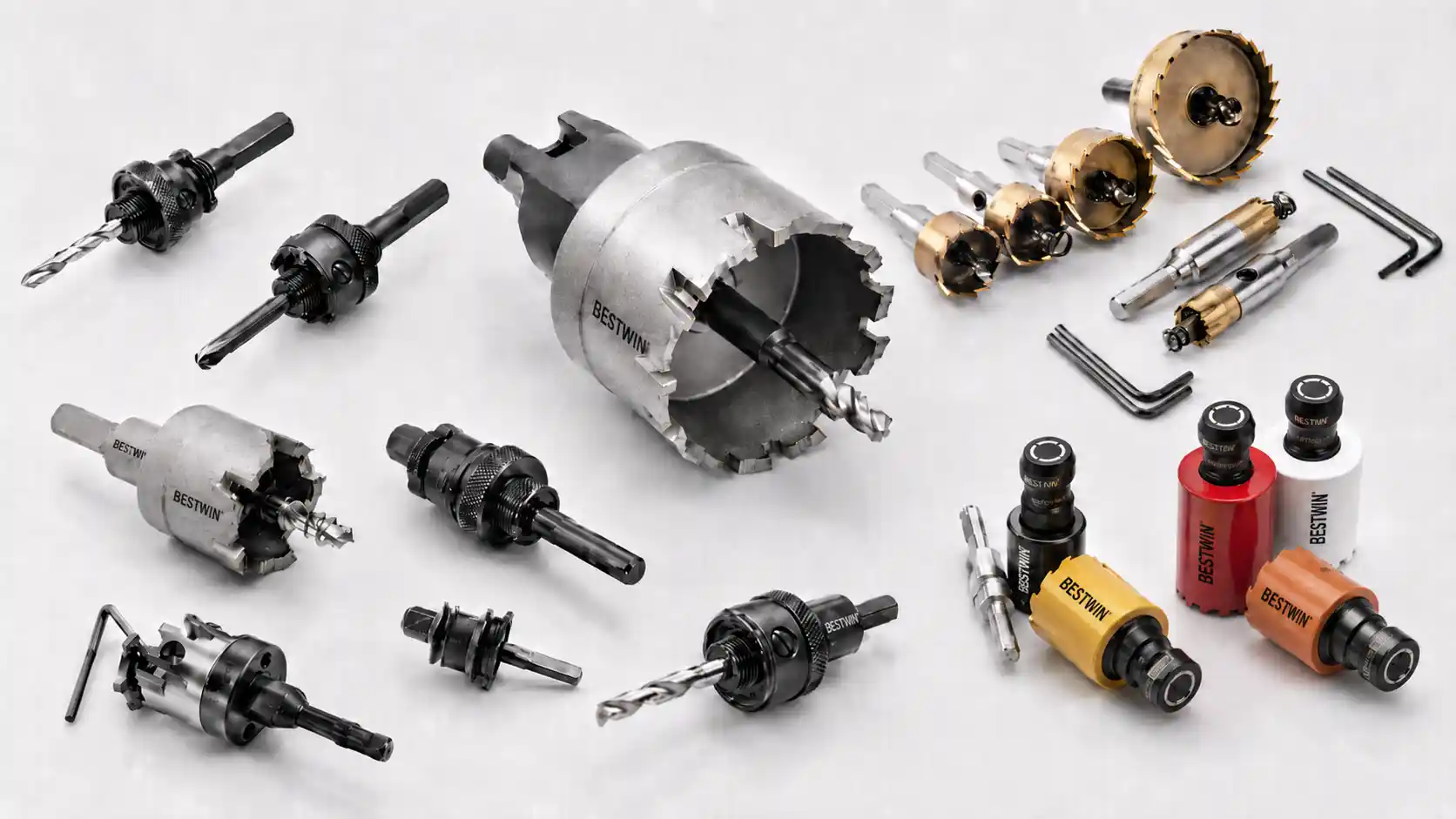
A dryer vent opening is much larger than an ordinary fastener hole. As diameter increases, the cutting edge travels farther during every revolution and the reaction torque at the drill becomes more noticeable. The selected hole saw must be compatible with a drill that provides suitable speed control, torque, chuck capacity, and operator control for that diameter and material.
High speed is not a substitute for cutting capacity. Excessive speed can heat the teeth, polish rather than cut the surface, soften some plastics, or discolor a coated panel. Very light feed can also create rubbing, while forcing a dull or unsuitable cutter increases the chance of grabbing. The correct operating range comes from the specific hole saw instructions, adjusted for diameter and material rather than copied from a smaller cutter.
The drill body and handles need room to stay square to the surface. In a laundry closet, mechanical room, or exterior corner, the theoretical opening position may leave too little space to control the tool. A large hole saw that enters at an angle can widen the opening and damage the visible face before the full circumference is established. Tool access therefore affects product suitability, not just operator convenience.
An arbor with a secure shank helps transfer torque, but shank shape alone does not prove that the complete assembly is approved for the work. A hex connection may improve grip in a compatible chuck. It does not mean percussion or impact action is permitted. Toothed hole saw systems normally rely on controlled rotary cutting unless the product instructions specifically state otherwise.
For repeat contractor work, the sample evaluation should include the actual drill model and normal site position. A hole saw that performs acceptably in a drill press may not produce the same result overhead or against an installed wall. The purchasing decision should reflect the tool and access conditions that crews will really use.
Usable Depth Must Match the Wall Build-Up
Cup height, overall product length, extension length, and usable cutting depth describe different things. The important value is how far the cutting edge can advance through the intended material before the cup, backplate, arbor, or retained plug limits progress. A tall-looking hole saw is not evidence of adequate capacity.
A framed exterior wall is normally deeper than a standard cutter. That does not automatically require one cup to remove the full wall section in a single pass. Many installations use a pilot reference and controlled cutting from both faces, but the method must suit the wall construction, the fitting, and site requirements. The selected hole saw still needs enough depth for the material it will cut from each side.
Depth also affects plug removal. Wood chips and a thick center plug can fill the cup before the edge reaches its rated limit. Slots in the body may provide access, yet their position and size determine whether the retained material can be removed conveniently. For repeat jobs, clearing time between cuts can matter as much as the first cutting speed.
An extension changes reach between the drill and cutter; it does not increase the cup’s cutting capacity. It can also add leverage and magnify runout if the connection is loose. Extensions make sense only when the approved components remain controllable and the extra reach solves a genuine access problem.
The pilot drill projects ahead of the teeth and can enter the wall cavity long before the cup completes the cut. Its required guidance length must be balanced against rear clearance. A long pilot should not be used as a substitute for inspecting the cutting path. The hole saw assembly cannot protect concealed wiring, pipework, studs, or ductwork that has not been located.
Arbor and Pilot Fit Control the Finished Opening
The arbor connects the cup to the drill, holds the pilot, and transfers the cutting load. Thread size, engagement, drive pins, locking features, shank dimensions, and supported cutter range all influence whether the assembly runs concentrically. Two products with the same nominal diameter may require different arbor arrangements.
A loose or poorly seated connection allows the hole saw to orbit around the intended center. The finished opening may then be larger than the label on the cup, and the entry edge can become uneven. Before changing to a smaller cutter, inspect the arbor, pilot, chuck grip, and cup seating. Downsizing does not correct mechanical runout.
The pilot needs to establish the center before the teeth touch the surface. If it is bent, blunt, or insecure, the cup can walk across paint, paper facing, or siding. Excessive projection can introduce flex and unnecessary reach into the cavity. Product approval should therefore record the pilot specification together with the hole saw and arbor rather than treating it as a generic consumable.
Quick-change systems can benefit contractors who work with several recurring vent, pipe, cable, and fan-opening sizes. The value depends on a stable connection and clear compatibility across the chosen cups. Quick change does not automatically mean quick plug ejection, so those functions should be evaluated separately.
Bestwin provides standard arbor and accessory options for matching different cutter sizes and drill interfaces. For a hole saw manufacturer reviewing a contractor or distributor program, photographs of the current drill chuck and arbor markings can help clarify compatibility. The product list should state which arbor covers each diameter and which replacement pilots are included.

Entry and Exit Quality Matter on Finished Walls
The visible side of a wall may be painted drywall, finished timber, laminated board, coated metal, or siding that will remain in view around the vent flange. Even when the flange hides part of the cut, damage extending beyond its footprint creates rework. Tooth condition, centering, support, and the way the cup first contacts the surface all influence that edge.
On a brittle or decorative face, a shallow scoring pass may help establish the circle when the hole saw and material instructions permit it. The tool must remain square and controlled. Tilting the cup to make one tooth bite first can create a wandering groove or an oversized opening, especially at large diameters.
Exit damage often appears when the last fibers or thin panel section can no longer resist the cutter. Cutting from the second face using an accurately located pilot reference can improve the finish in suitable wall constructions. The practical choice depends on access to both sides, cutter depth, wall layers, and the risk of damaging the exterior finish.
Wall cavities add another complication: loose insulation and debris can pack around the pilot or cup. The cutting path and work area need to be prepared according to the project method. Product selection should not assume that a tooth pattern intended for solid wood will behave identically when it meets paper, insulation, thin siding, and an air gap in sequence.
In general hole saw construction, the annular edge removes a ring and leaves a center plug. That makes large openings more practical than removing the whole diameter as chips, but it also makes plug clearance, pilot guidance, and usable cup depth part of the purchasing specification.
Sample the Complete Wall and Vent Assembly
A sample made in a single plywood offcut provides only limited evidence if production walls include drywall, sheathing, siding, and coatings. The most useful test panel reproduces the material layers, thicknesses, support, and visible finish expected on site. It also uses the intended drill, arbor, pilot, and hole saw as one complete hole saw assembly.
First inspect whether the cutter starts on center and runs without visible wobble. Then monitor chip formation, heat, vibration, and the ease of clearing the cup. A slower first hole is not necessarily a product failure if the wall contains several layers, but smoke, burning, polished teeth, chipped carbide, or severe chatter indicate that the selection or operating condition needs review.
After the cut, measure the finished opening rather than relying on the nominal cup marking. Inspect the entry edge, exit edge, exposed layers, and surrounding surface. Remove any normal finishing allowance required by the project before fitting the real vent hood or sleeve. The flange should cover the edge, the collar should pass through without being crushed, and the fasteners should land on suitable material.
The sample should also be repeated. One clean opening does not establish useful life for a contractor pack or distribution program. Compare several cuts for changes in cutting time, edge quality, tooth condition, arbor tightness, and plug-removal effort. For batch supply, keep the approved sample, item code, arbor, pilot, and packaging specification together so repeat orders use the same reference. A hole saw supplier needs the expected number of openings and wall mix to recommend a realistic product direction.
Table 2. Sample Results That Change Product Selection
| Sample observation | Details to review | Purchasing response |
|---|---|---|
| Opening is larger than expected | Arbor runout, pilot condition, cup seating, drill angle | Correct the assembly before changing diameter |
| Paper or veneer tears outside the flange | Tooth condition, entry stability, surface support | Compare a sharper material-rated cutter and sample again |
| Teeth rub and the cup becomes hot | Speed, feed, edge condition, material compatibility | Use the product guidance and reassess cutter type |
| Progress stops at a repeatable depth | Usable cup depth, retained plug, internal obstruction | Confirm rated capacity or divide the cut appropriately |
| Thin siding deforms or chatters | Backing support, cutter geometry, breakthrough control | Test a cutter suited to the panel construction |
| Plug removal takes longer than cutting | Slot access, chip packing, cup depth, arbor features | Include clearing time and replacement accessories in comparison |
| Vent collar does not pass or flange does not cover | Actual fitting dimensions, finished cutout, wall finish | Reconfirm the component template and allowed tolerance |
Kits Should Reflect Real Contractor Work
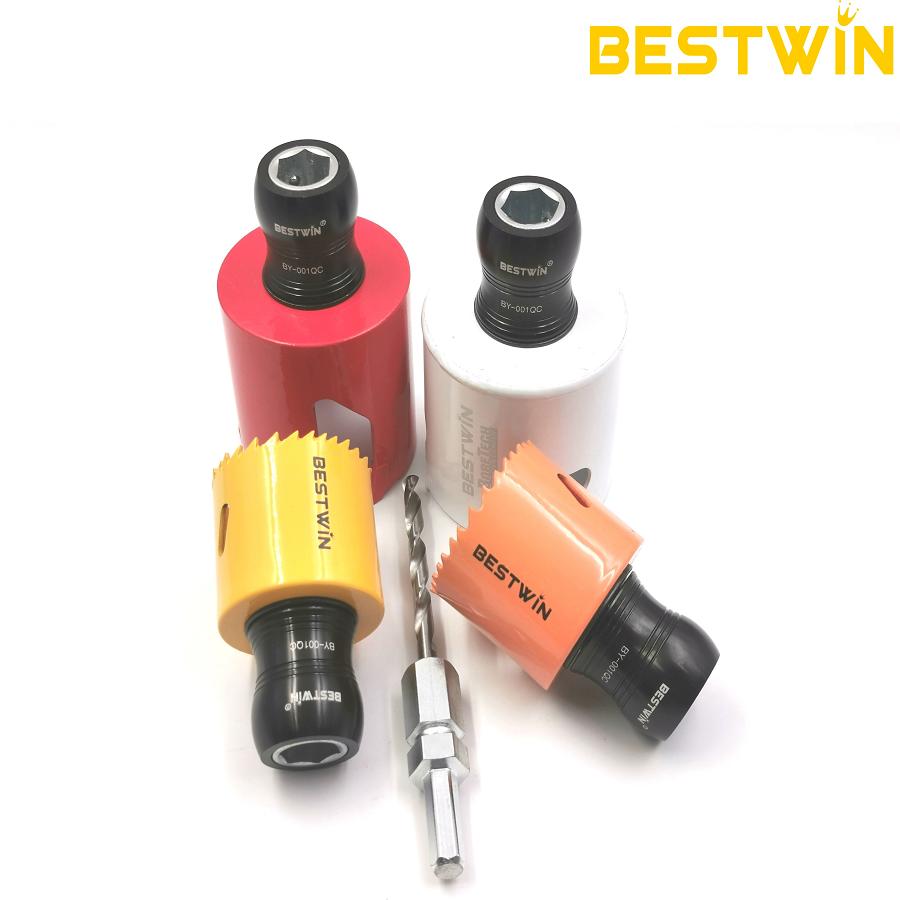
A large piece count can look attractive without covering the diameters that installers actually use. Accessories may be included in the advertised total, and several cups may remain unused while one large vent size wears repeatedly. A practical kit begins with the jobs it must support, then maps each opening to a hole saw, compatible arbor, and replacement pilot.
Dryer vent work may sit beside bathroom-fan ducts, cable passages, drain lines, and service openings in a contractor’s normal schedule. Those related tasks can justify a broader assortment, but they should not be used to inflate the kit with random sizes. Each hole saw needs a clear material and application range, and the arbor coverage should be visible without trial assembly on site.
For distributor stock, single-size replenishment can be more important than the original case. Contractors often wear one or two common cups faster than the rest. Stable item numbers, readable metric or inch markings, and separate replacement pilots help preserve a proven setup without replacing the entire kit.
Packaging also protects the cutting edge. Cups, pilots, and arbors should not strike one another loosely during transport. A divided case or molded tray makes inventory easier and reduces the chance that a damaged pilot is paired with a good cutter. Where OEM branding or private-label packaging is required, the label should preserve the critical diameter, product family, compatible arbor, and intended materials.
Bestwin can discuss individual cups, compatible accessories, and set composition for project, wholesale, and OEM supply. A productive review starts with the actual cutout sizes, wall materials, drill interface, expected quantities, and refill plan. The aim is a hole saw assortment that supports repeat jobs, not simply the largest possible case.
Order Details That Improve Product Matching
Providing a short application record helps a hole saw supplier narrow the product family without turning the inquiry into an engineering exercise. Begin with the vent hood or sleeve model and its specified cutout. Add photographs or a simple wall-layer description so the cutter is not matched to drywall while the exterior face is actually fiber cement or coated steel.
Useful information includes the thickness of each layer the hole saw will cut, whether both sides are accessible, and which surface remains visible. The drill type, chuck capacity, preferred shank, and any current arbor identifiers clarify the machine connection. State whether the order supports occasional maintenance, contractor kits, wholesale stock, or repeated project installation.
Quantity and packaging affect the recommended supply format. A distributor may need mixed master cartons and retail labels, while a contractor may prefer individual refills for the most-used diameter. OEM programs may also require color, marking, case layout, barcode, and sample approval. These details can be refined after the initial product direction is clear.
An initial inquiry can begin with the fitting, target diameter, wall materials, drill, and expected quantity. We can then identify which additional measurements or samples would help confirm the hole saw, arbor, and pilot combination.
Frequently Asked Questions
Is the nominal duct diameter the correct cutter size
Not necessarily. The vent hood, wall sleeve, seam, or collar may require a larger cutout than the nominal duct. Use the component manufacturer’s cutout dimension or template, then verify the result with the actual fitting before releasing the hole saw size for repeat work.
Can one hole saw cut every layer of an exterior wall
Only when the specific product is rated for every material it will meet and has adequate usable depth. A wall that combines drywall, wood sheathing, metal siding, fiber cement, stucco, or masonry may require separate material-rated cutters or another approved method.
Does an extension make the cutter cut deeper
No. An extension increases reach between the drill and the hole saw. It does not increase the cup’s usable cutting depth or plug capacity. Confirm the depth of the complete assembly and whether cutting from both faces is appropriate for the wall.
Is a bi-metal cutter always the best choice
Bi-metal is versatile for many wood, drywall, plastic, and metal situations, but it is not universal. Abrasive boards, masonry, hard metal, or special finishes can require another cutter construction. Match the actual material and sample result rather than relying on one alloy label.
What belongs in a contractor or distributor kit
Include the diameters that correspond to recurring fittings, an arbor that covers those sizes, suitable pilot drills, and clearly identified replacements. Confirm product material ranges, usable depths, case protection, and refill availability instead of judging the kit only by piece count.
Match the Cutter to the Finished Vent Opening
A reliable dryer vent opening starts with the actual hood or sleeve, then works backward through the cutout, wall layers, visible finish, cutter construction, usable depth, arbor, pilot, and drill. Representative samples show whether that complete assembly produces a covered, serviceable opening across repeated cuts. Bestwin can match a hole saw and accessories to the stated materials, sizes, tool connection, packaging, and order plan, supporting contractor, distributor, OEM, and repeat-supply needs.










 English
  العربية
  Français
  Português
  Português do Brasil
  Italiano
  简体中文
简体中文  繁體中文
繁體中文  日本語
日本語  한국어
한국어  Deutsch
  Español
  Slovenčina
  ไทย
ไทย  Türkçe