
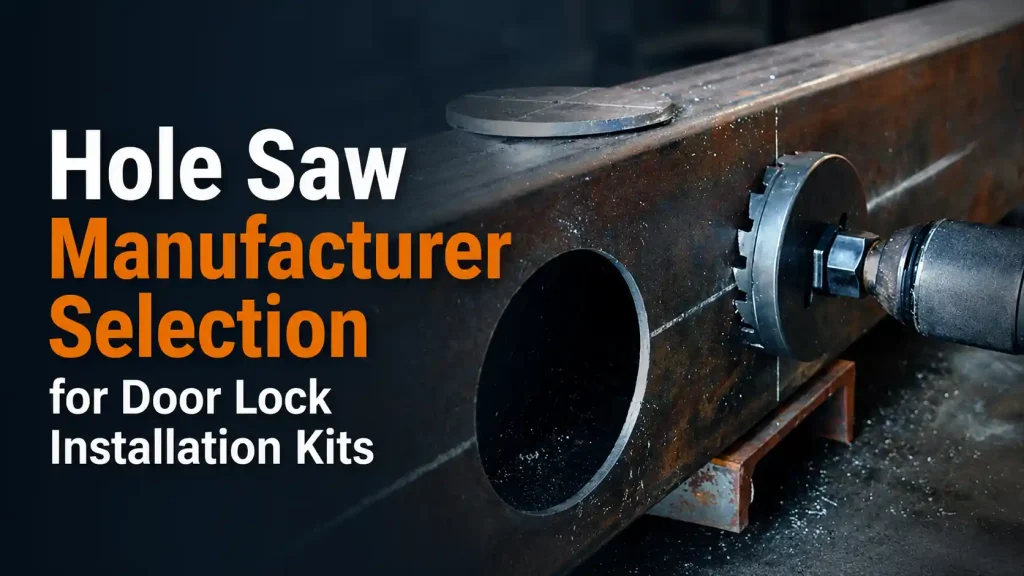
Door lock installation is one of the most familiar uses of a hole saw, yet a reliable commercial kit needs more than one diameter printed on the case. Tubular locks, cylindrical locksets, deadbolts, latch plates, and access hardware can require a face bore through the door plus an edge bore for the latch. Wood, engineered timber, steel skins, reinforcement, coatings, and existing preparation all influence the cutter, pilot, arbor, and set layout. The correct product program therefore follows the door, lock template, drill, and purchasing plan together.
Quick Answer
As a hole saw manufacturer, we match a door-lock kit to the lock template, required face and edge openings, door material, thickness, internal construction, visible-surface limit, drill interface, pilot and arbor, expected installation volume, refill plan, and OEM packaging. This keeps a common application practical for installers, door factories, hardware distributors, maintenance teams, and branded tool programs.
At Bestwin, we manufacture and supply hole saws, arbors, pilots, sets, and related cutting products for distributors, OEM customers, and professional users. Our hole saw manufacturer work connects the approved cutting system to a defined door and lock family instead of treating every door as plain timber and every nominal lock size as interchangeable.
Start with the Lock Template and Finished Openings
The lock or hardware template is the first technical document. It identifies the centerline, backset, face-bore diameter, edge-bore diameter, door-thickness range, latch dimensions, and any additional preparation. A familiar trade description does not replace the actual drawing because product families and regional practices can differ.
Our hole saw manufacturer review requests the lock model or template together with the door specification. We distinguish the large face opening from the smaller edge opening and identify whether the fitting requires a simple clearance hole, a tight location, or additional routing and drilling completed by other tools. This prevents a kit from being built around assumed dimensions.
Finished fit matters more than the number stamped on a cutter. The lock chassis, trim, latch, sleeve, screws, and reinforcement must assemble as intended. Acceptance can include diameter, roundness, alignment between face and edge bores, visible chipping, burrs, coating marks, and whether the real hardware seats correctly. The hole saw manufacturer sample should be checked with the actual lock components.
Backset and centerline are layout conditions, not cutter specifications. A commercial kit may include a guide or may be sold for use with a customer-approved jig. We need to know the intended locating system because pilot engagement, door-edge access, and drilling direction can change. The tool program must be compatible with that system without implying that the cutter alone controls the complete installation.
Table 1. Door-Lock Openings and Product-Matching Information
| Opening or condition | Typical function | Information we request |
|---|---|---|
| Large face bore | Lock body, deadbolt, or cylindrical chassis | Template diameter, door thickness, material, visible faces |
| Edge bore | Latch or bolt path | Template diameter, edge construction, alignment method |
| Timber door | Interior or exterior lock installation | Species or engineered core, veneer, finish, thickness |
| Steel-skinned door | Commercial, service, or security door | Skin thickness, reinforcement, core, coating |
| Replacement preparation | Existing or damaged opening | Current dimensions, new hardware, remaining support |
| Factory production | Repeated door and lock family | Fixture, machine, cycle volume, inspection limits |
| Field installation | Portable drilling on finished doors | Drill, access, protection, kit and refill needs |
This map gives the hole saw manufacturer a real selection boundary. A set approved for an unfinished timber door should not automatically become the production choice for a steel-skinned commercial door or an existing opening with limited support.
Door Material Changes the Cutter Direction
Solid wood, softwood, hardwood, plywood, medium-density fiberboard, particleboard, molded composite skins, metal skins, mineral cores, foam cores, and internal reinforcement behave differently. Veneers and decorative laminates can chip. Painted surfaces can mark. Steel skins create heat and metal chips. Hidden reinforcement can suddenly change the cutting load.
As the hole saw manufacturer, we ask for the door construction rather than the broad word “wood” or “metal.” Useful information includes face material, core, edge blocking, reinforcement, thickness, finish, and whether the opening passes through more than one layer. A cross-section or supplier specification is valuable for commercial doors.
Bi-metal hole saws can provide a flexible direction for mixed installation programs when the declared wood, plastic, and metal conditions fit the chosen product. HSS and carbide-tipped directions can serve other defined material or production requirements. Tooth form, body depth, chip clearance, pilot, and machine compatibility still need to be matched; material labels alone do not approve a cutter.
A metal skin over a timber or composite core deserves particular attention. The cutter can move from one chip type and cutting load to another during the same opening. The hole saw manufacturer sample should reproduce the complete material stack, not only a loose steel coupon or a plain board.
Door Thickness and Cutting Depth Are Separate Checks
Door thickness determines how far the cutting system must reach, but nominal body depth is not the only consideration. The pilot must engage appropriately, the arbor and chuck must clear the locating guide, chips need an exit path, and any reinforcement or internal void can affect progress. A thick decorative trim or jig can also reduce usable reach.
Our hole saw manufacturer inquiry records door thickness, cutting direction, guide thickness, cutter body depth, pilot projection, arbor configuration, and the clearance behind the work. If the application is intended to be completed from two faces under an approved process, that condition should be part of the sample plan rather than an unspoken assumption.
The edge bore has its own depth and access conditions. The narrow door edge provides less supporting area, and the latch path must align with the face preparation. The product system should match the edge material and jig while maintaining clearance for the drill and arbor.
Replacement installations require extra caution because an existing opening may reduce pilot support. The new lock template, current hole, remaining door material, and approved guide determine whether a standard piloted system is suitable. We treat this as a separate hole saw manufacturer application condition, not as an automatic extension of new-door work.
Bi-Metal, HSS, and Carbide Directions Need Defined Boundaries
Different cutter families can appear in door-hardware programs, but they are not universal substitutes. Bi-metal construction can suit broad professional kits where several approved materials are encountered. HSS or carbide-tipped products can be matched to other material, machine, and volume requirements. The decision depends on the actual door stack, cutting diameter, finish, drill, and expected holes.
Our hole saw manufacturer selection identifies an intended material range and operating boundary for each code. A distributor may need one general installation set for common timber and light metal-skinned doors plus separate products for higher-volume metal work. A door factory may prefer a narrower product specification tied to a repeat material and fixture.
Tooth construction affects entry, chip formation, heat, and cutting load. Body depth affects whether the cutter can clear the specified stack. Slots can influence chip and plug handling. The arbor connection and pilot determine how the assembly starts and transfers torque. These features must be reviewed as one system.
We avoid promising one cutter for every door. A hole saw manufacturer program is stronger when the approved materials, door thicknesses, lock families, and machines are visible in product codes and instructions. That gives purchasing and users a clear reason to select the correct set or refill.
Pilot, Arbor, Shank, and Drill Form One Cutting System
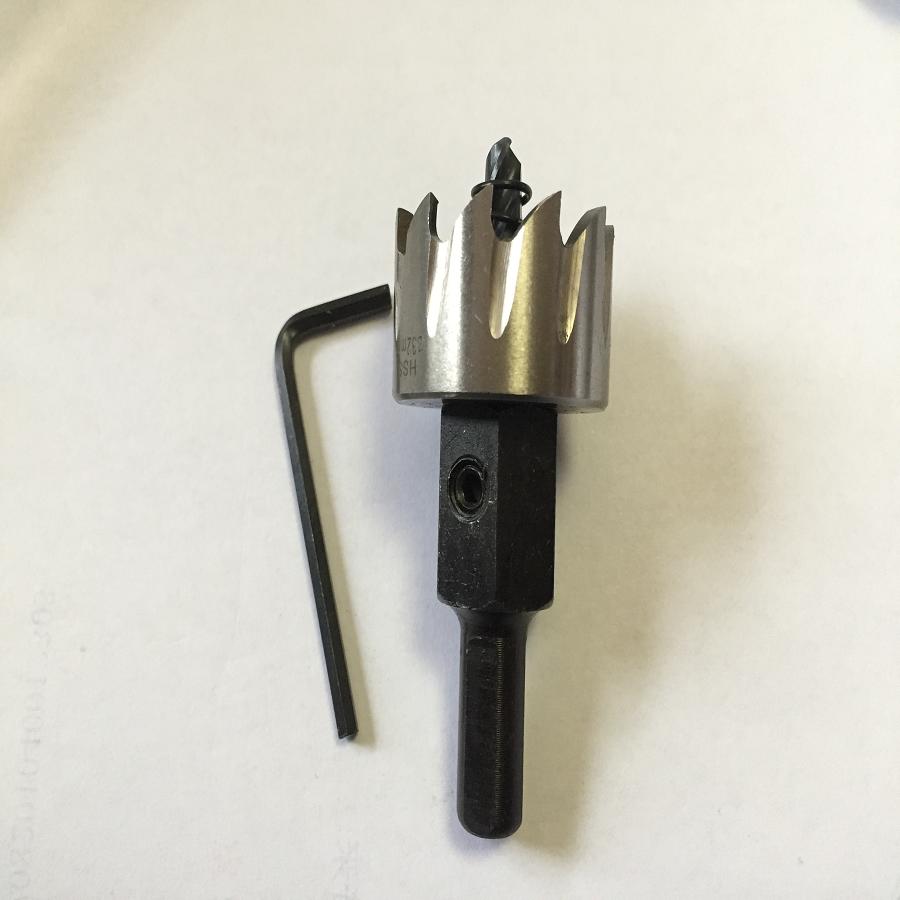
The cutter body is only one part of a door-lock kit. The pilot establishes the starting path, the arbor transfers torque, and the shank connects the assembly to the drill. Pilot diameter and projection, arbor thread or locking method, shank shape, chuck capacity, and runout can affect location, vibration, edge quality, and user control.
Our hole saw manufacturer review asks for the corded drill, cordless drill, drill press, or factory fixture used in the program. We request chuck type and capacity, speed range, available torque, guide system, and whether the work is field-installed or production-held. A shank can fit a chuck physically while still being a poor match for the diameter and load.
The pilot and cutter should be compatible with the intended guide. Some door-lock kits use a locating jig that constrains the face and edge openings. Others rely on the hardware template and a separate layout system. We match the cutting assembly to the declared arrangement and keep the jig or fixture approval within the customer’s installation process.
Arbor and pilot replacement should be part of the commercial plan. These parts do not necessarily wear or become damaged at the same rate as cutters. Separate codes allow a distributor, factory, or maintenance team to replenish one component without replacing the whole kit. The hole saw manufacturer quotation can show set and refill lines independently.

Visible Faces Need a Clear Acceptance Limit
Door surfaces can be unfinished, painted, veneered, laminated, wrapped, galvanized, powder-coated, or covered by protective film. The lock trim usually covers part of the opening, but it should not be assumed to hide every chip, scratch, burr, or witness mark. The visible limit depends on trim diameter and final appearance requirements.
As a hole saw manufacturer, we ask which faces are visible, whether both sides are finished, what trim covers the bore, and what rework is allowed. A sample can be assessed for chipping, delamination, coating lift, entry marks, exit burr, roundness, and actual lock fit. The customer decides the final acceptance boundary.
Thin steel skins can flex, and decorative veneers can break away near exit. Stable support, compatible feed, correct speed, and an approved drilling sequence matter. We provide product-specific information where available, while the door manufacturer or installer establishes safe workholding and process controls for its workplace.
The hole saw manufacturer product choice cannot replace a sound locating jig or door support. However, the cutter must be validated with the support condition planned for production or field installation. Testing only on a loose scrap may not reproduce vibration or breakout on a complete door.
Face and Edge Openings Must Align as an Assembly
The face bore and edge bore serve different parts of the lock but must meet in the intended location. A clean large opening is not sufficient if the latch path is displaced, and a correct edge diameter does not compensate for an incorrect backset. The lock template, guide, pilot, and door support work together.
Our hole saw manufacturer sample plan records both cutter sizes and the approved locating system. Acceptance uses the real lock chassis and latch so alignment is judged by assembly, not by visual impression alone. This is particularly important when one kit serves several door thicknesses or hardware models. The hole saw manufacturer sample record identifies the exact template revision used for that decision.
A professional kit may benefit from clearly separated face-bore and edge-bore positions in the case. Size markings, product colors, labels, or molded locations can reduce confusion. If multiple lock standards are included, the compatibility chart should identify which cutter and guide combination applies to each supported template.
For factory work, inspection can use a go/no-go gauge, fixture check, or assembly sample defined by the customer. For field work, the kit documentation can emphasize template verification and component identity. The hole saw manufacturer supplies the matched cutting products, while the hardware and door owner defines the final installation acceptance.
Common Kits Should Be Built Around Real Lock Programs
A useful door-lock set includes the diameters and interfaces used in the customer’s actual hardware program. Adding many unrelated sizes can make the case heavier and more expensive without helping the installer. Omitting a frequently used edge-bore cutter, pilot, or arbor can force an immediate separate purchase.
Our hole saw manufacturer set review uses a lock map. It records hardware family, template revision, face opening, edge opening, door material, thickness, guide, drill, expected installation count, and refill demand. The result can be a two-opening installer kit, a broader maintenance assortment, a door-factory station set, or an OEM-branded retail package.
Table 2. Door-Lock Kit Formats and Purchasing Logic
| Program type | Set direction | Refill logic |
|---|---|---|
| Common residential locksets | Face and edge cutters with matched arbor and pilot | Stock high-use cutter sizes separately |
| Commercial wood-door program | Products tied to approved lock and door families | Refill by installation volume and wear record |
| Steel-skinned door program | Metal-capable cutters validated on complete stack | Separate code from plain-timber kits |
| Door-factory station | Defined cutters and interfaces for a fixed fixture | Supply station packs and planned spares |
| Installer fleet | Portable cases with clear size identity | Replenish cutters, pilots, and arbors individually |
| Private-label retail set | Application-focused layout and instructions | Preserve approved contents across batches |
Set composition should follow use frequency. The large face cutter and smaller edge cutter may have different wear and replacement patterns. Pilots and arbors may serve multiple sizes if compatibility is confirmed. As a door lock hole saw supplier, we can structure separate refill SKUs so customers do not discard serviceable components. The hole saw manufacturer set record keeps every approved interface visible.
Packaging protects teeth and keeps parts identifiable. Molded cases can support mobile installation, while divided trays or cartons can suit a factory. Labels can show size, intended material, compatible arbor, customer code, and batch identity. The final case should be checked with all components installed so transport and access are verified before volume production.
Production Doors and Field Installations Need Different Reviews
A door factory can use fixtures, controlled support, repeat materials, defined machines, and inspection stations. A field installer works with finished doors, portable drills, occupied sites, variable access, and a wider range of construction. Even when the lock opening is nominally the same, the cutting conditions are different.
Our hole saw manufacturer program can separate production and installer codes. A factory code can focus on a declared door construction, fixture, cycle volume, and approved wear limit. An installer code can focus on portable-machine compatibility, clear markings, common hardware templates, case layout, and individual refills. For higher-volume projects, our door installation hole saw factory planning also connects the approved code to the intended station and replenishment schedule.
This separation prevents a field kit from being replenished with a product approved only for a rigid production fixture. It also prevents a factory station from receiving a general assortment when a controlled cutter specification is required. The hole saw manufacturer label and ordering description should make the boundary visible. A hole saw manufacturer order map can then direct each refill to the right user group.
Distributors serving both markets can stock the shared diameters under different application codes if the cutter family or included components differ. Sales, technical, and warehouse records then carry the same distinction, reducing substitution during urgent replenishment.
Samples Must Use Complete Doors and Real Hardware
A meaningful sample represents the intended order. We tie the hole saw manufacturer sample plan to the lock template, face and edge diameters, door material, thickness, finish, internal construction, locating guide, drill, arbor, pilot, installation volume, visible-surface limit, and packaging format.
Practical acceptance includes correct hardware fit, intended alignment, surface condition within the agreed limit, stable arbor engagement, adequate cutting depth, identifiable components, and observed wear that supports the purchasing plan. The sample can also confirm case layout and whether refills are easy to select by code.
The annular cutting concept and central pilot arrangement are described in the neutral technical reference linked here, providing common vocabulary when a project team works with a hole saw manufacturer. Final approval still depends on the real door, lock, guide, drill, and appearance requirement.
Sample quantity follows the qualification program. One set may support an early fit review, while several can be needed for different doors, lock families, factory stations, installer teams, extended trials, or retail-package approval. The hole saw manufacturer record identifies the exact cutter, arbor, pilot, size marking, case, label, and configuration intended for the order.

Batch Control Preserves the Approved Kit
After approval, the production specification needs more than two diameters. A hole saw manufacturer record can include cutter construction, tooth direction, body depth, arbor, pilot, shank, size marking, surface treatment, case layout, label, packaging, inspection fields, and customer-specific codes. These fields link repeat deliveries to the tested set.
At Bestwin, we support OEM labels, product coding, packaging, inspection, and repeat batch supply. As a door lock hole saw supplier, we keep customer variants separate when different door materials, lock standards, case contents, or branding should not share one finished-goods code.
Change communication should be agreed before volume production. The customer can identify which material, tooth, body, interface, pilot, label, document, or packaging changes require notice and whether another sample is needed. Our hole saw manufacturer quality record can follow that approval path.
Inspection should focus on decision-relevant characteristics. Cutter size and body depth affect the opening. Interface dimensions affect fit with the arbor and drill. Pilot alignment affects starting. Marking and package identity affect field selection and replenishment. The exact checks follow the approved product and order.
Send the Door, Lock, Drill, and Order Information
A useful RFQ gives our hole saw manufacturer team enough information to narrow the product direction without repeated assumptions. Technical inputs include the lock template or model, face and edge openings, backset, door material, core, skin or reinforcement, thickness, finish, visible-surface limit, guide, drill, chuck, cutting direction, and expected installations per cutter.
Commercial inputs include sample quantity, set quantity, individual refill quantities, installer or factory use, OEM branding, case layout, labels, packaging, inspection documents, annual volume, delivery destinations, target schedule, and change-notification expectations. Photos and a door cross-section can clarify mixed construction.
The correct kit follows the complete installation program, not a popular diameter alone. As your hole saw manufacturer, we can match the cutter family, face and edge sizes, arbor, pilot, shank, case, refills, samples, and batch controls to common door-lock installation work and preserve the approved configuration in repeat orders.










 English
  العربية
  Français
  Português
  Português do Brasil
  Italiano
  简体中文
简体中文  繁體中文
繁體中文  日本語
日本語  한국어
한국어  Deutsch
  Español
  Slovenčina
  ไทย
ไทย  Türkçe