
Introduction
A Drill Bit may look like a small tool accessory, but it can make a major difference in drilling speed, cutting stability, surface quality, tool life, and overall project efficiency. In concrete drilling, masonry work, stone chiseling, demolition, thinset removal, wood drilling, and shaping tasks, the right Drill Bit helps the tool work as intended. It transfers power more effectively, removes material more smoothly, and reduces unnecessary effort during operation.
Many users choose a Drill Bit only because the size looks close enough or because it is already available nearby. This can seem convenient at first, but an unsuitable bit may quickly slow the job down. If the accessory does not match the material, shank type, tool system, or working purpose, it may cause slow penetration, excessive vibration, overheating, fast wear, rough holes, poor scraping results, or repeated rework.
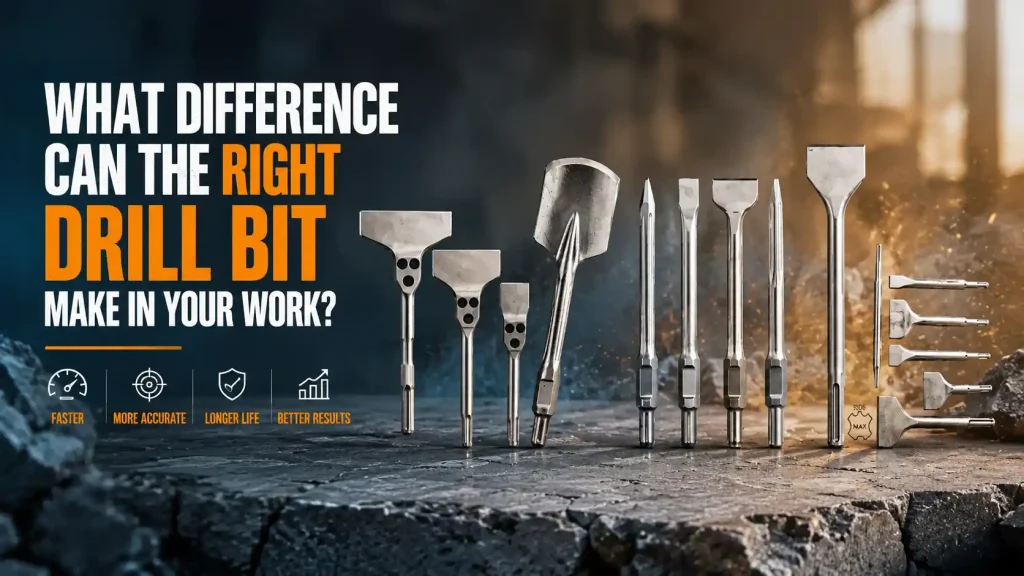
The right Drill Bit changes this situation. It helps the user match the tool with the actual task. An SDS Plus electric hammer bit can support general concrete and masonry drilling. An SDS Max electric hammer drill chisel can improve heavy concrete and stone chiseling. A PH65A demolition chisel can handle breaker-level impact work. A floor scraper chisel bit can remove tile adhesive or thinset more efficiently than a standard drilling accessory. A router bit set and wood auger bit can support cleaner woodworking results.
This article explains how the right bit can change work performance, why users should avoid making do with an unsuitable option, and how different bit types support drilling, chiseling, scraping, demolition, and woodworking applications.

Why Should You Avoid Using an Unsuitable Drill Bit?
Using an unsuitable Drill Bit may seem like a small compromise, but it often creates larger problems during the job. The tool may still rotate, strike, or scrape, but that does not mean the accessory is working efficiently. When the bit does not match the material or tool, the operator may spend more time, apply more pressure, and still get a poor result.
It can waste working time
The most obvious problem is slower progress. If a Drill Bit cannot cut, drill, chisel, or scrape effectively, the same work area may require more passes. A concrete hole may take longer to complete. A wall channel may need repeated correction. A thinset layer may remain partly attached because the scraper width or blade structure is not suitable.
At first, using whatever accessory is available may feel faster than changing tools. But once the work becomes slow, unstable, or messy, the total time cost increases. On larger projects, this delay can multiply across many holes, long wall slots, or wide floor areas.
It can increase tool stress
A power tool and its bit should work together. When the bit is not suitable, the machine may experience more vibration, heat, and mechanical stress. The operator may push harder, but extra pressure does not always mean better progress. It may only create more strain.
For example, a light-duty masonry Drill Bit is not designed for heavy concrete chiseling. In that kind of work, an SDS Max chisel or PH65A demolition chisel is more suitable because it can handle stronger impact and transfer force into the surface more effectively.
It can damage the work surface
Wrong selection can also damage the material. In brick or masonry, an unsuitable bit may chip the surface or create rough hole edges. In wood, the wrong cutting edge may cause burning, burrs, splitting, or inaccurate holes. In floor preparation, using a tool that is not designed for scraping may gouge the surface or leave adhesive behind.
This is why “close enough” is not always acceptable. A poor choice may complete part of the task, but it can create repair work afterward.
It can wear out faster
When a Drill Bit is used outside its proper application, it often wears quickly. The cutting edge may become dull, the tip may overheat, or the blade may lose its shape. Once wear begins, performance drops even further. This creates a cycle: slow work, fast wear, more stopping, and lower productivity.
How Can the Right Drill Bit Improve Speed and Efficiency?
The right Drill Bit improves efficiency because it allows the tool to apply force in the correct way. Instead of forcing the machine through the material, the accessory works with the tool’s motion, impact, or rotation. This helps the project move faster while keeping the result more controlled.
It transfers tool power more effectively
Different tools deliver force differently. A rotary hammer provides rotation and impact. A demolition breaker provides heavy repeated impact. A router provides high-speed cutting. A wood drilling tool needs steady rotation and chip removal. The correct bit is designed to receive that force and transfer it into the work surface.
An SDS Plus electric hammer Drill Bit can transfer impact into masonry drilling. An SDS Max chisel can support heavier concrete and stone work. A 30mm PH65A shank demolition chisel is made for breaker-level applications. A router bit set is designed for shaping wood profiles, not for impact drilling. When the tool and accessory match, less energy is wasted.
It reduces repeated passes
A suitable bit removes material more efficiently. A U-shaped concrete slotted chisel can create a wall channel more effectively than a standard drilling accessory. A floor scraper chisel bit with the right blade width can remove thinset or adhesive faster than a narrow or unsuitable tool. A clay spade chisel can clear hard dirt and loose concrete more efficiently than a pointed accessory in suitable conditions.
Repeated passes are one of the main causes of slow progress. The right structure reduces this waste and helps the user complete each step with fewer corrections.
It improves control and accuracy
Efficiency is not only about speed. It is also about control. A suitable Drill Bit helps the operator keep the tool stable, follow the intended direction, and produce cleaner results. This matters for anchor holes, wall slots, woodworking holes, trimming, grooving, and edge shaping.
For wood drilling, a four-flute auger bit can support smoother chip removal and more stable drilling. For harder masonry, a 3 or 4 cutter electric hammer bit can improve balance and cutting performance. For surface removal, selecting the correct scraper width can improve control around corners, edges, and larger open areas.
It reduces downtime
A proper bit also reduces downtime because it lasts longer in the correct application. When the bit is designed for the material and tool, it is less likely to overheat, clog, or lose cutting performance too early. That means fewer stops for replacement, cleaning, correction, or surface repair.

What Changes When the Drill Bit Matches the Material?
Material matching is one of the most important parts of Drill Bit selection. Concrete, stone, brick, masonry, wood, clay, hard dirt, thinset, and floor adhesive all behave differently. A bit that works well in one material may perform poorly in another. When the Drill Bit matches the material, the work becomes faster, cleaner, and more predictable.
Concrete and masonry become easier to drill
Concrete and masonry require impact resistance and a strong cutting structure. If the bit is too weak, it may heat up, wear down, or drill slowly. If the tip design is unsuitable, the hole may become rough or inaccurate.
An SDS Plus electric hammer Drill Bit is suitable for many general concrete, brick, and masonry drilling tasks. For harder applications, a 3 or 4 cutter electric hammer bit can improve stability and cutting performance. The correct cutter design helps break material and remove dust more efficiently.
Stone and heavy concrete need stronger chisels
Stone and heavy concrete are more demanding than light masonry. For these materials, the accessory must withstand stronger impact. An SDS Max electric hammer drill chisel is more suitable for heavy chiseling and breaking work because it is designed for higher impact applications.
Using a lighter Drill Bit in this type of job may not provide enough breaking force. The operator may spend more time on the same area while the tool vibrates heavily. With the correct chisel, material removal becomes more effective and controlled.
Hard dirt, clay, and loose concrete need a different shape
Not every tough material requires the same structure. Hard dirt, clay, and loose concrete often need a shovel or spade-style accessory instead of a narrow drilling tool. A 30mm PH65A hex shank clay spade chisel can help lift, break, and clear material over a wider area.
This is where the shape of a bit changes the result. Instead of making small impact marks, the spade design removes more material per movement and reduces repeated work.
Thinset and floor adhesive require scraping coverage
Removing thinset, floor tile adhesive, or old surface material is not the same as drilling. A standard Drill Bit is not designed to scrape flat surfaces. A 17mm A/F hex shank replacement blade floor tile thinset removal chisel bit floor scraper is more suitable because it provides blade contact with the surface.
Blade width changes the work experience. A narrow blade can offer better control in small spaces, while wider 4″, 5″, or 6″ blades can cover more surface area. Choosing the right width helps balance speed and precision.
Wood needs clean cutting and chip removal
Wood requires a different cutting action from concrete or stone. The right bit should cut cleanly and remove chips smoothly. If the accessory is not suitable, the hole may burn, split, clog, or become rough.
A four-flute wood auger bit can support wood drilling by improving chip removal and drilling stability. A 12PCS router bit set can support trimming, grooving, shaping, and profiling. In woodworking, the correct accessory saves time and improves the final appearance.
Table 1: Unsuitable Drill Bit vs. Right Drill Bit
| Working Situation | If the Drill Bit Is Unsuitable | If the Drill Bit Is Suitable |
| Concrete drilling | Slow penetration, overheating, fast wear | Faster drilling, better impact transfer, cleaner holes |
| Masonry wall work | Rough holes, cracked edges, poor control | More stable drilling and better hole accuracy |
| Wall slotting | Uneven grooves and repeated cutting | Cleaner channels and smoother slot formation |
| Stone chiseling | Low breaking force and heavy vibration | Stronger chiseling performance and better control |
| Demolition work | Slow material removal and accessory damage | Higher impact efficiency and more reliable breaking |
| Hard dirt and clay removal | Too many repeated passes | Wider shovel action and faster clearing |
| Floor thinset removal | Poor scraping effect and surface damage | Better coverage and faster surface preparation |
| Wood drilling | Burrs, burning, rough holes, chip clogging | Cleaner holes and smoother chip removal |
| Wood shaping | Poor edge finish and limited profile control | Better trimming, grooving, and shaping quality |
Which Drill Bit Types Can Make Different Jobs Easier?
A suitable Drill Bit is not only about size. It is about matching the structure to the working purpose. Different types are made for different tasks, and each one can make a specific kind of work easier.
SDS Plus electric hammer bit
An SDS Plus electric hammer Drill Bit is suitable for many general drilling tasks in concrete, brick, and masonry. It is often used for wall holes, anchor holes, light installation work, and basic construction drilling. Its advantage is balance. It provides enough impact performance for common hard materials while still offering good control.
SDS Plus flat brazed shovel U-shaped concrete slotted chisel
The SDS Plus electric hammer flat brazed shovel U-shaped concrete slotted through wall chisel is more suitable for wall slotting and channel work. It helps form grooves for cables, pipes, or installation channels.
The difference is clear: a normal drilling bit creates holes, while a slotted chisel helps form continuous channels. Using the correct type can reduce repeated cutting and make the slot cleaner.
SDS Max electric hammer drill chisel
An SDS Max electric hammer drill chisel is designed for heavier concrete and stone applications. It is suitable when the work requires stronger impact than a light-duty accessory can provide.
This type of Drill Bit can help users handle hard surfaces more efficiently. It is especially useful for chiseling, breaking, and removing tougher materials where stability and durability matter.
30mm PH65A shank demolition jack hammer chisel
A 30mm PH65A shank demolition jack hammer chisel for breaker is suitable for heavy demolition and breaking work. It is made for high-impact tools and demanding conditions.
The main advantage is force. When a project requires breaking concrete or removing hard material, this accessory helps deliver strong impact directly into the work surface.
30mm PH65A hex shank clay spade chisel
The 30mm PH65A hex shank demolition jack hammer clay spade chisel is suitable for removing hard dirt, clay, and loose concrete. Its wider shape helps clear material instead of only breaking it.
This is useful when the goal is not to drill a hole or cut a precise groove, but to lift and remove material. The right shape can greatly reduce repeated passes.
17mm A/F hex shank floor tile thinset removal chisel bit
The 17mm A/F hex shank replacement blade floor tile thinset removal chisel bit floor scraper is suitable for removing tile adhesive, thinset, and old floor materials. It is available with blade widths such as 1″, 2″, 3″, 4″, 5″, and 6″.
Narrow blades provide better control in detailed areas, while wider blades improve speed across larger surfaces. This accessory helps users avoid wasting time with tools that are not made for scraping.
12PCS set router bit
A 12PCS set router bit is suitable for woodworking tasks such as grooving, trimming, shaping, and edge profiling. It supports clean cutting and profile creation rather than impact work.
For woodworking users, this type helps improve the final surface and edge quality. Different profiles allow more flexible processing for different wood designs.
Four-flute wood auger Drill Bit
A four-flute wood auger Drill Bit with straight flute design is suitable for wood drilling. Its flute structure supports chip removal, which helps reduce clogging and improve drilling smoothness.
When drilling wood, the right accessory can help maintain hole accuracy, reduce burrs, and improve the overall finish.
How Does the Right Drill Bit Improve Work Quality, Tool Life, and Cost Control?
The right Drill Bit improves more than speed. It also affects work quality, tool life, and cost control. These benefits matter because a project is not only measured by how fast the first hole is drilled. It is measured by how consistently the work can continue and how much correction is needed afterward.
Better work quality
Work quality improves when the accessory produces the result required by the task. Clean holes, stable slots, smooth scraping, controlled chiseling, and accurate wood shaping all depend on the correct structure. If the bit is wrong, the user may need to repair rough edges, clean uneven surfaces, or redo inaccurate holes.
For concrete and masonry work, better quality means cleaner holes and stronger installation results. For floor removal, it means more even surface preparation. For woodworking, it means cleaner edges and less damage to the material.
Longer accessory and tool life
A suitable Drill Bit reduces unnecessary wear because it is working within its intended application. The cutting edge, tip, flute, blade, or chisel head is designed to handle a specific type of resistance. When used correctly, the accessory can last longer and perform more consistently.
This also helps protect the tool. If the accessory transfers power efficiently, the machine does not need to work under excessive stress. Lower vibration and smoother operation may help reduce mechanical strain over time.
Lower replacement and rework cost
Choosing the right Drill Bit may reduce replacement cost because the accessory is less likely to fail early. It can also reduce rework cost because the result is more accurate from the beginning. For users handling repeated jobs, these savings can become significant.
A cheaper or unsuitable option may seem acceptable for one quick task. But if it causes slow work, damaged surfaces, extra labor, or early replacement, it may not be the economical choice.
More predictable project progress
Project planning becomes easier when the accessory performs consistently. If the operator knows that the selected Drill Bit can handle the material and job type, work becomes more predictable. This matters in construction, installation, demolition, maintenance, renovation, and woodworking tasks.

How Can You Choose the Right Drill Bit Instead of Settling for the Wrong One?
Choosing the right Drill Bit requires a practical selection process. Users should not only ask, “What size do I need?” They should also ask, “What material am I working on? What tool am I using? What result do I need? How heavy is the job?”
Match the Drill Bit to the material
The first step is material matching. Concrete, stone, brick, masonry, wood, thinset, clay, hard dirt, and loose concrete all need different structures. A concrete accessory should have impact resistance and hard cutting performance. A wood accessory should cut cleanly and clear chips. A scraper blade should provide surface contact. A demolition chisel should withstand heavy impact.
Match the shank to the tool
The shank type must fit the tool. SDS Plus, SDS Max, PH65A, 17mm A/F hex, router bit shanks, and wood drilling accessories serve different tool systems. Using the wrong shank type can reduce performance and create safety or stability problems.
Match the shape to the job purpose
The shape should match the actual purpose. Drilling, chiseling, scraping, slotting, demolition, and shaping are not the same. A pointed chisel, flat shovel, U-shaped slotting chisel, scraper blade, router bit, and auger bit each solve a different problem.
Match the strength to the working intensity
A light job does not always need the heaviest accessory, and a heavy job should not rely on a light-duty option. The correct Drill Bit should match the working intensity. SDS Plus may be suitable for general masonry tasks, while SDS Max or PH65A chisels are more suitable for heavier impact work.
Consider the final result
Finally, users should consider the expected result. If the goal is a clean hole, the Drill Bit must support accuracy. If the goal is fast demolition, it must support impact. If the goal is floor preparation, it must provide scraping coverage. If the goal is woodworking finish, it must provide clean cutting and control.
Table 2: Drill Bit Selection Guide by Job Purpose
| Job Purpose | Suitable Drill Bit Type | Why It Helps |
| General masonry drilling | SDS Plus Electric Hammer Bit | Balances impact force, drilling speed, and control |
| Concrete and hard masonry drilling | High quality 3 or 4 cutter electric hammer bit | Improves stability and cutting performance |
| Wall slotting | SDS Plus U-shaped Concrete Slotted Chisel | Helps form cleaner cable or pipe channels |
| Heavy concrete and stone chiseling | SDS Max Electric Hammer Drill Chisel | Handles stronger impact and heavier material removal |
| Demolition work | 30mm PH65A Jack Hammer Chisel | Supports breaker-level impact and efficient breaking |
| Hard dirt, clay, and loose concrete removal | 30mm PH65A Clay Spade Chisel | Provides wider shovel action for faster clearing |
| Floor tile thinset removal | 17mm A/F Floor Scraper Chisel Bit | Improves scraping coverage and surface preparation speed |
| Wood drilling | Four-flute Wood Auger Drill Bit | Helps chip removal and improves hole quality |
| Wood trimming and shaping | 12PCS Router Bit Set | Supports grooving, trimming, profiling, and edge finishing |
Conclusion
The right Drill Bit can make a clear difference in work speed, accuracy, tool stability, surface quality, and long-term cost control. Using an unsuitable option may seem convenient for a moment, but it can slow the project down through poor cutting, fast wear, unstable operation, rough results, and repeated rework. In many jobs, making do with the wrong accessory costs more time and effort than choosing the correct one from the beginning.
A suitable Drill Bit helps the tool perform better because it matches the material, shank type, working strength, and job purpose. It can make concrete drilling faster, stone chiseling stronger, wall slotting cleaner, floor thinset removal smoother, demolition more efficient, and woodworking more accurate. The key is not simply choosing the strongest or largest option, but selecting the right structure for the actual job.
For users who need Drill Bit solutions for drilling, chiseling, demolition, surface removal, and woodworking, Bestwin offers a range of options, including SDS Plus electric hammer bits, SDS Max electric hammer drill chisels, PH65A demolition chisels, clay spade chisels, floor scraper chisel bits, router bit sets, and four-flute wood auger bits for different project requirements.










 English
  العربية
  Français
  Português
  Português do Brasil
  Italiano
  简体中文
简体中文  繁體中文
繁體中文  日本語
日本語  한국어
한국어  Deutsch
  Español
  Slovenčina
  ไทย
ไทย  Türkçe