
Introduction
A Drill Bit is not just a small tool accessory. In construction, renovation, masonry drilling, woodworking, demolition, wall slotting, tile removal, and installation work, the right Drill Bit can directly affect working speed, hole accuracy, tool stability, surface quality, and long-term operating cost. When the bit does not match the material or the machine, the result may include slow drilling, excessive vibration, broken tips, uneven holes, poor dust removal, overheating, or unnecessary tool wear.
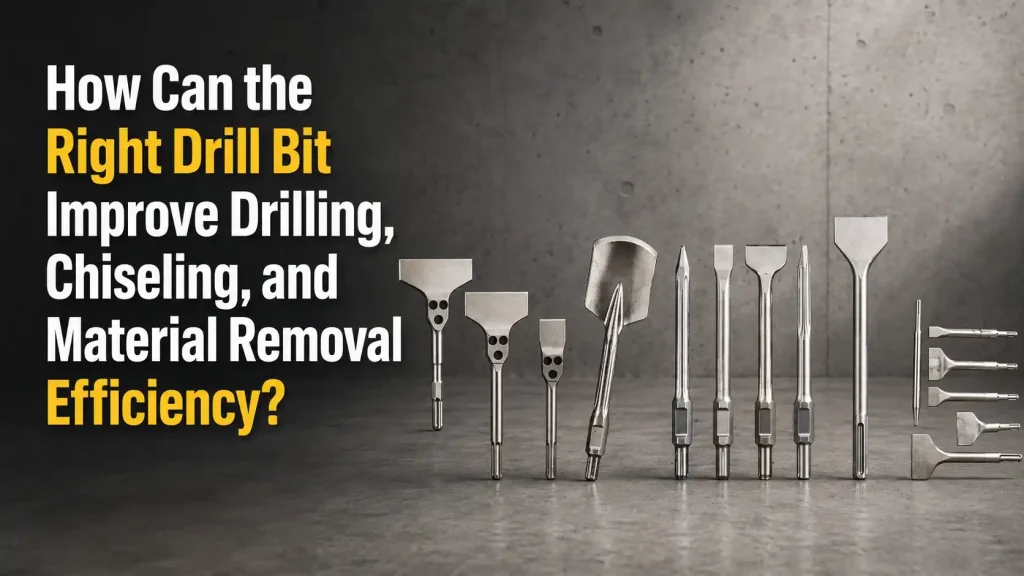
Different working environments require different Drill Bit structures. A concrete wall may need an SDS Plus electric hammer bit or a U-shaped concrete slotted chisel. Heavy concrete and stone work may require an SDS Max electric hammer drill chisel. Demolition work may depend on a 30mm PH65A shank jack hammer chisel or clay spade chisel. Floor renovation may need a 17mm A/F hex shank floor scraper chisel bit for tile and thinset removal. Wood drilling, shaping, and grooving may use auger Drill Bits or router bit sets.
This is why Drill Bit selection should not be based only on size. A suitable Drill Bit should match the tool system, material hardness, working depth, impact force, flute design, shank type, and application purpose. When these factors are considered together, drilling and material removal become more efficient, safer, and easier to control.

What Makes a Drill Bit Important for Different Construction and Installation Tasks?
A Drill Bit plays a key role in how power is transferred from the machine to the working material. Whether the task involves drilling holes, cutting wall channels, removing concrete, scraping floor adhesive, or drilling timber, the bit is the direct contact point between the tool and the surface. Its design determines how effectively force, rotation, impact, and cutting action are converted into useful work.
Matching the Drill Bit to the Material
Different materials respond very differently to drilling and chiseling. Concrete, brick, stone, tile adhesive, wood, clay, and loose concrete do not have the same density, structure, or resistance. A Drill Bit designed for wood cannot perform properly in reinforced masonry. A router bit used for shaping timber is not suitable for breaking concrete. In the same way, a demolition chisel may be too aggressive for precise installation holes.
For concrete and masonry, SDS Plus electric hammer bits are commonly used for general drilling and installation work. They are suitable for drilling anchor holes, pipe holes, bracket holes, and other common construction openings. For heavier stone or concrete removal, SDS Max drill chisels provide stronger impact transfer and better durability under high-force working conditions.
For wood applications, a four-flute wood auger Drill Bit or straight flute drilling bit is more suitable because it is designed to cut fibres and remove chips cleanly. For shaping, trimming, or grooving wood panels, a 12PCS router bit set may provide different profiles for more flexible woodworking operations.
Improving Work Efficiency and Tool Stability
The right Drill Bit can make work faster and more controlled. When the bit geometry fits the task, the tool can operate with less unnecessary resistance. The operator does not need to apply excessive pressure, and the machine can transfer power more smoothly.
For example, a high-quality 3-cutter or 4-cutter electric hammer bit can improve drilling stability in concrete because the cutting edges distribute impact and rotation more evenly. Better flute design also helps remove dust from the hole, reducing heat buildup and lowering the risk of bit jamming. In deeper drilling tasks, this becomes especially important because poor dust removal can slow progress and increase wear.
In chiseling applications, the working shape of the bit is equally important. A flat brazed shovel chisel can be useful for slotting, scraping, and surface removal. A U-shaped concrete slotted through-wall chisel is more suitable when a clean channel is needed for cable or pipe routing. A clay spade chisel is designed for wider material displacement, making it more effective for hard dirt, clay, and loose concrete than a narrow pointed chisel.
Reducing Wear, Breakage, and Replacement Cost
A Drill Bit that is not suitable for the task usually wears faster. Excessive friction, poor impact absorption, wrong shank matching, and improper cutting geometry can all shorten service life. In demanding work environments, bit failure can interrupt workflow and increase replacement costs.
Durability depends on several details. The material of the bit, brazing quality, cutter structure, flute depth, shank strength, and heat resistance all matter. For hammer drilling, the Drill Bit must handle repeated impact. For demolition, the chisel must resist bending and edge deformation. For wood drilling, the bit must remove chips efficiently to avoid burning or clogging.
| Drill Bit Type | Suitable Material | Typical Application | Main Advantage |
| SDS Plus electric hammer bit | Concrete, brick, masonry | General drilling and installation holes | Stable impact drilling |
| SDS Max electric hammer drill chisel | Concrete, stone | Heavy chiseling and breaking | Strong impact transfer |
| PH65A demolition jack hammer chisel | Hard dirt, loose concrete, demolition surfaces | Breaker-based demolition work | High breaking force |
| Floor scraper chisel bit | Tile, thinset, floor adhesive | Tile and adhesive removal | Wider scraping coverage |
| Wood auger Drill Bit | Wood, timber | Deep wood drilling | Fast chip removal |
| Router bit set | Wood panels, boards | Trimming, shaping, grooving | Clean edge forming |
How Should You Choose a Drill Bit for Concrete, Stone, and Masonry Work?
Concrete, stone, and masonry applications place heavy stress on drilling accessories. These materials often require both rotation and impact, especially when the hole must be deep, accurate, and clean. Choosing the correct Drill Bit for these tasks helps improve productivity while reducing damage to the tool and work surface.
SDS Plus for General Hammer Drilling
SDS Plus Drill Bit products are widely used for general electric hammer drilling. They are suitable for many common concrete, brick, and masonry tasks, especially when the hole size and drilling depth are moderate. The SDS Plus shank system allows efficient impact transfer while keeping bit changes relatively simple.
An SDS Plus electric hammer bit is suitable for drilling holes for anchors, screws, wall plugs, cable supports, pipe brackets, and construction fixings. In installation work, accuracy and stability are important because uneven holes can weaken fastening strength. A stable SDS Plus Drill Bit helps keep the drilling direction more consistent and reduces unnecessary side movement.
For channel work, an SDS Plus electric hammer flat brazed shovel U-shaped concrete slotted through-wall chisel may be used where grooves or wall slots are required. This kind of chisel is not mainly for round holes. Instead, it helps create channels for electrical wiring, communication cables, water pipes, or other embedded installation paths.
SDS Max for Heavier Concrete and Stone Work
When the material is harder, thicker, or more demanding, SDS Max accessories are usually more suitable. SDS Max electric hammer drill chisels are built for stronger machines and higher impact energy. They are commonly used for concrete removal, stone chiseling, surface breaking, and heavier renovation tasks.
Compared with SDS Plus, SDS Max has a larger shank structure and stronger impact capacity. This allows the tool to transfer more force into the material. In heavy masonry work, this difference can improve breaking speed and reduce the chance of bit damage. For projects involving dense concrete, natural stone, old structural surfaces, or thick masonry sections, using an SDS Max Drill Bit or chisel can provide better working efficiency.
However, the tool and bit must match correctly. An SDS Max chisel cannot be used in an SDS Plus machine. Shank compatibility is essential for safety, performance, and equipment protection.
Cutter Design and Flute Structure
For concrete drilling, cutter design is one of the most important factors. A standard bit may work for simple holes, but high-quality 3-cutter or 4-cutter electric hammer bits can offer better stability, especially when drilling harder masonry. Multiple cutters help distribute impact pressure and reduce the chance of the bit wandering at the hole entrance.
Flute structure also affects performance. The flute is responsible for carrying dust and broken material out of the hole. If the flute is too shallow or poorly designed, dust may remain inside the hole and slow drilling. This can cause heat buildup, friction, and faster wear. A well-designed Drill Bit removes debris more efficiently, helping the bit stay cooler and maintain drilling speed.
For deep holes, dust removal becomes even more important. A bit with effective flute geometry can reduce jamming and make the drilling process smoother. This is especially useful in repeated installation work where many holes must be drilled in one working period.
Which Drill Bit or Chisel Bit Works Better for Demolition and Material Removal?
Demolition and material removal require different bit designs from ordinary drilling. Instead of creating a clean circular hole, the tool must break, lift, scrape, or remove material from a surface. This requires stronger impact resistance, suitable blade width, and correct chisel geometry.
Demolition Chisels for Breakers
A 30mm PH65A shank demolition jack hammer chisel is designed for heavy-duty breaker applications. It is commonly used where strong impact force is needed to break concrete, remove old surfaces, open hard ground, or handle demolition work. The PH65A shank structure is made for compatible jack hammers and breakers, helping transfer impact force into the working surface.
In demolition work, the chisel must resist repeated shock. The working tip should maintain its shape under impact, while the shank must remain stable inside the tool. If the chisel is too weak or poorly matched, it may bend, crack, or reduce breaking efficiency. A suitable demolition chisel helps improve force concentration and reduces wasted impact energy.
Clay Spade Chisels for Hard Dirt and Loose Concrete
A 30mm PH65A hex shank demolition jack hammer clay spade chisel is different from a narrow demolition point. Its wider blade shape allows it to lift, loosen, and remove material more effectively. This makes it useful for hard dirt, clay, and loose concrete removal.
The advantage of a clay spade chisel is surface coverage. Instead of only breaking a small point, it can separate material across a wider area. This is useful when removing compacted clay, clearing foundation areas, loosening old fill, or handling uneven ground surfaces. For tasks that require both impact and lifting action, a spade chisel can be more efficient than a standard narrow chisel.
Floor Scraper Chisel Bits for Tile and Thinset Removal
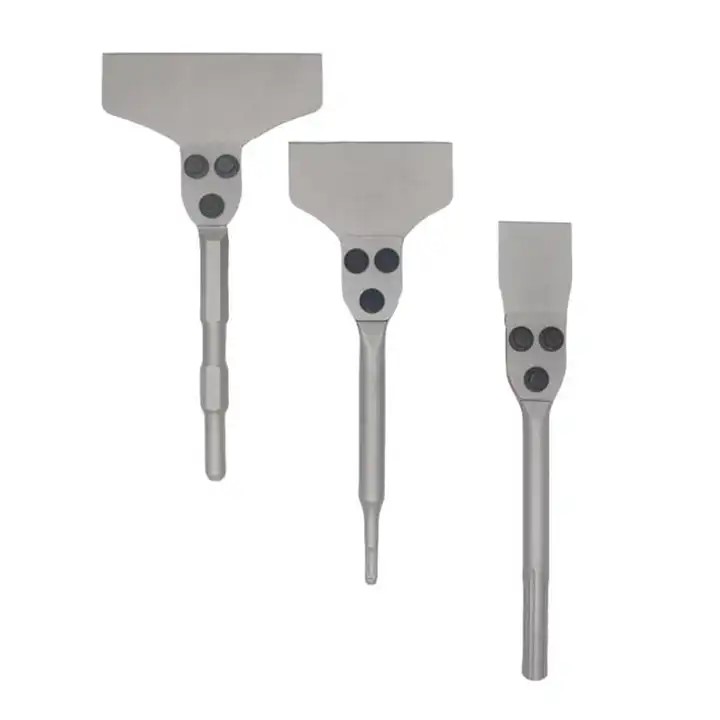
Floor removal work requires a different approach. When removing tile, thinset, floor adhesive, or surface residue, a wide scraping edge is often more practical than a pointed bit. A 17mm A/F hex shank replacement blade floor tile thinset removal chisel bit can be used for scraping and lifting surface layers.
Blade width matters in this application. Options such as 1″, 2″, 3″, 4″, 5″, and 6″ allow users to choose the right balance between control and coverage. A narrower blade may be better for corners, edges, or stubborn spots. A wider blade can cover more area and improve speed on open floor surfaces. Selecting the correct scraper width helps avoid unnecessary surface damage while improving removal efficiency.
| Work Type | Recommended Bit or Chisel | Shank Type | Best Use |
| Concrete breaking | SDS Max drill chisel | SDS Max | Heavy concrete and stone chiseling |
| Wall slotting | U-shaped concrete slotted chisel | SDS Plus | Cable, pipe, and wall channel work |
| Heavy demolition | Demolition jack hammer chisel | 30mm PH65A shank | Breaker-based demolition |
| Clay and dirt removal | Clay spade chisel | 30mm PH65A hex shank | Hard dirt, clay, loose concrete |
| Tile adhesive removal | Floor scraper chisel bit | 17mm A/F hex shank | Thinset, tile, and floor residue removal |
What Drill Bit Features Help Improve Precision, Speed, and Service Life?
A Drill Bit may look simple, but its performance depends on several technical features. Shank type, flute design, cutter structure, blade geometry, and material strength all influence how well the bit works in real applications. Understanding these features helps users choose products more accurately.
Shank Compatibility
The shank connects the Drill Bit to the tool. If the shank does not match the machine, the bit cannot operate safely or effectively. SDS Plus, SDS Max, 17mm A/F hex shank, and 30mm PH65A shank systems are designed for different tools and working forces.
SDS Plus is suitable for many electric hammer drilling applications. SDS Max is better for heavier impact work. 17mm A/F hex shank floor scraper bits are used with compatible tools for tile and adhesive removal. 30mm PH65A shank chisels are used with larger demolition breakers.
Correct shank matching improves power transfer and reduces vibration. It also helps protect the chuck or tool holder from abnormal stress. Using the wrong shank system can reduce efficiency, damage the machine, or create safety risks.
Cutting Edge and Flute Design
The cutting edge determines how the Drill Bit enters and breaks the material. In concrete drilling, 3-cutter and 4-cutter designs can improve balance and reduce bit wandering. In wood drilling, the edge must cut fibres cleanly while the flute removes chips. In router applications, the cutting profile determines the final shape of the wood edge or groove.
Flute design is especially important for drilling speed. A good flute removes dust, chips, or debris from the hole. If material remains trapped, the bit may overheat, slow down, or become stuck. For wood auger Drill Bits, chip removal is a major performance factor. A four-flute wood auger Drill Bit with straight flute structure can help guide drilling and remove wood chips more effectively.
Application-Specific Geometry
Different Drill Bit and chisel shapes exist because different tasks require different working actions. A round drilling bit creates holes. A U-shaped chisel cuts channels. A flat shovel chisel removes surface material. A spade chisel lifts and loosens hard dirt or clay. A floor scraper blade separates tile adhesive and thinset. A router bit shapes wood edges or cuts grooves.
Choosing by shape is just as important as choosing by size. A bit with the wrong geometry may still fit the machine, but it may not perform well. For example, a narrow chisel can break hard material, but it may be inefficient for scraping wide floor areas. A wide scraper can remove adhesive, but it may not concentrate enough force for deep concrete breaking.
Heat Resistance and Impact Durability
Drilling and chiseling generate heat and shock. In concrete and stone applications, the bit must withstand repeated impact. In wood drilling, heat can build up if chips are not removed properly. In demolition, the chisel must resist deformation under high force.
A durable Drill Bit should maintain its cutting edge, resist bending, and perform consistently across repeated use. For frequent drilling or removal work, choosing better-quality bit construction can reduce downtime and replacement frequency.
How Can Buyers Select a Drill Bit for Long-Term Professional Use?
Selecting a Drill Bit for long-term use requires more than choosing the lowest-cost option. The better approach is to evaluate the working material, tool type, application frequency, hole requirements, and expected service life. This helps ensure that the bit supports stable work rather than becoming a weak point in the process.
Start from the Work Material
The first question should always be: what material will the bit work on? Concrete, stone, brick, wood, tile adhesive, clay, and loose concrete all require different bit structures.
For concrete and brick, SDS Plus electric hammer bits are often practical for general drilling. For heavy concrete and stone, SDS Max chisels are more suitable. For hard dirt and clay, a clay spade chisel may be more efficient. For tile and thinset removal, a floor scraper chisel bit provides better surface coverage. For timber, a wood auger Drill Bit is better suited to deep and clean drilling. For shaping wood, a router bit set offers more profile options.
Consider Tool Power and Shank System
The Drill Bit must match the machine. A powerful breaker requires a stronger chisel and compatible shank. A rotary hammer may require SDS Plus or SDS Max accessories. A router needs router bits designed for rotational cutting. Using a bit that does not match the machine can reduce performance and increase risk.
Tool power should also match the application. A small hammer drill may not be suitable for heavy demolition. A large breaker may be too aggressive for delicate removal work. The bit, tool, and material should work together as a system.
Balance Speed, Durability, and Finish Quality
The most aggressive Drill Bit is not always the best choice. Some tasks require speed, while others require accuracy or surface protection. For example, tile removal may require controlled scraping to avoid damaging the base surface. Wood drilling may require clean chip removal to prevent burning or rough holes. Concrete installation holes may require accuracy for proper anchor performance.
A good selection balances drilling speed, service life, and finish quality. This is especially important when the same type of work is repeated many times. A stable Drill Bit can help reduce fatigue, improve consistency, and make the final result more reliable.
Evaluate Replacement and Inventory Needs
For repeated construction or renovation work, it is useful to keep different Drill Bit types available. A complete selection may include SDS Plus bits, SDS Max chisels, demolition chisels, floor scraper blades, wood auger Drill Bits, and router bit sets. This makes it easier to respond to different jobsite requirements without forcing one bit to do unsuitable work.
Keeping the right bit types in stock can reduce delays and prevent tool misuse. It also helps maintain consistent work quality across drilling, chiseling, scraping, shaping, and demolition tasks.

Conclusion
Choosing the right Drill Bit can improve drilling speed, hole accuracy, impact efficiency, material removal performance, tool protection, and long-term working reliability. Because concrete, stone, brick, wood, tile adhesive, clay, and loose concrete all require different working actions, the Drill Bit should be selected according to material, shank type, tool compatibility, cutter design, flute structure, and application purpose.
For general masonry drilling, SDS Plus electric hammer bits are practical and efficient. For heavier concrete and stone work, SDS Max drill chisels offer stronger impact performance. For demolition and hard ground removal, PH65A shank chisels and clay spade chisels provide higher breaking and lifting force. For floor renovation, scraper chisel bits help remove tile, thinset, and adhesive more efficiently. For woodworking, auger Drill Bits and router bit sets support clean drilling, shaping, and finishing work.
For users looking for reliable Drill Bit and chisel bit options across drilling, demolition, wall slotting, tile removal, woodworking, and material removal applications, Bestwin offers product choices designed to support practical worksite needs and stable long-term performance.










 English
  العربية
  Français
  Português
  Português do Brasil
  Italiano
  简体中文
简体中文  繁體中文
繁體中文  日本語
日本語  한국어
한국어  Deutsch
  Español
  Slovenčina
  ไทย
ไทย  Türkçe