
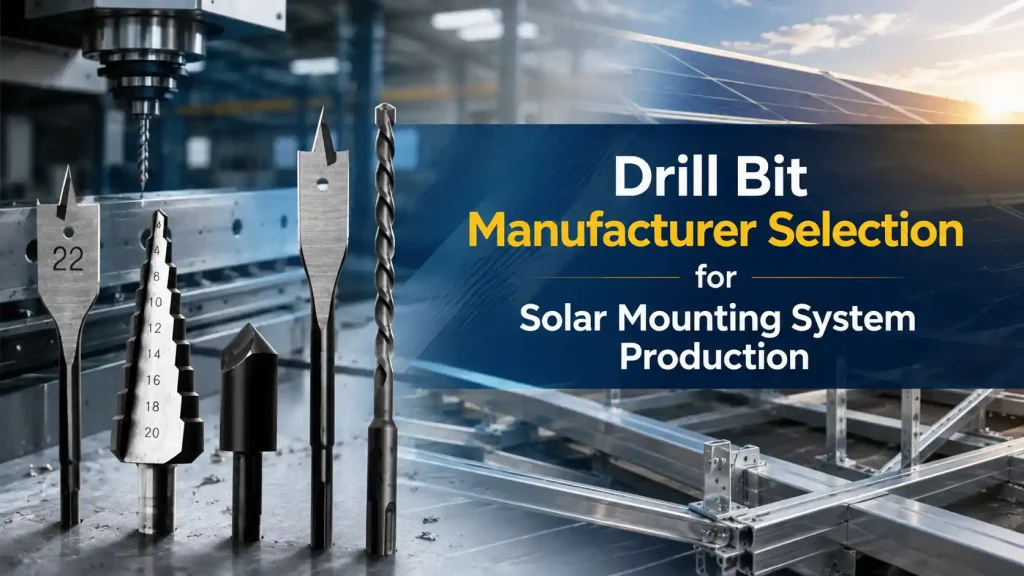
Solar mounting hardware may look repetitive on a bill of materials, yet its holes are produced in very different conditions. Aluminum rails need clean attachment holes, galvanized steel brackets need controlled entry and exit edges, stainless fasteners create hard repair situations, and concrete or masonry foundations require an entirely different cutting structure. For a mounting-system producer, distributor, or OEM program, the practical task is not to buy one universal tool. It is to build a drill bit assortment that follows the materials, machines, hole drawings, production volume, and field-installation work behind the finished system.
Quick Answer
A suitable drill bit program for solar mounting system production separates factory metalworking from site anchoring. The manufacturer matches bit material, geometry, diameter, working length, and shank to aluminum rails, carbon-steel or galvanized brackets, stainless components, and masonry foundations. It then confirms the assortment with representative workpieces before assigning stable product and refill codes.
Bestwin manufactures and supplies drilling tools for B2B buyers, OEM tool brands, distributors, mounting-system producers, and project contractors. The matching process begins with component drawings, material grades, machine interfaces, annual hole volume, packaging needs, and sample requirements rather than a generic request for assorted bits.
Solar Mounting Hardware Needs Separate Factory and Jobsite Bit Families
The same project can involve holes made on a production line and holes made at the installation site. Factory work may include aluminum extrusion rails, thin galvanized brackets, thicker carbon-steel plates, stainless clips, polymer isolation parts, and packaging or jig materials. Jobsite work can add concrete, brick, stone, timber blocking, or pre-existing steel that must be adapted. A single drill bit family rarely covers all those conditions with a consistent hole result, so each drill bit group needs a defined material boundary.
Factory production usually values repeatable diameter, controlled burrs, predictable tool changes, and compatibility with drill presses, machining stations, fixtures, or portable tools. Installation teams value portability, clear material identification, rapid size recognition, durable cases, and direct compatibility with the drills or rotary hammers already assigned to the crew. These priorities change the assortment even when nominal hole sizes overlap.
The first purchasing decision is therefore a boundary decision. The inquiry must state which drill bit products are for factory metalworking, which are for installation kits, and which are only contingency items. That separation prevents a metal twist bit, a masonry bit, and a multi-material drill bit from being treated as interchangeable because they share the same diameter.
Table 1. Solar Mounting Component and Drill Bit Direction
| Component or task | Typical material condition | Drill bit direction | Information needed for matching |
|---|---|---|---|
| Rail attachment hole | Aluminum extrusion with defined wall thickness | Sharp metal-cutting geometry with controlled chip removal | Alloy, temper, wall thickness, hole diameter, machine type |
| Bracket or splice plate | Galvanized or coated carbon steel | HSS or another suitable metal family matched to hardness and volume | Grade, coating, thickness, entry and exit requirement |
| Stainless clip or repair hole | Stainless steel with heat sensitivity | Heat-resistant metal-cutting family with stable edge geometry | Stainless grade, thickness, coolant policy, expected hole count |
| Concrete foundation fixing | Concrete, block, or masonry | Carbide-tipped percussion or rotary-hammer family | Substrate, anchor diameter, embedment depth, hammer interface |
| Timber blocking or roof support | Softwood, hardwood, or engineered timber | Wood-specific spur, auger, or suitable twist geometry | Timber type, pilot size, depth, access space |
| Installer contingency kit | Mixed but documented site materials | Separate labeled groups rather than one universal item | Approved materials, tools, common sizes, refill frequency |
Aluminum Rails Need a Clean Entry, Stable Diameter, and Controlled Exit Burr
Aluminum rail production can generate thousands of similar holes, but the material is not automatically easy to manage. A soft alloy can load a cutting edge, a thin wall can distort near the exit, and an unsupported profile can vibrate. An unsuitable drill bit may still pass through the rail while leaving a raised edge that interferes with clamps, grounding parts, fasteners, or protective packaging. Drill bit geometry therefore affects assembly as well as cutting time.
The drawing provides the nominal diameter, yet selection also depends on alloy and temper, profile wall thickness, whether the hole crosses one wall or two, and how the rail is supported. A portable drill used for occasional adjustment creates a different load from a guided production fixture. The same nominal size can therefore require a different length, point geometry, finish, or replacement interval.
For repeat production, the factory should identify the hole families that consume the most drill bit inventory. Common mounting holes may justify dedicated drill bit codes and larger refill quantities. Rare service dimensions can remain in a controlled secondary assortment. This is more useful than purchasing a large case with many visually impressive pieces but too few of the diameters that actually follow the rail drawings.
The sample should be tried on the real rail profile or a retained production offcut of the same specification. Approval is based on the hole features that affect assembly: usable diameter, visible burr condition, rail deformation, fastener fit, and a practical replacement point. The purpose is not to create a laboratory procedure; it is to confirm whether the selected drill bit can support the production and purchasing plan.

Steel Brackets Change the Material and Coating Requirements
Solar mounting brackets can include plain carbon steel, galvanized steel, coated steel, and stamped parts with local hardening or deformation around the work area. A drill bit that cuts an aluminum rail acceptably may rub, overheat, or lose its edge quickly in these components. The metal grade, coating, thickness, and hole volume must be stated separately in the drill bit inquiry.
Coatings also affect the commercial definition of an acceptable hole. A rough exit burr may damage handling, seating, or downstream finishing. A poorly controlled entry can mark a visible surface. If the component is already galvanized or coated, the project team needs to specify whether drilling is part of normal production, a repair operation, or a site modification. Each situation creates a different volume and packaging need.
Higher hole volume tends to favor a tightly defined metal-cutting drill bit family with controlled sizes and scheduled refills. Low-volume repair kits may favor a smaller drill bit assortment, but they still need material labels and a clear boundary between mild-steel and stainless work. The lowest unit price is not automatically the lowest cost when early edge loss creates extra tool changes, damaged parts, or emergency replenishment.
Diameter tolerance should be tied to the fastener and drawing, not described with vague phrases such as standard accuracy. The customer can provide the fastener type, nominal clearance, plate thickness, and any inspection gauge already used in production. The manufacturer can then recommend a product direction and sample quantity based on those conditions.
Stainless Components Require Heat-Resistant Product Matching
Stainless clips, roof interfaces, and repair plates represent a smaller share of some mounting systems, but they can expose a weak drill bit assortment quickly. Stainless steel resists cutting, generates heat, and can become more difficult when a dull edge rubs instead of cutting. A general-purpose drill bit that works on mild steel may give an unstable result or an uneconomic replacement rate.
The matching information begins with the stainless grade, material thickness, hole diameter, machine, available speed control, cooling or lubricant policy, and expected number of holes. A suitable drill bit is then chosen for that actual load. The decision may point toward a cobalt-bearing or another heat-resistant metal family, but the material label alone is not enough; point geometry, edge condition, and batch consistency still matter.
For an OEM or distributor program, each stainless-capable drill bit should not be mixed into a case without clear identification. Users need to distinguish it from general metal pieces before the first hole is attempted. Laser marking, printed size positions, color-coded holders, or an agreed packaging map can support this drill bit distinction, subject to the order specification.
The approval sample should cover the stainless grade and thickness that drive the purchase. A result on thin mild steel does not validate a product for stainless roof hardware. Likewise, one successful hole does not define the refill forecast. The sample record needs enough holes to reveal whether cutting behavior and edge life remain commercially usable for the planned work.
Concrete and Masonry Anchors Need a Separate Hammer-Tool Interface
Ground-mounted arrays, carports, rooftop equipment bases, and accessory supports may require drilling into concrete, block, or masonry. These holes belong to a different drill bit family from the tools used on rails and steel brackets. Cutting-tip construction, dust movement, hammer action, diameter, usable length, and shank interface all influence the drill bit match.
The anchor schedule is the most useful starting point. It identifies the required hole diameter and embedment depth, while the substrate description clarifies whether the work involves normal concrete, lightweight block, brick, stone, or another base. The power-tool list then determines whether the team uses a keyed or keyless chuck, an SDS-plus platform, another rotary-hammer interface, or a non-hammer drill for a limited material.
Working length must exceed the required hole depth with room for dust and safe tool engagement, but an unnecessarily long drill bit can be harder to control in shallow work. The assortment should therefore follow the real anchor schedule instead of assuming that longer is always more useful. Diameter and shank identification should remain visible after transport and repeated use.
For project supply, masonry items can be packed as a clearly separated module within an installation case or supplied under independent refill codes. This prevents a crew from replacing a worn anchor tool with a same-diameter metal item. It also allows distributors to replenish the masonry sizes that move fastest without purchasing a complete mixed case.

Diameter, Working Length, and Shank Must Follow the Drawings and Tool List
Three dimensions govern much of the assortment: diameter, working length, and total or shank configuration. Diameter follows the fastener, anchor, cable pass-through, or assembly clearance. Working length follows material thickness, hole depth, stacked components, and access. Shank follows the machine or portable tool. A mistake in any one of these fields can make a drill bit unusable even if the other two are correct.
The project drawing and fastening schedule should be converted into a size matrix before quantities are assigned. High-frequency production dimensions belong in larger pack quantities. Medium-frequency sizes can support model variants or service operations. Rare dimensions may be better held centrally instead of duplicated in every case. This structure connects inventory to the product design rather than to a generic piece count.
Tool compatibility deserves the same attention. Straight or round shanks, hex shanks, and SDS-style interfaces serve different equipment. Maximum chuck capacity also matters for larger diameters. If factory stations and installation crews use different machines, the RFQ should list both. The selected product code then records the intended machine group, reducing substitutions during repeat ordering.
Length selection needs a realistic access review. Solar hardware can place holes near flanges, channel walls, roof seams, clamps, or partially assembled structures. A short body may improve control in a confined position, while a deeper anchor requires more usable length. Providing a drawing or photo of the access condition can be more informative than requesting long bits as a general precaution.
Production Volume Determines Set Size and Refill Quantities
A solar mounting system factory does not consume every size at the same rate. Rail and bracket drawings usually concentrate demand in a limited group of holes. Installation kits may need broader coverage, but their refill pattern still reflects the anchors and fasteners used most often. Set design should follow this frequency instead of treating all positions equally.
A compact production assortment suits a stable product line with a small number of approved holes. It can provide more pieces of fewer sizes and make stock counting simple. A broader installer assortment suits contractors working across several mounting designs, roof types, and foundation details. Even then, the contents should stay within documented materials and tools.
Piece count can be misleading. Two cases with the same advertised count may allocate their contents very differently. One may duplicate useful metal sizes, while another fills positions with screwdriver accessories or rarely used dimensions. The commercial comparison should therefore use the itemized bill of contents, not only the number printed on the case.
An experienced drilling bit manufacturer can translate the component matrix into product-family and quantity options, but the customer still supplies the drawings, materials, machines, production forecast, and target markets. This division keeps the recommendation connected to real mounting hardware rather than to a generic tool assortment.
Table 2. Assortment Capacity and Refill Logic
| Supply situation | Suitable assortment structure | Refill method | Main risk to avoid |
|---|---|---|---|
| Stable rail production | Narrow metal family with repeated core diameters | Individual size codes in production quantities | Paying for unused sizes |
| Mixed bracket production | Separate aluminum, mild-steel, and stainless groups | Material-family and diameter codes | Mixing visually similar tools |
| Standard installer kit | Metal and masonry modules with approved common sizes | Module or individual fast-moving codes | One general-purpose label for all materials |
| Multi-project contractor kit | Broader documented range linked to tool platforms | Usage-based refill list by region or project | High piece count without useful coverage |
| OEM retail or distributor program | Agreed case map, labels, inserts, and replacement codes | Barcode or SKU-linked replenishment | Sample contents drifting in later lots |
Wrong Material Labels and Inflated Piece Counts Create Avoidable Cost
The most common purchasing errors begin before the tool reaches a machine. A vague request for metal bits may not distinguish aluminum, mild steel, stainless steel, thickness, or hole volume. A request for masonry bits may omit the rotary-hammer interface. A request for a large set may count every accessory without showing how many actual cutting tools are included.
Universal claims also deserve restraint. A multi-material drill bit can be useful for documented mixed service, but it does not remove the need to separate high-volume factory metalwork from concrete anchoring or demanding stainless work. The sample needs to represent each approved material group. If one item is intended only for contingency use, the packaging and product record should say so.
Another risk is approving a case while leaving refill items undefined. When the first common size wears out, the customer may have no matching individual code and may need to purchase another complete set. A good supply plan identifies high-consumption replacements at the same time as the initial assortment.
Price comparisons need a common basis. Material grade, finish, geometry, size range, shank, packaging, quantity, inspection requirement, and delivery terms should be aligned before unit prices are compared. Otherwise, a lower quote may describe a different product or a different content mix.
Samples Must Use the Actual Rail, Bracket, and Anchor Schedule
Sample confirmation is most useful when it answers purchasing questions. Can the proposed metal family cover the named rail alloy and bracket grades? Does the stainless direction remain usable for the planned number of holes? Does the masonry product match the anchor diameter, depth, substrate, and hammer platform? Are the size marks and case positions clear enough for the intended users?
The sample record can stay concise. It links the proposed product code to workpiece material and thickness, machine interface, nominal diameter, working length, observed hole condition, practical tool-change point, packaging position, and decision. Retaining representative approved samples or clear photos can help the next production lot match the agreed identity.
Bestwin supports sample matching, OEM packaging discussion, product identification, and batch-supply planning according to the customer’s technical parameters and order structure. As an industrial drill bit supplier, the company can organize separate product directions for factory metalwork and site anchoring, then carry approved codes into quotation and repeat orders.
The sample quantity should reflect the range of materials rather than only the number of sizes. A program with one aluminum rail, one galvanized bracket, one stainless clip, and one concrete anchor condition may need several product families even when diameters overlap. Testing only the easiest workpiece creates a weak basis for batch approval.
Batch Orders Need Stable Product Codes and Change Control
Once a drill bit sample is approved, the order description needs to preserve the features that created the acceptable result. The product code should connect to drill bit material and finish, point or cutting structure, nominal diameter, working length, shank, marking, pack quantity, case position, and any inspection requirement. This makes the next purchase easier to compare with the approved sample.
Batch identity can include purchase order, lot reference, product code, quantity, and packing list details. The level of control depends on the program, but it should be sufficient for a factory, distributor, or OEM customer to isolate a question and identify the affected supply. Clear records are especially useful when several visually similar sizes or material families share one case.
Changes that affect application fit need communication before shipment. Examples include a material grade, coating, geometry, working length, shank detail, marking method, pack layout, or individual refill code. The order agreement can define which changes require renewed sample confirmation. This is a practical purchasing boundary, not a claim that no manufacturing variation can exist.
Staged delivery can help large solar programs. The first quantity supports pilot production or an initial project, while later releases follow actual consumption. Refill quantities can then be adjusted around the sizes that wear fastest. The approach reduces excess stock without forcing the customer to wait until every drill bit is depleted.

Material Grades, Machines, Quantities, and Packaging Complete the RFQ
A useful RFQ gives the manufacturer enough information to match products without turning the request into a long operating manual. The core package includes component drawings or a hole schedule; material grades, coatings, and thicknesses; hole diameters and depths; factory and portable machines; shank interfaces; annual or project hole estimates; initial and repeat quantities; target market; required documents; packaging; labeling; and delivery plan.
Photos of rails, brackets, fixtures, roof interfaces, and foundation conditions can resolve questions that a material name leaves open. Existing tool and case samples are also useful when an OEM program needs compatibility with a current range. The manufacturer can then identify which features can remain standard and which need a dedicated product, marking, or pack configuration.
Commercial information belongs beside the technical data. State whether the quotation is for loose refills, small boxes, installer cases, distributor packaging, or private-label supply. Include expected order quantity by size or assortment, destination, barcode needs, language, and launch timing. This allows tooling and packaging decisions to be considered together.
The resulting quotation should make each product family visible. Metal, stainless-capable, wood, and masonry directions need separate descriptions where applicable. The line items should not hide the assortment behind one total piece count. Clear line-level data supports sample approval, landed-cost comparison, and later replenishment.
Final Takeaway
Solar mounting hardware needs a drill bit program built around actual rails, brackets, stainless parts, foundations, machines, hole drawings, and consumption. Separating factory metalworking from site anchoring, confirming representative samples, and assigning individual refill codes makes the assortment easier to approve and repeat.
The factory can match drill bit families to the customer’s materials, dimensions, tool interfaces, packaging, OEM requirements, sample plan, and batch quantities. A complete inquiry gives the manufacturer a practical basis for recommending products that fit both mounting-system production and project supply.







 English
  العربية
  Français
  Português
  Português do Brasil
  Italiano
  简体中文
简体中文  繁體中文
繁體中文  日本語
日本語  한국어
한국어  Deutsch
  Español
  Slovenčina
  ไทย
ไทย  Türkçe