
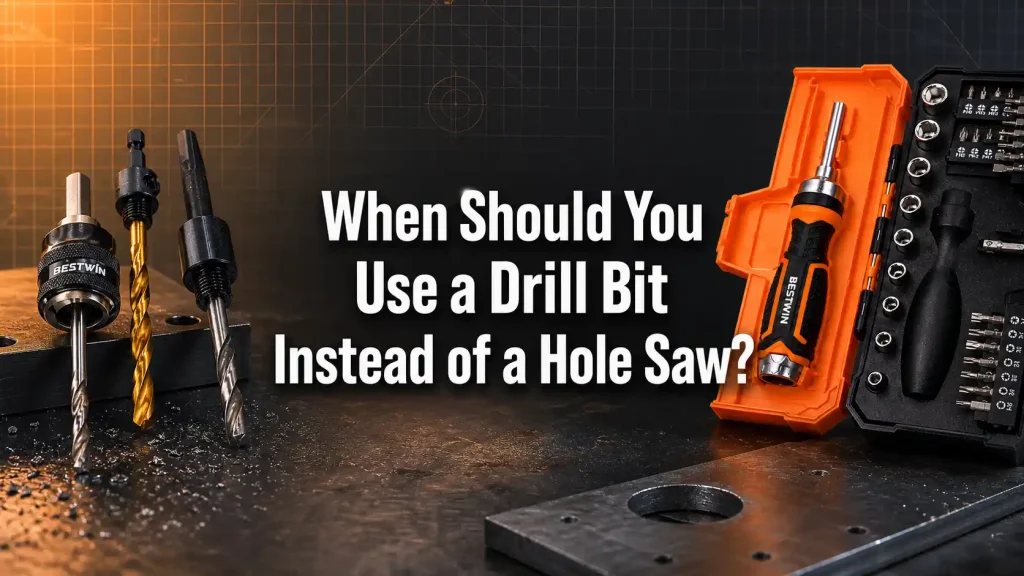
A round opening can be made in several ways, but the tool choice changes the speed, finish, accuracy, and load on the drill. An installer making a 6 mm pilot hole has a very different job from an electrician opening a 60 mm cable passage. Problems begin when the same cutting method is expected to handle both. A Drill Bit may be accurate and easy to control at smaller diameters, while a hole saw removes only a ring of material and becomes more efficient as the opening grows. Choosing between them requires more than comparing the number printed on the package.
Rýchla odpoveď
Use a Drill Bit for pilot holes, fastener holes, small through-holes, deep holes, and work that needs a solid, accurately sized bore. Use a hole saw for larger circular openings where removing the entire center would waste time, create heat, or demand too much torque. Material, diameter, depth, edge quality, tool power, access, and whether the center plug can be removed should guide the choice.
For general work, Vŕtací bit selection starts with the hole function. If a screw, anchor, dowel, bolt, or pipe fitting depends on the bore itself, the cutting design matters most. If the goal is a broad pass-through for cable, conduit, plumbing, ventilation, or hardware, a compatible hole saw is often the more practical cutter.
The Basic Difference Is How Material Is Removed
A standard Drill Bit cuts the full cross-section of the hole. Its point establishes the center, cutting lips remove material from the middle outward, and flutes carry chips away. As diameter increases, the tool must remove more material, and the required torque rises. This method is efficient for small and medium bores, especially when depth, straightness, or a controlled bottom matters.
A hole saw is a cylindrical cutter with teeth around its rim. It cuts an annular path and leaves a center plug. Because it removes less material, it can make a much larger opening than a conventional bit of similar drilling effort. The tradeoff is that the tool is bulkier, needs room for the body and arbor, can trap a plug, and may require more careful starting and chip clearance.
Rozdiel ovplyvňuje výsledné dielo. Vrták vytvára súvislý otvor, ktorý môže viesť skrutku alebo slúžiť ako referenčný bod pre neskoršie obrábanie. Vykružovacia pílka vytvára veľký otvor s relatívne úzkou škárou. Žiadny z nástrojov nie je univerzálne lepší. Každý je efektívny, keď jeho rezacia činnosť zodpovedá účelu otvoru.
Choose a Drill Bit for Fasteners and Accurate Small Holes
Fasteners need controlled diameter. Pilot holes for screws, clearance holes for bolts, holes for wall anchors, dowels, rivets, and alignment pins are normally Drill Bit work. A hole that is slightly too large may reduce thread engagement or anchor grip, while a hole that is too small may split wood, overload the fastener, or make installation difficult.
Depth control also favors a conventional bit. A stop collar, tape marker, depth rod, or machine stop can limit penetration. The flutes provide a path for chips from a deeper bore, although the operator still needs to withdraw the tool when chips pack. A Drill Bit is easier to use for blind holes because it does not require extracting a center plug from a cup.
Small holes are also easier to place accurately. The point can locate a center mark, and a short rigid bit can resist wandering when the surface is prepared correctly. For repeated fabrication, a guide, jig, drill press, or bushing can keep the Drill Bit square and improve consistency.
Typical jobs include cabinet hardware, shelf pins, electrical mounting screws, metal brackets, concrete anchors, wooden joints, and starter holes for larger cutters. In many large-opening operations, the pilot Drill Bit in the arbor still determines where the hole saw starts.
Choose a Hole Saw for Large Pass-Through Openings
Large openings create a different problem. A conventional Drill Bit big enough to remove the full center may require heavy torque, a powerful machine, and a rigid setup. In sheet metal, wood panels, plastic, or wallboard, removing a narrow ring is usually faster and produces less waste. A hole saw is therefore common for conduit, cable glands, pipes, locks, recessed hardware, and service penetrations.
The hole saw must match the material. Tooth form, tooth pitch, body construction, and cutting-edge material affect whether the cutter works in wood, steel, stainless sheet, plastic, masonry, tile, or composite panels. A bi-metal saw that works well in sheet metal is not automatically suitable for ceramic tile, and a carbide-tipped cutter needs different feed control from a general wood saw.
The center plug is part of the process. In thin sheet it may come free easily, while thick or layered material can trap it inside the cup. The operator needs a safe way to stop the tool, remove the plug, and clear chips. A hole saw saves cutting effort at larger diameters, but it adds handling steps that a normal Drill Bit does not have.
Table 1. Drill Bit and Hole Saw Comparison
| Decision factor | Vŕtací bit | Kružidlová píla |
|---|---|---|
| Typical diameter | Small to medium | Medium to large |
| Material removed | Full bore | Narrow circular kerf |
| Best use | Fasteners, anchors, dowels, deep bores | Cable, pipe, conduit, locks, broad pass-throughs |
| Depth capability | Good with chip clearing and suitable length | Limited by cup depth and plug removal |
| Center control | Point locates the hole | Pilot bit and arbor locate the cutter |
| Torque at large size | Rises quickly | Often more efficient, but can grab strongly |
| Blind-hole use | Practical | Usually inconvenient |
| Main maintenance concern | Cutting lips, point, flutes, shank | Teeth, cup, arbor, pilot bit, plug clearance |
Start With Hole Function, Not Tool Appearance
The hole function is the best first question. A neat circular shape is not enough. Ask what will pass through the hole, what will contact its wall, how accurately the diameter must be held, whether both faces are visible, and whether the opening stops inside the material or passes through it.
If the wall of the hole supports a fastener, bearing surface, dowel, or anchor, use a Drill Bit with a cutting design suited to the material. If the opening only provides clearance around a cable or pipe, a hole saw may be faster. If the hole needs a flat bottom, neither a general twist bit nor a standard hole saw may be ideal; a different boring cutter may be required.
Access changes the choice. A deep beam or thick timber may exceed the cup depth of a hole saw. A long Drill Bit or auger may reach through, but it must stay straight and clear chips. In a thin enclosure wall, a hole saw can create the required diameter without the bulk and torque of a very large solid cutter.
The center condition matters too. A hole saw leaves a plug, which may be useful when the removed piece needs inspection, but inconvenient in layered panels. A Drill Bit converts the center into chips, which is easier in a blind hole but creates more waste and heat at large diameter.
Match the Cutter to the Material
Wood allows many options, but grain and finish determine the best setup. A sharp Drill Bit can make clean pilot, dowel, and hardware holes. For a large cable opening, a hole saw reduces material removal. Backing the exit side helps both tools avoid splintering. Large wood holes near an edge require careful feed because either cutter can split weak grain.
Metal demands attention to speed, lubrication, work hardening, and chip form. A small Drill Bit is usually the first choice for fasteners and pilot holes. A hole saw becomes useful for larger openings in sheet, box sections, and panels, provided the teeth and cutting speed match the metal. Excessive speed can destroy either tool, while insufficient feed can rub rather than cut.
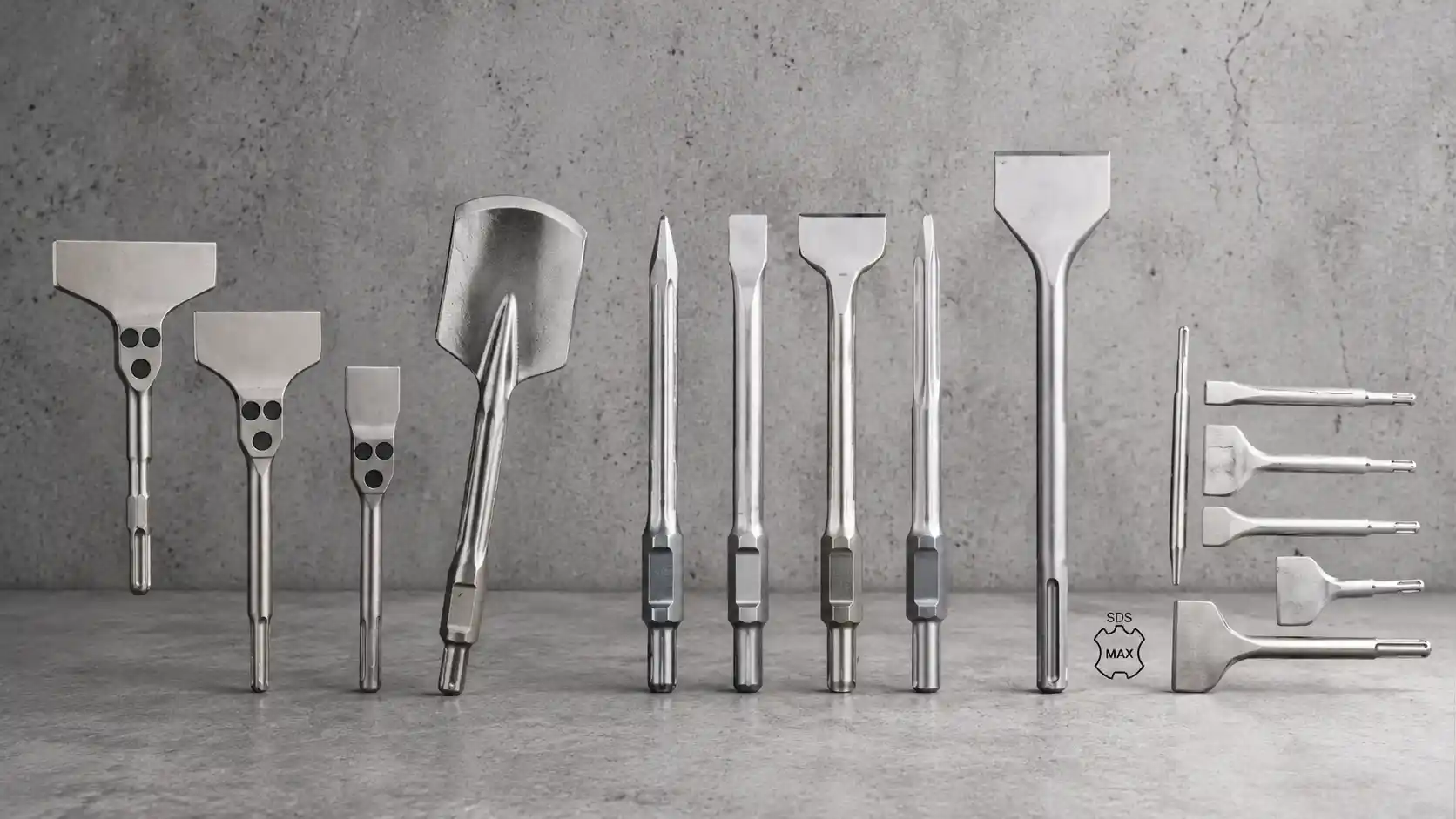
Masonry and concrete use impact-compatible or rotary-hammer cutting systems. A masonry Drill Bit is appropriate for anchors and small service holes. Larger penetrations may require a core-style cutter rather than a general hole saw. The tool, shank, and machine mode must be compatible. Running an impact cutter in the wrong chuck or using hammer action on an unsuitable cup can damage the tool and workpiece.
Tile, glass, and brittle surfaces need cutters designed to avoid cracking and uncontrolled edge chipping. The work should be supported, and the start should be controlled without excessive impact. The broad term vŕtačka covers many cutting designs, so material compatibility should be confirmed rather than assumed from diameter alone.
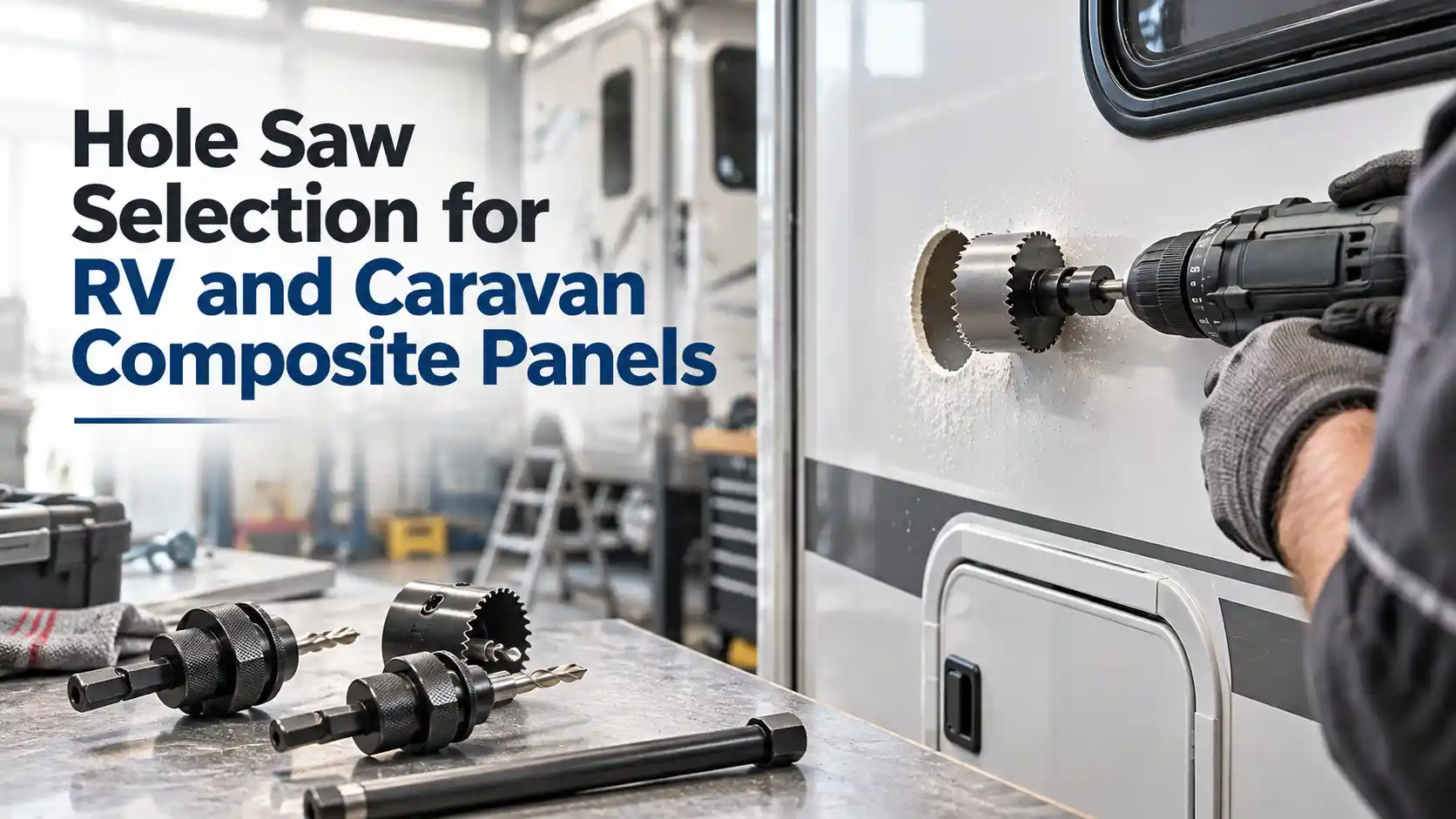
Plastic and composite panels can melt, fray, or delaminate. Sharp edges and moderate heat are important. A Drill Bit may grab as it exits thin plastic, while a hole saw may build heat if chips remain in the kerf. Test cuts on matching scrap can reveal the correct speed and support method before a finished panel is drilled.
Diameter Changes Torque, Speed, and Control
As cutter diameter grows, the cutting edge moves faster at the same spindle speed. That is why a large tool normally needs a lower rotational speed than a small one. A large Drill Bit operated at a speed suitable for a small bit can overheat, grab, or overload the machine. A hole saw has the same surface-speed concern because its teeth run at the outer diameter.
Torque demand also increases with radius. A cutter that catches at 60 mm has much more leverage than one that catches at 6 mm. The operator should use a drill with suitable low-speed torque, a secure side handle when provided, and a stable stance. The workpiece must be clamped so it cannot spin or lift.
Do not assume that a hole saw is automatically easy because it removes less material. It can still bind when the cut is angled, chips pack, teeth catch a seam, or pressure is uneven. A large Drill Bit can also self-feed aggressively in wood or break through suddenly in sheet metal. Controlled speed and feed are part of selection, not merely operating technique.
Check the Drill, Chuck, Arbor, and Shank
Fréza musí pasovať do stroja. Potvrďte kapacitu skľučovadla, typ stopky, menovitý priemer, rozsah otáčok, krútiaci moment, režim príklepu alebo rotačný režim a obmedzenia výrobcu. Vŕtací nástroj s okrúhlou, šesťhrannou, SDS alebo inou stopkou potrebuje správny držiak. Vynútenie nekompatibilnej stopky do skľučovadla znižuje upnutie a môže poškodiť obe časti.
A hole saw adds an arbor and pilot assembly. The arbor must fit the cup and the drill. Drive pins should engage where the system uses them, threads should be clean, and the pilot should be straight. A loose arbor can create runout, rough edges, and repeated shock. The pilot Drill Bit should extend far enough to establish the center before the saw teeth touch, but not so far that it creates an unnecessary obstacle behind the work.
Inspect the chuck or holder before a large cut. Worn jaws, dirt, oil, or incomplete insertion can allow a Drill Bit to slip. On a hole saw, the same problem affects the whole assembly and may be more severe because torque is higher. Tighten the system according to its design and recheck after a short test when the job is demanding.
Use the Pilot System Correctly
The pilot hole controls the beginning of a hole saw cut. Mark the center, support the work, and start square. The pilot Drill Bit should enter first and stabilize the arbor. If the tool is tilted when the teeth touch, one side can strike before the other, causing walking, chipped teeth, or an oval entry.
In delicate surfaces, a guide template can control the cup more reliably than a pilot alone. This is useful when an existing opening must be enlarged and there is no center material for the pilot. A securely clamped template gives the hole saw a circular guide. Trying to balance the cup freehand around an existing opening is likely to damage the edge.
For a conventional Drill Bit, a center punch, awl mark, brad point, guide bushing, or starter hole can improve location. The correct method depends on material. A deep punch mark in thin sheet may distort the panel, while no starting mark on hard metal may let the bit walk. The objective is a controlled start without weakening the work.
Compare Edge Quality and Finishing Work
The required finish can change the economical choice. A small, sharp Drill Bit can leave an accurate edge with little cleanup. A hole saw may leave burrs in metal, fibers in wood, or a rough exit if pressure is not reduced. The opening may be acceptable for concealed conduit but not for a visible fitting without deburring or trimming.
Backing material supports the exit side in wood, laminate, and plastic. In sheet metal, a deburring tool may be needed after either cutter. In painted panels, protect the finish and control chips so they do not scratch the surface. A Drill Bit that creates long metal chips needs careful handling; a hole saw can create a sharp circular slug.
If both faces are visible, consider cutting from both sides after the pilot passes through. This can reduce breakout with a hole saw in wood or laminated panels. A Drill Bit may also benefit from reduced feed near breakthrough. The final millimeters often determine whether the edge is clean or damaged.
Accuracy should be defined realistically. A standard hole saw is useful for installation openings, but it is not a precision reamer. A general Drill Bit may also produce a hole slightly larger than nominal because of runout, uneven lips, machine movement, or material behavior. If the fit is critical, plan the finishing method rather than expecting one roughing tool to deliver a finished tolerance.
Manage Chips, Heat, and Cutting Pressure
Both tools need chip space. A Drill Bit carries chips through its flutes, while a hole saw must clear chips from a narrow circular kerf. Deep cuts need pauses for chip removal. Packed chips increase heat, torque, and side force, which can dull the cutter or damage the edge of the opening.
Use enough feed for the cutting edges to bite, but do not force the tool. Rubbing creates heat without useful progress. In metal, appropriate cutting fluid may reduce friction and carry heat away. In wood and plastic, excessive heat can burn, melt, or load the teeth. The correct speed and feed should produce consistent chips rather than smoke or polished dust.
Pecking can help a Drill Bit clear a deep bore. For a hole saw, withdraw periodically so chips can leave the kerf and air can reach the teeth. Stop the machine before removing a trapped plug. Do not pull at a plug while the cup can rotate.
Recognize When the First Choice Is Wrong
Slow progress is not always a reason to push harder. If a Drill Bit squeals, burns, produces powder instead of chips, or needs increasing pressure, check sharpness, speed, material compatibility, and chip packing. If a hole saw shakes, walks, loses teeth, or creates a heavily tapered opening, inspect the pilot, arbor, cup, setup angle, and machine capacity.
The wrong diameter range is another warning. Using a very large conventional Drill Bit in a light handheld drill may create unacceptable torque. Using a hole saw for a tiny fastener hole adds cost and reduces accuracy. Using a shallow cup in thick stock leads to repeated plug removal and may prevent the cutter from reaching through.
The best correction may be a different tool family. A step cutter may suit thin sheet with several hole sizes. An annular cutter may suit machine-based metal fabrication. A core cutter may suit masonry penetration. A Drill Bit and a hole saw cover many tasks, but responsible selection includes recognizing their limits.
Table 2. Practical Selection Checklist
| Question | Choose a Drill Bit when | Choose a hole saw when |
|---|---|---|
| What is the hole for? | A fastener, anchor, dowel, or accurate bore | A cable, pipe, lock, vent, or broad clearance opening |
| How large is the diameter? | Small or moderate | Large enough that full material removal is inefficient |
| Is the hole blind? | Depth must stop inside the work | Usually avoid unless the plug can be managed |
| Is the material thick? | A suitable long bit can clear chips | Cup depth and plug removal remain practical |
| Is finish critical? | Bit design can control the bore | Edge can be deburred or trimmed after cutting |
| Is the machine light-duty? | Diameter stays within chuck and torque limits | Priemer píly zostáva v rámci udávanej kapacity vŕtačky |
| Is there an existing opening? | A guide can place a new small bore | A template can guide the cup without a pilot center |
Avoid Common Selection and Operating Mistakes
Jednou chybou je výber len podľa priemeru. Dva nástroje môžu mať rovnakú nominálnu veľkosť, ale byť určené pre rôzne materiály, hĺbky, stroje a úrovne dokončenia. Ďalšou chybou je ignorovanie účelu otvoru. Priepustný otvor a otvor pre spojovací materiál nemajú rovnaké požiadavky na toleranciu alebo povrch.
Another mistake is using maximum speed to finish faster. Large cutters normally need lower speed. Excess speed damages a Drill Bit edge, overheats a hole saw, and increases the consequence of a catch. Excessive pressure is equally harmful because it bends the cutter, overloads the drill, and makes breakthrough harder to control.
Poor workholding is a serious error. The work should not be held by hand when the cutter can grab it. Thin sheet, small brackets, and round parts are especially likely to spin. Clamp the work, support the exit side, and keep hands away from the cutting path and sharp chips.
Finally, operators sometimes keep using a damaged pilot or arbor because the cup still looks usable. A bent pilot Drill Bit makes the whole hole saw orbit. Loose threads or worn drive pins create shock. The support components deserve the same inspection as the cutting teeth.
Build a Useful Kit Around Real Jobs
A practical kit is based on repeated work. Installers who handle anchors and hardware need a range of compatible Drill Bit sizes, depth control, and replacements for the most frequently worn diameters. Teams making electrical and plumbing openings need hole saw sizes that match common conduit, glands, locks, and pipe clearances, along with sound arbors and spare pilots.
Storage should keep sizes visible and cutting edges protected. Mixed loose tools lead to wrong-size selection and chipped edges. Clean off chips and moisture before storage, inspect the shank, and replace a bent or badly worn cutter. A sharp Drill Bit and a sound hole saw reduce load on the machine and improve repeatability.
Procurement should record material, diameter range, shank or arbor system, machine type, and expected quantity of holes. That information is more useful than ordering a generic assortment without knowing the work. A small focused kit often performs better than a large set with many unsuitable sizes.

How Bestwin Fits the Final Choice
Once the hole function, material, diameter, depth, finish, and drill capacity are clear, the product category becomes straightforward. Bestwin drill-bit ranges can support anchor, fastener, woodworking, and rotary-hammer tasks, while its hole-saw products cover larger pass-through work in compatible materials. The useful comparison is not which category is better, but which cutter removes the required material with the least unnecessary load and finishing work.
For small and controlled bores, Drill Bit options should be matched to the work material and holder. For broad openings, a suitable TCT or bi-metal hole-saw system may reduce cutting volume, provided the arbor, pilot, speed, and machine capacity are correct. This keeps the buying decision connected to the job rather than to a general product label.
Konečné zhrnutie
Use a Drill Bit when the bore itself matters: fasteners, anchors, dowels, alignment, depth, and smaller accurate holes. Use a hole saw when the goal is a larger circular opening and removing only a ring of material is more efficient. Material compatibility, diameter, depth, edge finish, torque, chip clearance, workholding, and holder condition should be checked before the trigger is pulled.
The most reliable choice begins with the finished opening. Define what passes through it, what touches its wall, how clean it must be, and what the drill can safely drive. Then select the cutter, speed, support, and finishing method as one system. That approach produces cleaner work, reduces damaged tools, and prevents a simple hole from becoming an expensive repair.









 English
  العربية
  Français
  Português
  Português do Brasil
  Italiano
  简体中文
简体中文  繁體中文
繁體中文  日本語
日本語  한국어
한국어  Deutsch
  Español
  Slovenčina
  ไทย
ไทย  Türkçe