
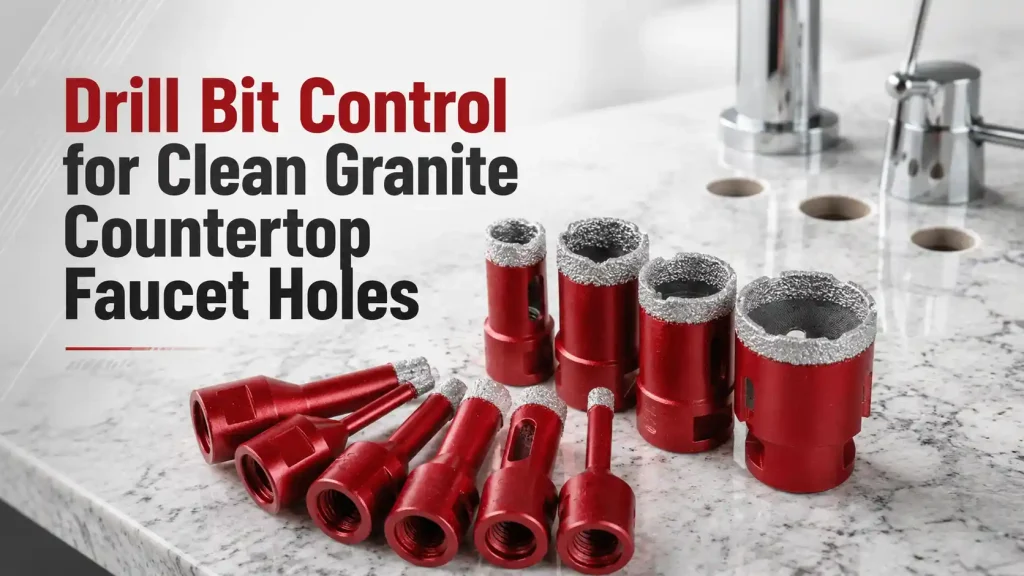
A granite countertop faucet hole can look acceptable from above and still be unsuitable for production. Chipping may sit under the flange, the bore can run out, the underside can break away, or the tool can slow sharply near breakthrough. Those outcomes are not controlled by the material name alone. At Bestwin, we manufacture hole-making tools for stone workshops, countertop fabricators, OEMs, and distributors, and we match each Drill Bit direction to the actual slab, diameter, machine interface, cooling method, and finish limit. Our goal is a repeatable hole and a reproducible product identity—not a one-time cut that depends on an operator rescuing the process.
快速回答
A Drill Bit makes clean faucet and accessory holes in a granite countertop when its cutting specification, diameter, runout, interface, speed, feed, cooling, starting method, and breakthrough support are treated as one process. For dense natural stone, a diamond hole-saw direction is often evaluated, but the final construction and operating window must be proven on the actual slab. We use representative coupons or production offcuts, record entry and exit quality, measure the bore, track cutting time and tool wear, and repeat the test after the tool is no longer new. That evidence lets us manufacture and release the agreed tool instead of relying on a broad “for granite” label.
The Finished Hole Is More Than Its Nominal Diameter
The faucet drawing normally starts with a diameter, but the finished requirement is wider. The fixture must pass through the bore, the flange or gasket must seat on an undamaged surface, the hole center must remain within the layout tolerance, and the remaining stone around the opening must retain enough integrity for handling and installation. A Drill Bit that produces the correct nominal size can still fail if the bore is tapered, oval, off-center, or surrounded by chips that extend beyond the cover plate.
We begin with the fitting and countertop drawing rather than a generic size list. The useful inputs include finished diameter tolerance, slab thickness, top and bottom finish limits, edge distance, distance to a sink cutout, and whether the hole intersects a laminated build-up. A soap dispenser, air switch, filtered-water faucet, and main mixer can each have different clearance and cosmetic limits. When several openings appear in one countertop, the worst location—not the easiest center position—sets the sample condition for the Drill Bit.
The installation sequence also matters. A hole cut in a loose slab can be supported and cooled differently from one added after the countertop is installed. A vertical field cut changes water control, chip evacuation, and machine stability. Our standard project route is workshop production with controlled equipment, but we still document the intended orientation. We do not transfer a test result from a rigid bench drill to a hand-held field process without repeating the relevant checks.
Granite, Engineered Stone, and Sintered Surfaces Need Separate Records
“Stone countertop” can refer to materials with very different cutting behavior. Natural granite varies in mineral composition, grain size, fissures, and reinforcement. Engineered quartz combines hard mineral content with resin and may respond differently to heat and loading. Sintered stone and porcelain slabs can be extremely hard and brittle, with a finished surface that chips differently from the body. One Drill Bit label does not establish equal performance across those groups.
We ask for the trade name, material family, thickness, surface finish, mesh backing, resin repair, and any laminated edge or substrate. A representative offcut is the strongest starting point because it captures details that a short material description misses. If several slab sources will be used in production, the sample plan includes the most abrasive and the most fracture-sensitive variants. That prevents a Drill Bit approval from being based on one unusually easy piece.
Natural variation means that one hole is not a useful lifetime claim. The first bore can intersect a different mineral structure from the tenth. We therefore judge a sequence of holes and retain photographs plus cutting-time data. Sudden variation can indicate the slab, the tool, cooling, or machine movement. A controlled record helps us separate those effects and avoids changing the Drill Bit specification in response to one isolated mineral pocket.
Start With the Drill Bit Interface and Runout
The cutting edge cannot follow a clean circle if the machine interface does not hold a clean axis. Thread type, arbor fit, adapter stack, spindle condition, chuck grip, and tool-body concentricity all affect runout. A longer adapter can magnify small alignment errors. A worn spindle or contaminated mating surface can make a new Drill Bit appear defective even when its own geometry is within the agreed limit.
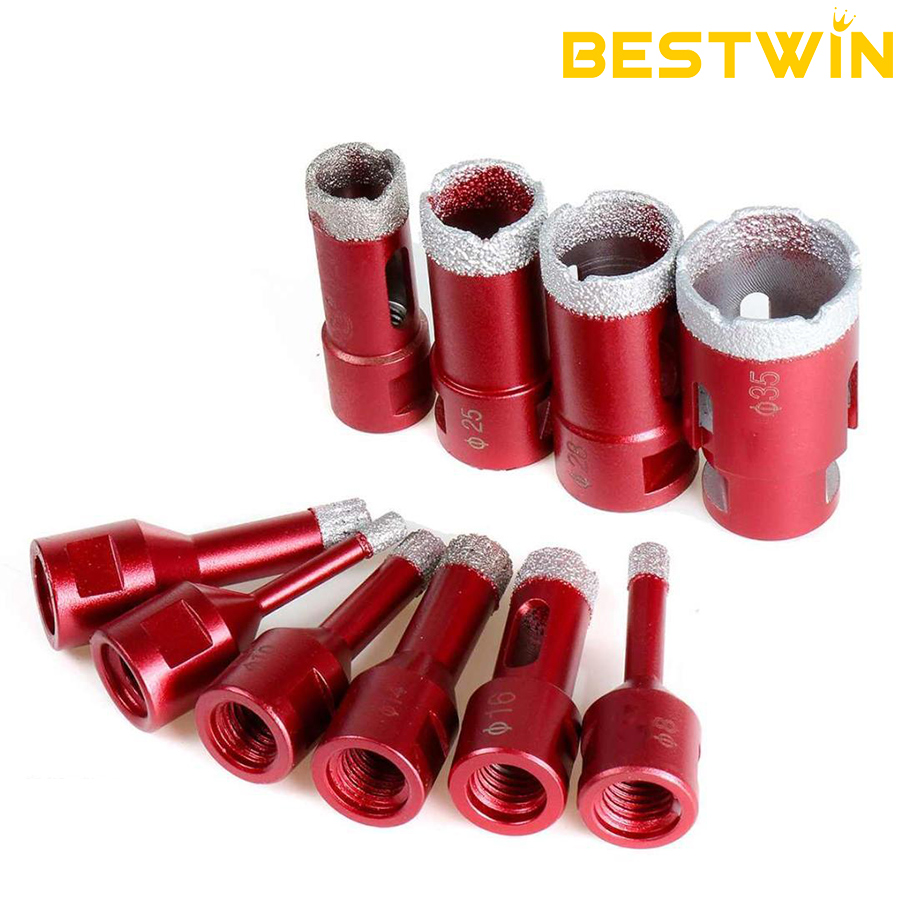
For the M14 brazed diamond hole-saw direction shown above, the interface must match the intended machine. An M14 thread does not become compatible with every drill or grinder simply because an adapter exists. We review speed range, guarding, wet-use suitability, support, and the complete adapter arrangement. If a customer needs a different interface, we record it as a separate configuration rather than assuming the cutting body can be moved between machines without a new sample.
Runout is checked close to the cutting end and, where practical, at more than one angular position. The machine contribution and the tool contribution should not be mixed into one unexplained number. We inspect thread cleanliness and seating, mount the Drill Bit according to the agreed method, and record the indicator setup. For repeat orders, the interface dimensions become controlled characteristics because they influence both hole geometry and vibration.
Starting accuracy deserves the same attention. Annular diamond tools do not always have a pilot point, so the process may use a guide, template, angled entry, or machine-controlled interpolation. The chosen method must keep the Drill Bit from walking across the finished surface. If a guide is used, its clearance and wear condition are part of the production setup. A loose guide can enlarge the entry even when the rest of the bore is acceptable.
Drill Bit Cooling and Slurry Removal Protect the Cutting Zone
Water can cool the contact, carry abrasive slurry away, and reduce airborne dust, but “wet drilling” is not a complete operating instruction. Flow direction, volume, containment, and continuity matter. If water reaches only the outside of the Drill Bit while slurry packs inside the annulus, cutting can slow and temperature can rise. If flow stops near breakthrough, the final part of the hole may experience the highest stress.
我们以可观察的方式规定了取样方法:水进入的位置、流速是否连续、岩芯和矿浆如何离开切口,以及在流速中断时会发生什么。机器和工作场所的控制措施也必须适合湿式操作。电气安全、飞溅控制、防滑和矿浆收集仍然是客户生产系统的一部分;我们的工具记录不能取代这些现场控制措施。
Dry or limited-water processes require their own validation. Dust extraction, short cutting intervals, cooling pauses, and tool construction can differ. Dense stone dust is abrasive and can mask the sound or feel that signals a changing cut. We do not take a wet-test result and present it as proof of dry performance. The Drill Bit must be sampled in the method that will actually be released.
Table 1. Granite Hole Requirement and Sample Evidence
| Requirement | Project input | Sample evidence | Release focus |
|---|---|---|---|
| Finished diameter | Fitting drawing, tolerance, coating or plating clearance | Bore measurement at entry, middle, and exit | Fit without excessive play or interference |
| 表面光洁度 | Visible-side chip limit and flange coverage | Standard-light photographs with scale | Damage remains inside the agreed cosmetic boundary |
| Position and axis | Hole center, edge distance, sink-cutout relationship | Template check and axis/runout record | Opening stays within layout and assembly tolerance |
| Material condition | Granite source, thickness, mesh, repairs, lamination | Identified slab coupon and retained sample | Test represents the production construction |
| Cutting process | Machine, interface, speed, feed, cooling, guide | Setup sheet, cutting time, operator observations | Method is reproducible without rescue actions |
| Tool durability | Expected holes per tool and quality limit | Sequential-hole log and wear photographs | Quality remains acceptable through the agreed interval |
Speed and Feed Need a Window, Not One Magic Number
The correct rotational speed depends on diameter, tool construction, stone, machine behavior, and cooling. A larger Drill Bit has a higher rim speed at the same spindle rpm, so a number copied from a smaller size can create a different cutting condition. Feed also changes through the hole. Excessive force can increase vibration and breakout; too little effective cutting can allow rubbing, loading, and unnecessary heat.
We establish a practical operating window during samples. The record includes machine model, no-load setting, loaded behavior if available, feed method, water condition, and average cutting time. The objective is not to force every operator to reproduce one perfect second count. It is to define a stable range in which the Drill Bit cuts without abnormal noise, glazing, severe slowdown, or damage beyond the finish limit.
Operator feel can help during development, but it cannot be the only control for a repeat program. Phrases such as “light pressure” or “not too fast” need measurable support. A drill stand can use a feed setting or travel-time range. A CNC machine can retain a program. A hand-held workshop process can still use a guide, speed band, time expectation, and stop rule. We convert the successful sample into the most concrete instructions the equipment allows.
这 钻头 category provides the broader product context, while the released tool must retain its own diameter, interface, cutting specification, and process boundary. Two sizes from the same family may require different speed windows because rim velocity, contact area, core removal, and machine stability change with diameter.
Entry Control and Breakthrough Control Are Different Problems
The visible top face usually receives the most attention, but entry and exit damage have different causes. At entry, walking, guide clearance, impact, and insufficient surface support can chip the finish around the circle. During the body of the cut, runout and packed slurry can widen or polish the bore unevenly. Near breakthrough, the remaining stone becomes thin and less able to resist thrust. A Drill Bit process that starts clean can still break a large underside fragment at the end.
We record both faces. If the underside will be hidden, it may have a different cosmetic limit, but uncontrolled breakout can still reduce strength or interfere with a washer and nut. Reducing feed near breakthrough, supporting the underside, or drilling from both faces may be evaluated where the geometry allows. Each method has alignment implications, so it must be proved rather than described as an automatic cure.
Drilling from both sides can protect two finished faces, but the axes must meet accurately. A small center error can create a step in the bore or an oval transition. The guide or CNC reference therefore becomes critical. If a laminated edge or sink reinforcement is nearby, support must reflect the final construction. A test in an open center coupon may not reproduce the stress around the actual faucet deck.
A New Drill Bit and a Production Drill Bit Must Both Pass
The first hole made by a fresh Drill Bit often receives ideal conditions: a clean tool, a carefully prepared guide, continuous water, and full operator attention. Production approval requires more. We continue the sequence until the agreed inspection interval or lifetime target is represented, then compare cutting time, bore size, surface damage, noise, and visible wear. A tool that cuts one excellent hole but degrades unpredictably does not provide a stable basis for a countertop program.
Wear does not need to look dramatic to affect the process. Diamond exposure, bond behavior, edge rounding, body distortion, thread damage, or slurry packing can change how the tool enters and clears material. We photograph the cutting rim at defined intervals and clean the Drill Bit consistently before inspection. If dressing or another maintenance action is part of the intended method, the trigger and procedure must be documented.
更换规则应与输出质量挂钩。固定数量的孔可能很方便,但材料变化可能导致磨损提前或延迟。有用的停止信号包括切割时间超出约定范围、切屑超出允许边界、直径漂移、异常振动或可见损坏。我们帮助将样本记录转化为实际的检查间隔,同时将最终决定与客户的材料和工艺联系起来。
At this stage, our role as a Drill Bit manufacturer becomes directly relevant. At Bestwin, we match the tool body, diamond cutting direction, interface, critical dimensions, marking, and sample evidence to the agreed application. We manufacture and inspect the production identity against that record, so a reorder can refer to a controlled configuration instead of an image or a generic stone-tool name.
Drill Bit Quality Evidence Must Travel From Sample to Batch
A good sample is useful only if its identity survives into production. We assign controlled dimensions and appearance criteria to the Drill Bit, retain the approved configuration, and connect incoming material, in-process checks, and final inspection to the order. The exact control plan depends on the product, quantity, and agreement, but the principle remains the same: functional evidence and manufacturing identity must not separate after approval.
Packaging is functional for an abrasive cutting edge. Contact between tools can damage a rim before the first hole. Threads and seating faces also need protection from impact and contamination. We review individual separation, box strength, moisture exposure, label readability, and count method according to the order route. A Drill Bit that passes factory inspection should arrive in the same controlled condition.
Table 2. Production Release Checks
| Check | Factory record | Functional connection | Revalidation trigger |
|---|---|---|---|
| Interface and seating | Thread or shank dimensions, fit inspection | Controls alignment and machine compatibility | Interface, adapter, or machine change |
| Body geometry | Diameter, roundness, critical length, runout method | Influences bore size, vibration, and axis | Tool-body or forming-process change |
| Cutting rim | Agreed abrasive construction and visual standard | Influences cutting rate, heat, and edge quality | Diamond or bond specification change |
| Sample cutting result | Identified slab, setup, hole sequence, photos, measurements | Confirms performance on the target countertop | Material family, thickness, or method change |
| Marking and traceability | Product code, size, batch or order identity | Keeps field feedback connected to the build | Label or coding change |
| Packing protection | Rim separation, moisture and impact protection, quantity | Prevents transport damage before first use | Packing format or shipping route change |
Within the Drill Bit Suppliers category, we make our value concrete by connecting the actual granite sample, tool identity, process window, inspection result, packing method, and change rule. At Bestwin, we keep that connection in the project record and use it to support repeat production.
As a Drill Bit supplier, we can also align marking, packaging, and inspection documents with OEM and distributor programs when the requirements are defined. That customization does not replace application testing. Private labeling, color, or box artwork can identify the order, but the cutting configuration and representative stone result remain the foundation.
Troubleshoot Drill Bit Performance With Evidence From the Hole
When a hole quality problem appears, the location and timing provide clues. Entry chips point toward starting movement, guide condition, impact, or surface sensitivity. A polished bore and rising cutting time can point toward ineffective cutting or poor slurry removal. A tapered or oval hole suggests alignment, runout, uneven loading, or machine movement. Large underside breakout focuses attention on support and feed near breakthrough. The Drill Bit should be inspected with the slab and setup evidence, not in isolation.
我们需要提供带有标尺的两个面部照片、已移除的岩芯(如果可用)、清洁前的工具边缘、机器和适配器布置、供水、速度设置、切割时间以及工具寿命中的孔数。一段短视频可以显示行走、振动或冷却中断的情况。订单或批次标识很重要,因为它将报告与生产记录联系起来。
For a concise general description of the tool category, 钻头 explains the basic function of creating cylindrical holes. Granite countertop work adds the real qualification boundary: abrasive mineral structure, annular cutting, finish protection, coolant and slurry control, machine interface, and a functional lifetime limit.
If a process changes, we do not assume the old result remains valid. Moving from natural granite to engineered quartz, increasing slab thickness, changing from a stand to a hand-held machine, adding an adapter, reducing water, or tightening the chip limit can all justify a new sample. The required revalidation can be focused on the changed risk instead of repeating every project step without purpose.
What Information Should You Send Bestwin for Sample Evaluation?
Send us the countertop material name and source, representative offcuts, slab thickness, surface finish, backing or lamination, required hole diameter and tolerance, fitting drawing, visible-side chip limit, underside limit, edge distance, and relationship to sink cutouts. Include the machine, interface, adapter, speed range, guide or fixture, feed method, wet or dry process, water delivery or extraction, expected holes per tool, and the way operators decide that a tool is worn.
For a repeat program, add order quantity, size mix, target packaging, marking, inspection documents, sample quantity, and change-notification expectations. If more than one factory or countertop material will use the same Drill Bit, identify the range before approval. Bestwin can then match the product and sample plan to the true boundary instead of validating only the easiest combination.
The second 钻头 link gives your team a starting view of our broader range. The RFQ should still identify the stone, interface, diameter, process, and finish evidence needed for release. That is the information we use to recommend the sample direction and prepare a traceable response.
Clean Faucet Holes Begin With a Reproducible Agreement
A clean granite faucet hole is not the result of one isolated feature. It comes from the relationship among the Drill Bit construction, machine interface, runout, starting control, speed, feed, cooling, slurry removal, breakthrough support, material variation, and wear limit. When those conditions are recorded, the hole can be repeated by a production team and reviewed when something changes.
At Bestwin, we manufacture, match, sample, and inspect the tool around that complete application. We keep the approved identity connected to dimensions, cutting evidence, marking, packing, and repeat orders. Send us the actual countertop construction and process boundary, and we can prepare a Drill Bit sample that answers the question that matters to your project: whether the required faucet hole stays within fit, finish, and production limits after the first successful cut.










 English
  العربية
  Français
  Português
  Português do Brasil
  Italiano
  简体中文
简体中文  繁體中文
繁體中文  日本語
日本語  한국어
한국어  Deutsch
  Español
  Slovenčina
  ไทย
ไทย  Türkçe