
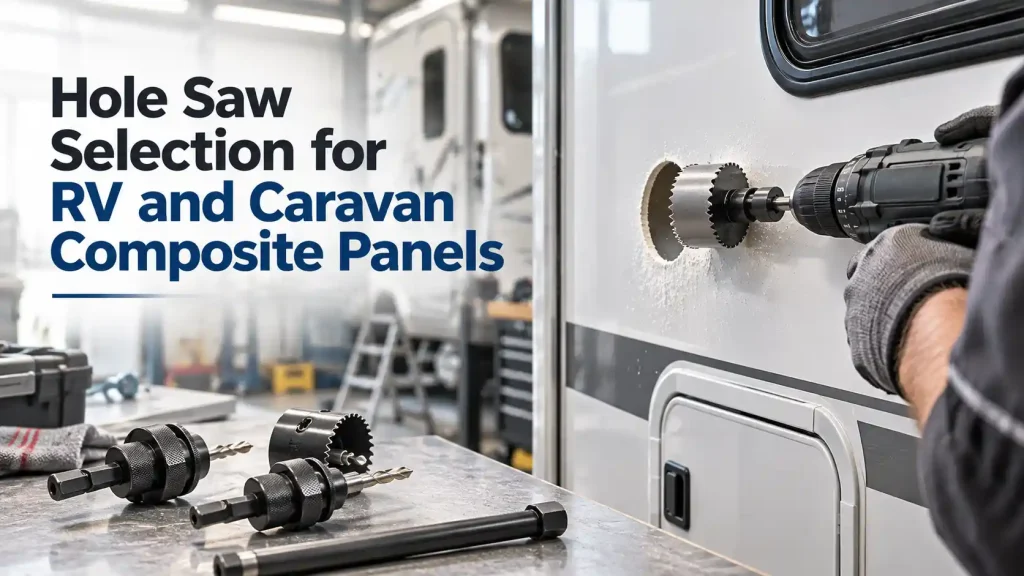
An RV sidewall can look uniform from the outside even when the cutter must pass through gelcoat, fiberglass, aluminum, plywood, foam, adhesive, decorative laminate, and a second skin. A service opening that is only slightly oversized may leave a cable gland unsupported, while a rough edge can damage a hose, wiring sleeve, seal, or trim ring. For caravan manufacturers, conversion workshops, repair networks, distributors, and OEM kit suppliers, dependable results begin with a hole saw assembly matched to the finished fitting and the complete panel construction.
快速回答
选择一个 开孔器 for RV and caravan work by starting with the actual cutout required by the installed component, then matching the cutter family, usable depth, arbor, pilot drill, and support method to every layer of the panel. HSS and bi-metal cutters cover many mixed workshop duties involving thin steel, aluminum, wood-based layers, and plastics. Carbide-tipped products are a practical direction for harder metal service plates when the product grade and thickness are compatible.
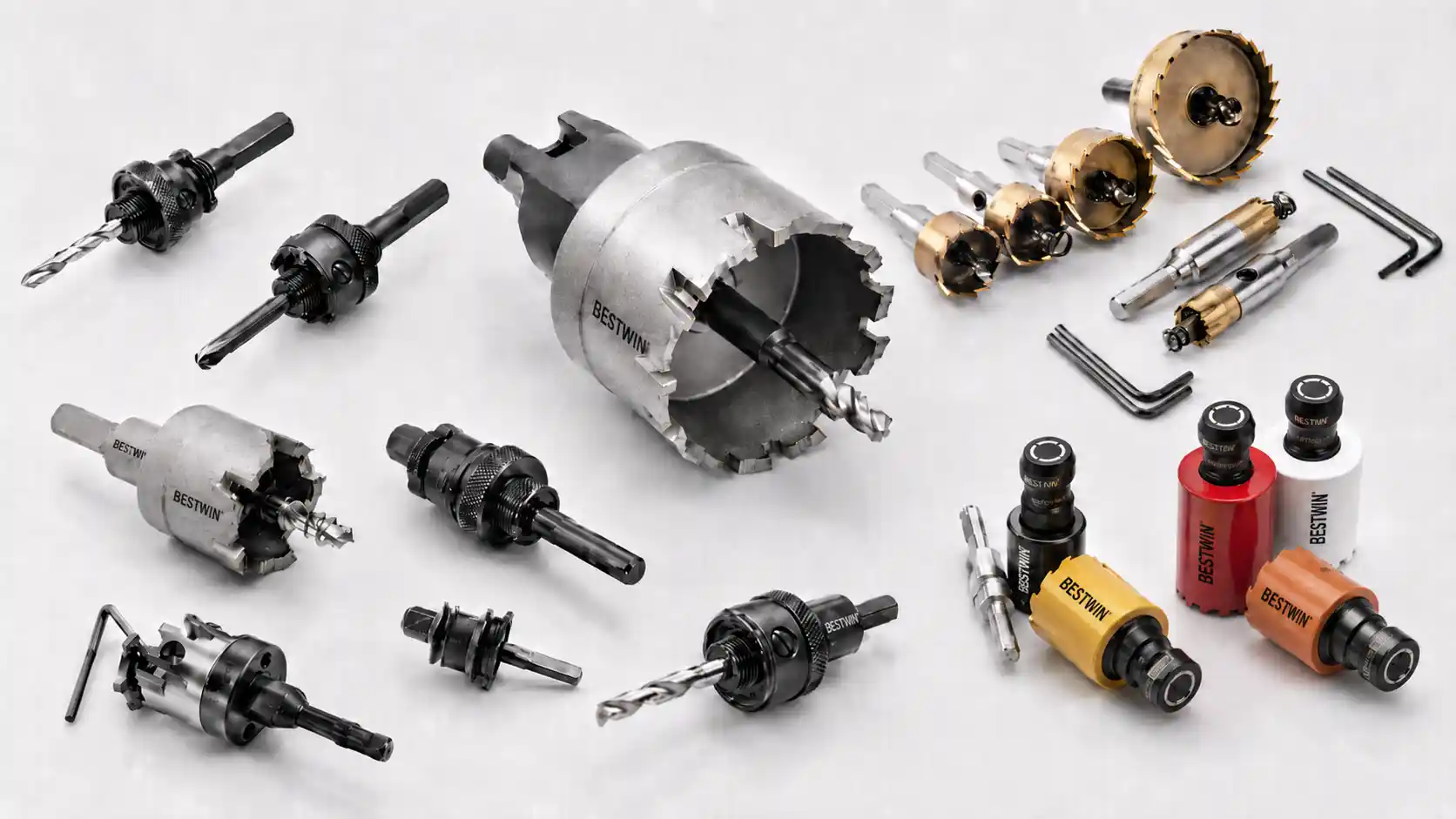
Bestwin manufactures hole saw, arbor, and pilot ranges for industrial and OEM supply and matches cutter and arbor directions to application conditions such as finished diameter, panel materials, wall depth, and production quantity. Its HSS, M42 bi-metal, TCT, and accessory options allow an RV tool assortment to be organized around real service openings rather than a random collection of diameters. Sample approval on the production panel remains essential because laminated walls and molded interior parts behave differently from single sheets.
The Installed Component Defines the Finished Opening
RV and caravan bodies use round cutouts for cable glands, water connections, drain fittings, heater ducts, sensor sleeves, antenna cable entries, appliance service lines, lighting penetrations, and ventilation components. The diameter printed on a pipe, hose, or conduit is rarely enough to select the cutter. A fitting may include a threaded body, stepped shoulder, gasket, retaining nut, or trim flange that changes the required opening.
The reliable dimension is the finished cutout stated on the component drawing or confirmed with a physical sample. Clearance needs to allow assembly without removing the material that supports the seal. An opening that is too tight can scrape threads, distort a plastic fitting, or force the installer to enlarge the edge by hand. An opening that is too large can reduce gasket contact, expose a rough laminate edge, or leave the trim ring unable to cover the cut.
The nominal diameter of a hole saw is only the starting point. Arbor runout, tooth condition, panel movement, and cutting pressure can change the result. A cutter that makes an acceptable opening in rigid bench material may produce a larger or less round hole in a flexible caravan wall. Approval should therefore use the actual fitting and evaluate both assembly and sealing contact after the panel returns to its normal position.
开孔器 sizes for an RV production kit can be grouped by the installed components they serve. This creates a practical assortment for cable entries, plumbing fittings, drains, air ducts, and service hardware while keeping replacement cups and accessories easy to identify.
Composite Construction Changes the Cutting Requirement
An RV wall is often a bonded structure rather than a single workpiece. The outer surface may be fiberglass-reinforced plastic, coated aluminum, or thin steel. Beneath it may sit plywood, foam, honeycomb, adhesive, or structural reinforcement. The interior face can be decorative plywood, plastic, laminate, or a molded panel. Roof and floor assemblies introduce their own combinations of outer membrane, insulation, wood, and inner lining.
The hole saw must be judged against the complete stack. A product that cuts the exterior skin cleanly may pack with foam or wood chips before it reaches the inner face. A hole saw suitable for the metal skin may be too aggressive at breakthrough through a brittle plastic liner. The pilot drill may remain stable in plywood but wander after entering a deep, low-density core.
Fiberglass and gelcoat faces
Fiberglass skins can chip, splinter, or delaminate near the edge if the panel vibrates or the teeth strike aggressively. Gelcoat makes surface quality visible and may crack beyond the area hidden by a flange. A sharp hole saw, square entry, controlled feed, and close support help contain damage. A sample should be checked for exposed fibers, lifted skin, and edge fractures after the protective tape is removed.
The product choice depends on the fiberglass construction and the other layers in the wall. A cutter selected only for the outer face may not be the best assembly for plywood, aluminum reinforcement, or the inner liner beneath it. Mixed-layer validation is more useful than relying on a generic fiberglass label.
Aluminum and coated metal skins
Thin aluminum can grab or distort if it is unsupported. Painted steel can show scratches or chipped coating outside the fitting flange. HSS and bi-metal products are common directions for these duties, subject to the material grade, thickness, and intended batch size. The hole saw needs to create chips rather than rub around the opening, because heat and packed swarf can damage the visible finish.
Harder metal service plates or stainless brackets may need a different cutter family from the main wall. A carbide-tipped product can be a stronger direction for some tougher metal applications. It should not be treated as a universal solution for every composite panel because tooth geometry, impact sensitivity, thickness, and exit behavior still need to match the workpiece.
Plywood, foam, and decorative liners
Plywood provides support but can leave splintered fibers on the exit face. Foam and honeycomb cores offer little guidance to the pilot, and loose material can pack inside the cup. Decorative plastic or laminated inner panels may melt, crack, or tear when the hole saw breaks through. These layers make cutting sequence and support as important as tooth material.
Table 1. RV Panel and Cutter Direction
| RV component | Typical layer condition | Product direction | 主要批准点 |
|---|---|---|---|
| Fiberglass sidewall | Gelcoat or FRP over plywood and foam | Sharp HSS or bi-metal subject to sample approval | Limited chipping and no skin lift |
| Aluminum caravan skin | Thin non-ferrous sheet over a bonded core | HSS 或双金属 | Round entry without grabbing or distortion |
| Painted steel service panel | Coated single metal sheet | Suitable HSS, bi-metal, or TCT direction | Controlled burr and coating damage |
| Decorative interior liner | Plastic, laminate, or thin plywood | Sharp cutter with close exit support | No cracking, melting, or breakout |
| Roof sandwich panel | Outer membrane, deck, insulation, and inner lining | 刀具和深度与整个堆栈匹配 | Aligned cut with protected roof surface |
| Stainless equipment plate | Harder removable service plate | Compatible TCT or metal-cutting product | Flat sealing face and repeatable diameter |
Usable Cutting Depth Must Match the Full Wall
Cup height and usable cutting depth are not always the same. Arbor hardware, internal shoulders, accumulated chips, and the center plug can reduce the distance the teeth can advance. This matters when a caravan sidewall or roof is thicker than a normal sheet-metal task.
A shallow hole saw may finish the outer skin but stop in the core. Continued pressure can compress insulation, bend the pilot, heat the panel, or loosen the visible skin from the bonded structure. A deeper cup is useful only when it also provides practical chip and plug clearance. The operator still needs access to remove packed material before it interferes with the teeth.
Some assemblies are better completed from both faces. A pilot reference can establish the center, after which each visible skin is cut from its supported side. This can reduce breakout when both faces are accessible and the center transfers accurately. The method is less suitable when furniture, tanks, wiring, or finished trim block the interior face. The cutting plan must reflect how the vehicle is assembled, not an ideal bench setup.
Hidden framing changes the decision. RV panels may contain aluminum or timber rails, bonded inserts, cables, hoses, or reinforcement around equipment zones. A hole saw that has enough depth can still be the wrong choice if the pilot or cup intersects a structural member. Approved cutout locations and verified internal clearance are part of the product application because they determine the layer stack and cutting load the tool will actually meet.
Arbor and Pilot Control the Path Through the Panel
The arbor is the mechanical link between the drill and cutter. Thread fit, drive pins, shank size, pilot retention, and the diameter range supported by the arbor affect concentricity. Excess play creates a larger kerf, an irregular entry, and uneven tooth loading. In a finished RV panel, that movement can mark a much wider area than the nominal opening.
The pilot drill establishes the center and stabilizes the hole saw until the teeth form a complete track. Its projection must suit the panel. Too little projection may let the cutter skate before it is guided. Too much projection can enter a hidden cavity early, flex inside a foam core, or strike wiring and fittings before the cup reaches the next skin.
Curved molded parts and textured surfaces make the initial contact less stable. The teeth may touch one side first and push the cutter away from the center. Where a pilot cannot be used, a secure guide or template can control the start. The guide must resist movement and should be validated with the selected cutter diameter rather than improvised during final assembly.
Bestwin supplies round, hex, SDS Plus, and quick-change arbor directions within its accessory range. An RV workshop typically benefits from a consistent interface across the most-used hole saw sizes, with separate replacement pilots and arbors. Faster changeover is useful only when the assembly seats accurately each time.

Surface Protection Depends on Support and Cutting Sequence
The outside face of a caravan is weather-exposed and highly visible. The inside face may carry decorative laminate, wall covering, or molded trim. Both faces can be customer-visible even when a fitting covers the immediate edge. Cutting quality therefore includes the surrounding surface, not only whether the center plug falls out.
Backing close to the cut limits vibration and supports the exit edge. It is straightforward on a loose service panel but more difficult on an assembled wall. A rigid backing block can be held or clamped behind some locations, while others require staged cutting or completion from the opposite side. The chosen method should protect the more sensitive face without allowing the cutter to drift.
Masking tape or a protective film can reduce incidental marks and make layout lines easier to see. It cannot compensate for a dull hole saw, loose arbor, or poor support. When the teeth stop producing clean chips, additional pressure often increases heat and surface damage. The correct response is to restore the cutting assembly or choose a more suitable hole saw, not to hide the finish under more tape.
Feed near breakthrough deserves special attention. The panel offers less resistance as the last fibers or thin skin are cut. If the operator maintains heavy pressure, the hole saw can lunge forward, tear the exit edge, and drive the pilot into a concealed space. A controlled final feed and stable drill position protect the liner and the components behind it.
Roof panels add a sealing concern. The opening must leave a flat, intact area for the flange or gasket. Surface waves, torn membrane, crushed core, or delamination can prevent even compression around the fitting. A clean hole saw cut reduces repair work, but water-tight installation still depends on the approved fitting, sealant system, and vehicle construction.
Heat Chips and Plug Removal Affect Repeated Openings
RV manufacturing and conversion work often repeats the same diameters across a vehicle model. The first opening may look good while later holes become slower, rougher, or hotter. That pattern usually points to tooth wear, packed chips, trapped laminate fragments, or a connection that is loosening during the batch.
Aluminum swarf can smear and fill the gullets. Fiberglass dust and strands can remain around the edge. Wood chips and foam may pack inside the cup, while melted plastic can wrap around the pilot. The hole saw needs to be withdrawn as required for clearance, and the tool must be stopped before debris or a plug is removed by hand.
Cutting fluids may assist some metal operations, but their use in an RV panel must consider coatings, adhesives, plastics, sealants, decorative finishes, and cleaning requirements. A fluid appropriate for a loose metal service plate may be unacceptable on a bonded sidewall. The production method should be approved with the actual materials rather than transferred from a general metalworking routine.

Plug removal has a direct effect on cycle time. A laminated plug can hold metal, fiberglass, plywood, foam, and liner material in one compressed stack. Clearance slots and access inside the cup become important when the same hole saw is used repeatedly. Excessive prying can damage the cup, bend the pilot, or nick the cutting edge before the next opening.
术语 开孔器 describes the annular cutting tool, but it does not identify the tooth material, body construction, cutting depth, arbor interface, or workpiece range. Those product details determine whether a cutter fits repeated RV panel work.
Production Approval Should Reproduce the Vehicle Panel
A useful sample uses the same outer skin, core, adhesive, reinforcement, inner liner, and surface finish as the production vehicle. A scrap of plain aluminum or plywood may confirm that the hole saw teeth cut, but it cannot show how the complete laminate responds. The drill, arbor, pilot, backing, access angle, and cutting direction should also resemble the planned workstation.
Repeated samples reveal issues that one opening can hide. An early cut, a middle cut, and a later cut show whether heat, chip packing, arbor loosening, or tooth wear changes the diameter and edge. The hole saw should be evaluated before it reaches the point where an obviously damaged opening is accepted as normal wear.
Inspection should use the installed component. A cable gland needs enough support around its sealing face. A water fitting must sit flat without stressing the wall. A hose sleeve should not rub on exposed fibers or a sharp metal burr. A trim ring should cover the edge without concealing delamination or an oversized opening. The fit of the real hardware is more informative than a diameter check by itself.
Table 2. RV Opening Approval Checks
| Check | 可接受的结果 | Likely product or setup issue when it fails |
|---|---|---|
| 直径和圆度 | 安装正确且保持稳固 | Wrong size, arbor runout, panel movement, or worn teeth |
| Exterior surface | No chip, scratch, or crack beyond the flange area | Unstable entry, trapped debris, or unsuitable tooth condition |
| Interior finish | Liner remains intact without tearout or melted ridge | Poor backing, heavy breakthrough, heat, or wrong cutting sequence |
| Laminate edge | No lifted skin or crushed core around the opening | Excess feed, poor support, or unsuitable cutter behavior |
| Sealing face | Gasket or flange sits evenly on sound material | Burr, distortion, delamination, or oversized cut |
| 重复一致性 | Later holes match the approved first opening | Wear, packed chips, arbor loosening, or changing support |
The sample record can identify the approved hole saw family, diameter, usable depth, arbor, pilot, panel code, and expected replacement point. This connects product selection to a repeatable production condition without turning approval into a general vehicle-design exercise.
An RV Kit Should Follow the Vehicle Bill of Materials
A useful kit contains the recurring diameters and compatible accessories for a defined vehicle range. It does not need every size available. A caravan line may use several cable-gland openings, one water-fill connection, drain fittings, heater or ventilation penetrations, and removable service-panel cutouts. Each opening has a material stack, depth, surface requirement, and expected frequency.
The kit list can pair every diameter with its hole saw family, arbor, pilot, and replacement reference. For an OEM program, customer requirements include the finished dimensions, panel materials, wall depth, expected quantity, compatible drill interface, packaging, and replacement plan. High-use cups and pilots deserve individual refill stock. Less common sizes can remain in the master set. Separating replacement components prevents a complete kit from being retired because one cup or pilot has reached its wear limit.
A hole saw manufacturer can support OEM and distributor programs with consistent interfaces, logical size coverage, batch inspection, replacement availability, and packaging that keeps matched parts together. Bestwin’s HSS, M42 bi-metal, TCT, and arbor ranges give RV and caravan programs several product directions for metal, plastic, wood-based, and mixed-material duties. The approved combination should remain tied to the real panel code and opening.
For distributors and repair networks, assortment labels should describe more than diameter. Cutter family, compatible arbor, usable depth, intended material direction, and replacement parts reduce incorrect substitutions at the workshop. A hole saw supplier also needs stable repeat availability because repair operations may return to the same vehicle cutouts long after the original kit was purchased.
Common Symptoms Identify the Weak Part of the Assembly
An opening that grows beyond the expected diameter often indicates arbor runout, a loose cup, a bent pilot, or a flexible panel rather than the wrong printed size alone. A crescent-shaped entry or heavy scratching on one side suggests that the cutter did not establish a stable track. A pilot hole that remains centered while the main opening drifts points back to the cup-to-arbor connection or uneven support.
Chipped gelcoat and lifted fiberglass direct attention to entry stability, tooth condition, support, and feed. An aluminum skin that wrinkles or grabs is usually under-supported or being struck too aggressively. A melted plastic liner shows excess rubbing or heat. A splintered decorative panel indicates poor exit support or an uncontrolled breakthrough.
A plug that cannot be removed may show that the hole saw cup lacks practical clearance for the laminate stack. Repeated clogging can also mean the selected hole saw is being asked to clear materials and depth beyond its efficient range. A hot hole saw with little chip production needs a product or process correction before more vehicle panels are damaged.
Corrective action should target the cause: restore backing, replace the pilot, tighten or change the arbor, clear chips more frequently, revise the cutting sequence, or select a cutter family better suited to the actual stack. Increasing drill force without fixing the assembly can enlarge the opening and accelerate surface damage.
常见问题解答
Can one hole saw cut every layer of an RV sidewall?
It can be possible when the hole saw’s material capability, usable depth, chip clearance, and pilot arrangement suit the full laminate. Thick walls, sensitive liners, or hidden reinforcement may require staged cutting or completion from the opposite face. The selected hole saw should be tested on the full production panel.
Is a bi-metal cutter suitable for fiberglass and aluminum RV panels?
Bi-metal hole saw products cover many mixed workshop materials, including thin metal, wood, and some plastics, but RV laminates vary. Fiberglass construction, aluminum thickness, backing, adhesive, and the inner liner all affect the result. Approval on the complete panel is more reliable than selecting from the outer skin alone.
Why does the inner wall tear when the exterior opening is clean?
The inner face may be flexible, brittle, unsupported, or struck abruptly at breakthrough. Pilot projection, feed, tooth condition, backing, and cutting from the second face can change the result. The hole saw also needs to remain aligned through the low-density core.
Does the hose or cable size equal the required cutter diameter?
Not necessarily. The installed gland, sleeve, grommet, flange, or fitting determines the cutout. Use the hardware drawing or a physical sample and confirm that the gasket remains supported after assembly.
What belongs in an RV hole saw kit?
The kit should contain the recurring cutter diameters, compatible arbors, pilot drills, adapters, and replacement items for the vehicle’s actual openings. Each size should be linked to its panel stack, usable depth, fitting, and approved cutting method.
Match the Cutter to the Complete RV Panel
Reliable RV openings start with the installed fitting and follow the cut through every layer of the wall, roof, floor, or service plate. Diameter, tooth material, usable depth, arbor stability, pilot travel, backing, surface protection, plug removal, and batch consistency all affect the finished result. Bestwin manufactures 开孔器 and accessory ranges for metal, plastic, wood-based, and mixed workshop applications. A matched and panel-approved assembly gives vehicle manufacturers, conversion shops, distributors, and repair networks a clearer route from the first sample to repeat supply.








 English
  العربية
  Français
  Português
  Português do Brasil
  Italiano
  简体中文
简体中文  繁體中文
繁體中文  日本語
日本語  한국어
한국어  Deutsch
  Español
  Slovenčina
  ไทย
ไทย  Türkçe