

Quick Answer
Match a hole saw to an interior door lock by the lock manufacturer’s required opening, the door’s construction, and the cutting depth available in the selected cup. A wood-compatible bi-metal product can serve the larger circular opening through a suitable timber or wood-based door. The smaller edge bore, latch recess, and screw holes are separate operations. The lock template determines the dimensions and position; the hole saw cutter’s nominal size alone does not establish a complete installation method.
At Bestwin, we manufacture and supply hole saws, arbors, and drilling accessories for woodworking and installation work. Our range includes M42 bi-metal products, compatible arbor options, and tool assortments for contractors, door workshops, distributors, and OEM customers. We match these products to the actual material and opening so a door hardware kit contains useful cutting tools rather than a collection of sizes with unclear roles.
Door Hardware Gives the Opening a Specific Job
Interior door locks bring several operations to the same small area. The larger face opening accepts the lock assembly or the components behind the trim. A smaller opening from the door edge accommodates the latch. Screws and a faceplate may require their own preparation. Each operation contributes to the same finished lock, but they do not all call for the same tool.
A suitable hole saw belongs where a circular through-opening is required in material the product is rated to cut. It is useful because the hole saw cup removes a ring of material around a core rather than clearing the entire diameter as loose chips. That cutting form suits many larger door-hardware openings, provided the hole saw cup depth, pilot arrangement, and access fit the particular door.
The familiar applications include timber interior doors, wood-based door leaves, workshop preparation of replacement doors, and lock installation during property refurbishment. These are woodworking applications with a hardware-defined result. A clean circular opening is valuable, but it must also be in the correct place and permit the intended lock components to sit together naturally.
Our woodworking product range supports tools for both small drilling tasks and larger round openings. Keeping the lock opening distinct from the latch bore and finishing work makes the assortment more useful. A larger cup cannot replace a suitable tool for a narrow edge bore, and a small twist bit cannot efficiently substitute for every circular face opening.

Begin With the Lock Template and the Actual Door
The lock template identifies the required face opening, edge opening, and relationship between them. The distance from the edge to the face-opening center is especially important because the latch and lock body must meet. That location comes from the hardware specification. Choosing a hole saw cup before confirming the lock arrangement can leave an otherwise neat opening in an unusable position.
Door thickness affects both the hardware and the cutting operation. The lock must suit the leaf, while the hole saw needs a practical way to complete the opening within its usable cutting depth. These are related checks, but one does not prove the other. A lock sold for a particular thickness range does not establish that every cup can cut through that thickness in one pass.
The door’s internal construction deserves equal attention. A solid timber leaf, an engineered solid-core door, and a hollow-core leaf present different conditions. A thin surface skin does not reveal where the lock block sits or how much support exists around the proposed opening. The door manufacturer’s hardware preparation information is therefore part of the application requirement.
Existing openings change the starting condition. A replacement lock may fit the current preparation, or it may call for a different arrangement. A larger new cup cannot be assumed to remain centered in an old opening because its pilot may no longer have material to engage. Enlargement is a separate operation requiring suitable support and guidance, rather than an automatic use of an ordinary lock-installation setup.
Table 1. Door Lock Preparation and the Cutting Product
| Preparation task | Relevant tool direction | Main application check |
|---|---|---|
| Larger circular face opening | Wood-compatible toothed cup and suitable arbor | Template diameter, position, and usable cutting depth |
| Smaller latch opening from the edge | Appropriate boring accessory | Alignment with the lock body and available door material |
| Latch faceplate recess | Suitable recessing or finishing tool | Hardware dimensions and door preparation instructions |
| Hardware screw holes | Correct small drilling accessory where required | Fastener and substrate requirements |
| Enlarging an existing face opening | Supported, guided enlargement method | Stable centering where the original pilot location is absent |
Bi-Metal Products Offer a Practical Woodworking Direction
Our M42 bi-metal range includes products for wood and other specified materials. In an interior timber door application, the useful features are a cutting form suitable for the leaf, a diameter that matches the hardware opening, and a hole saw cup that works with the intended arbor. A material label can identify a product family, but it does not replace those application checks.
Bi-metal construction combines different roles within the hole saw cutting cup. For the installer, the practical result is a toothed product family that can cover suitable woodworking tasks while also offering options for other materials. The exact product rating still matters. Compatibility with wood does not create unrestricted suitability for every composite door, hidden reinforcement, or metal-faced assembly.
For a door workshop, it is helpful to keep the frequently used hardware-opening sizes together with their matching accessories. This makes the tool’s role obvious at the bench. A hole saw cup selected for the face opening can stay with the pilot and arbor intended for that product, while separate tools serve the latch and screw preparations.
We supply M42 bi-metal products and quick-change arbor options within our hole cutting range. These products support practical kit configurations for installation and woodworking. The value comes from a compatible combination and an appropriate material match, rather than describing one cutter as a universal door-making solution. The rest of the lock preparation remains distinct work with its own tools.
Protect the Door Faces and the Area Under the Trim
The visible surface of an interior door sets a clear standard for the finished opening. Veneer, paint, decorative film, and wood-based skins can show damage around the cut. A trim rose or plate may cover the opening edge, but it is not a reason to accept uncontrolled breakout beyond the area the hardware can conceal or support.
A stable workpiece helps the hole saw cut where intended. If the leaf moves, the pilot and cup can lose their relationship to the marked opening. Suitable support also protects the opposite face and gives the operation a predictable backing condition. The product and setup work together; a good cutting edge cannot compensate for a door shifting during entry.
Where the approved method uses cutting from both faces, accurate transfer and alignment matter. This can help control the visible exit edge, but the method must fit the door and hardware instructions. It is not permission to create two loosely aligned openings that happen to overlap inside the leaf. The finished passage still needs to accommodate the lock body correctly.
A practical sample check uses the actual surface finish or a representative piece. It establishes whether the chosen hole saw and setup leave an acceptable edge and whether the hardware covers and seats as intended. Testing only unfinished softwood can miss the condition that matters most on a decorative door surface. Surface quality belongs with the product decision from the beginning.
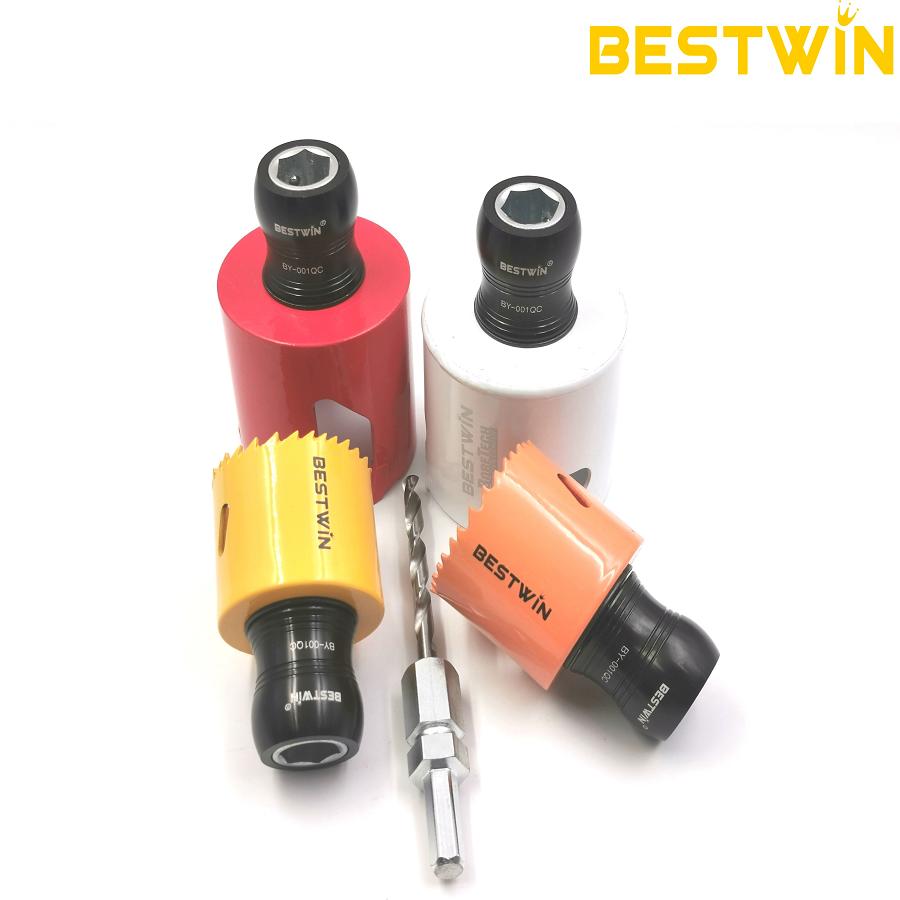
Cup Depth and Plug Clearance Decide How the Cut Can Finish
A hole saw cup has a finite internal cutting depth. Once the core occupies that space, additional projection of the arbor does not create more room inside the hole saw cutter. The relevant dimension is the usable capacity of the selected hole saw, together with the intended cutting approach. Overall assembly length is useful for reach, but it is not the same specification.
Door thickness can make this distinction important even when the surface material is easy to cut. An installer may have a suitable diameter and still need a different cup or a product-appropriate approach to finish the passage. Pushing harder when the core has reached the available cup space does not solve the capacity mismatch.
Plug removal also affects repeated work. A core left inside the hole saw cup can prevent the next opening from progressing normally. Access slots and the product’s removal arrangement can therefore influence how convenient the tool is across several doors. Clearing the tool follows the product instructions, with the machine stopped and isolated as appropriate for handling the accessory.
The term hole saw describes this ring-cutting tool form. For lock work, that form explains both its usefulness and its capacity limit: a circular core remains inside the hole saw cup during the cut. Product matching therefore considers the opening diameter, usable depth, and a practical way to clear the core between operations, without assuming that a deeper reach automatically means a deeper cut.
The Arbor and Pilot Need to Work as One Assembly
The arbor connects the hole saw cup to the drill and supports the pilot arrangement. Its thread or mounting system must match the selected cutter. A connection that appears to engage is not enough if the drive arrangement or product compatibility is wrong. The tool assembly needs to be appropriate as a whole before it reaches the door surface.
Our arbor range includes hex-shank and quick-change options for compatible products. Quick change can be useful when work alternates between suitable cup sizes, while conventional arrangements can serve a stable bench setup. The suitable direction depends on the products being combined and how often the installation work changes diameter. The name of the connection should remain clear on replacements.
Pilot projection contributes to starting control, but it also affects what is reached before the hole saw cup completes the cut. The assembly needs suitable access and clearance on both sides of the door. This is especially relevant when the leaf is close to a support or when hardware preparation occurs at a crowded bench. Tool reach should be considered together with the space around the work.
A replacement pilot for the hole saw must belong to the intended arbor arrangement. An accessory that can be inserted physically may still have the wrong retention feature, projection, or application suitability. Clear identification of the compatible components keeps the complete hole saw useful and reduces the chance that a worn pilot turns an otherwise serviceable cup into a poorly controlled assembly.
Keep Door Construction Limits Clear
A hollow-core leaf may contain a designated lock block or another prepared fixing area. Cutting beyond that area can remove material the lock needs for support. The visible face does not provide enough information to locate that internal structure reliably. The cutting plan therefore follows the door manufacturer’s preparation details as well as the hardware template.
A solid-core or engineered leaf can contain different layers and adhesive systems. The chosen hole saw needs material suitability and usable capacity for that construction. The fact that a door resembles timber on the outside does not prove that its entire section behaves like solid softwood. Representative material and the specific product rating provide a more useful basis for the match.
Fire-rated, security-rated, or otherwise specially specified door assemblies require their approved preparation and hardware arrangements. General woodworking guidance does not establish permission to alter them. This boundary is particularly important for replacement work, where the existing leaf may belong to a tested assembly and the new opening could change more than the visible appearance.
Metal-faced doors and reinforced constructions are separate product questions. A wood-rated setup does not automatically cover a steel skin or an internal metal component. Material-specific products may be necessary, and the complete door arrangement still governs whether the proposed preparation is allowed. The hole saw remains a cutting accessory within that arrangement rather than the authority for modifying it.

Useful Kits Separate Common Openings From Extra Accessories
A practical lock-installation assortment begins with the hardware families the workshop or contractor actually installs. It contains the corresponding face-opening sizes, compatible arbors and pilots, and the separate accessories needed for the smaller preparation tasks. A higher piece count does not necessarily make the kit more useful if its main cups do not fit the common locks.
As a hole saw manufacturer, Bestwin supplies bi-metal cutting products and related accessories for woodworking applications. Bestwin supports OEM and ODM services for bulk supply, brand identification, packaging, and product assortments for different markets. We supply these configurations around useful cutting roles, keeping the hole saw cup family and compatible connection understandable when a kit is opened at the bench.
Replacement cups matter because wear is rarely distributed evenly across an assortment. One common hardware size can see much more use than the others. A clear size designation and matching arbor information make it easier to keep that working combination available. Replacing the high-use cutter can be more practical than treating the entire case as a disposable unit.
For a hole saw supplier, supporting the complete product combination also means distinguishing cups from accessories in the assortment. A spare pilot, an arbor, and a cutting cup each serve a different purpose. We supply product families and kit options that keep those roles visible for distributors and installation customers, with replacement identification that relates directly to the tool in service.
Table 2. Evaluating a Door Hardware Cutting Kit
| Kit consideration | Useful result |
|---|---|
| Cup sizes tied to actual hardware | The common face openings are covered |
| Material suitability | The cutting product fits the intended door construction |
| Compatible arbor and pilot | The assembled tool has the correct connection |
| Practical cup depth | The selected method can complete the opening |
| Separate latch and screw accessories | Different preparation tasks retain suitable tools |
| Identifiable replacements | Worn cups and pilots can be replenished accurately |
Frequently Asked Questions
Can one hole saw make every opening for a door lock?
The larger face opening, the latch opening, and the screw preparations usually have different dimensions and functions. A hole saw cup can serve the appropriate circular face opening, while other tools handle the smaller bores and recess work. The lock template establishes the complete preparation, so one cutter should not be treated as a full installation system.
Does every interior door need the same face-opening size?
No. The hardware design determines the opening. Different locks, latches, and trim arrangements can require different preparations, even on doors that look similar. Match the hole saw to the specified cutout rather than assuming that a familiar size covers every interior lock. The relationship between the edge opening and face opening also remains important.
Can a standard pilot guide the enlargement of an existing opening?
An existing hole can remove the material where the pilot normally starts. A standard assembly may therefore lack stable centering for the larger cup. Enlargement needs a suitable supported method and guidance arrangement. It is a separate application from cutting a new opening in an unbroken face and should be evaluated on that basis.
Is a quick-change arbor necessary for door work?
It can be convenient when compatible cup sizes change often, but it is not a universal requirement. A conventional compatible arbor can serve repeated work with one size. The essential point is that the hole saw cup, drive arrangement, pilot, and drill connection belong together. Convenience comes after compatibility and a suitable cutting setup.
Can the same kit be used on a fire-rated door?
Only within the preparation and hardware requirements of the approved door assembly. A kit’s ability to cut a material does not establish that the modification is permitted. The door and hardware instructions remain decisive. General interior woodworking use is not a substitute for the requirements of a rated assembly.
What makes a trial opening useful?
Use representative door material, the intended cup and arbor, and the actual lock components. Check the visible edge, passage through the leaf, and the way the hardware sits together. That connects the sample to the real application. A clean hole by itself does not establish correct placement, sufficient support, or compatibility with the lock.
Match the Opening to the Hardware
Interior door lock work starts with a specific hardware preparation and a known door construction. Match the hole saw cutting cup to that opening, keep the arbor and pilot compatible, and allow for depth and surface finish. Bestwin manufactures and supplies bi-metal hole cutting products and woodworking assortments that support this practical relationship between the tool, the door, and the finished lock.


 English
 العربية
 Français
 Português
 Português do Brasil
 Italiano
 简体中文
 繁體中文
 日本語
 한국어
 Deutsch
 Español
 Slovenčina
 ไทย
 Türkçe